"Gold Has Overtaken U.S. Treasuries": The World’s No. 1 Foreign Reserve Asset Has Changed
- Input
- 2026-06-03 18:32:41
- Updated
- 2026-06-03 18:32:41
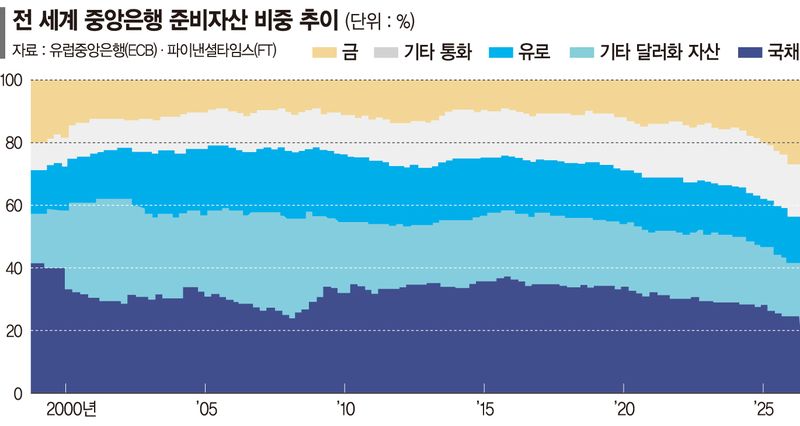
Gold is now the largest asset in foreign exchange reserves held by central banks around the world, surpassing U.S. Treasury bonds, the European Central Bank (ECB) said on the 2nd local time. The shift reflects years of steady gold buying by central banks.
The Financial Times (FT), citing an ECB report released on the 2nd, said gold accounted for 27% of global central bank reserve assets at the end of last year. That was up 7 percentage points from 20% a year earlier. Over the same period, the share of U.S. Treasury bonds fell 3 percentage points, from 25% to 22%.
Reserve assets are highly liquid holdings that central banks build as a buffer to defend the value of their currencies and prepare for financial market volatility. Until recently, the U.S. dollar, the world’s reserve currency, was seen as the safest asset. Central banks also held interest-bearing U.S. Treasury bonds as their main reserve asset.
That trend began to change after Russia’s full-scale invasion of Ukraine in 2022 and the freezing of Russian dollar assets. In a report, ECB President Christine Lagarde explained, "Geopolitical tensions have continued, and central bank demand for gold has risen sharply." Concerns that some countries could face U.S. asset freezes also played a major role.
The decline of U.S. Treasuries from the top spot in reserve assets was also influenced by the sharp rise in gold prices.
Gold prices have surged in recent years, breaking above $5,500 per ounce in January and extending their record-setting rally.
Even so, the dollar remains dominant. According to the ECB, U.S. Treasury securities and other USD-denominated assets still account for 42% of global central bank reserve assets, far ahead of all others. Central bank gold buying has also slowed. Net purchases exceeded 1,000 tons for three straight years, but fell slightly to 850 tons last year. Since 2022, the most active buyers of gold have been China, Poland, the Republic of Türkiye, and India. The share of euro-denominated assets remained unchanged at 15%.
The ECB said central banks around the world hold more than 36,000 tons of gold. That is close to the peak reached during the Bretton Woods system, when the gold standard was still in place. Under that system, the United States exchanged dollars for gold, and exchange rates were pegged to the U.S. dollar. At the time, central banks worldwide held about 38,000 tons of gold. The Bretton Woods system began in July 1944 and lasted for more than 20 years, but it ended on Aug. 15, 1971, when the United States suspended gold convertibility. Even after the system collapsed, central banks continued to regard U.S. Treasuries as the safest asset and made them a core part of their reserves.
[email protected] Song Kyung-jae Reporter