KIOXIA Overtakes Toyota to Become Japan's No. 2 by Market Cap as AI Shakes Up Manufacturing's Throne
- Input
- 2026-06-03 13:56:02
- Updated
- 2026-06-03 13:56:02
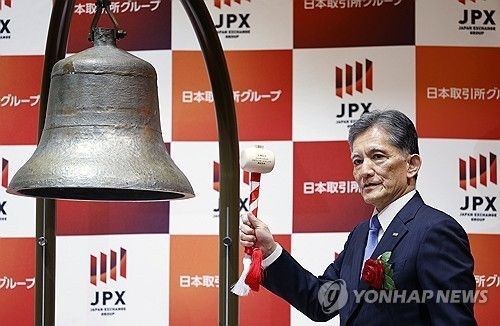
[The Financial News, Tokyo = Reporter Seo Hye-jin] Kioxia Holdings, a Japanese semiconductor company, briefly overtook Toyota Motor Corporation on the 3rd to become the second-largest company on the Japanese stock market by market capitalization. After SoftBank Group recently reclaimed the top spot for the first time in 22 years, AI semiconductor companies have been pushing Toyota aside one after another, signaling a shift in power on the Japan stock market from traditional manufacturing to AI.
On the Tokyo Stock Exchange that day, KIOXIA's share price surged as high as 83,140 yen during trading, setting a new all-time high since its listing. Its market capitalization briefly reached 45.4 trillion yen, surpassing Toyota Motor Corporation's 45 trillion yen and placing it second among listed Japanese companies. The ranking later reversed again as profit-taking selling emerged.
The Nikkei 225 Stock Average jumped by more than 2,000 points intraday, breaking above 68,000 for the first time ever. Semiconductor-related stocks, including KIOXIA, led the rally as forecasts for growth in the global semiconductor market were repeatedly raised and expectations grew for expanded AI investment.
What particularly fueled investor buying was KIOXIA's aggressive growth strategy and shareholder return policy unveiled the previous day.
At an investor briefing, KIOXIA said it would introduce a progressive dividend system, under which dividends would be maintained or increased rather than cut. The company plans to begin paying dividends as early as the second half of fiscal 2027, which runs from April 1, 2026, to March 31, 2027. If realized, it would be the company's first dividend since its listing in December 2024.
It also left open the possibility of share buybacks. KIOXIA said it will consider using about half of its free cash flow, excluding capital expenditures and R&D costs, for shareholder returns, and will also review additional returns of surplus cash if its merger and acquisition plans are delayed.
The company also unveiled a large-scale investment plan to meet rising AI demand.
KIOXIA plans to invest a total of 210 billion yen in capital spending and research and development over the three years from April this year through March 2029. Annual capital expenditure will average 470 billion yen, while R&D spending will average 230 billion yen, both more than 60% higher than in the previous period.
It also disclosed expansion plans. Hiroo Ota, president of KIOXIA, said at the briefing that discussions had begun on building a new production building at the Kitakami Plant in Iwate Prefecture.
KIOXIA's memory production bases are the Yokkaichi Plant and the Kitakami Plant. At present, the Kitakami Plant is operating up to its second production building, but the company is considering constructing a new one with the goal of starting operations sometime after 2029 to 2030. The decision reflects the view that existing production capacity alone will not be enough to meet expected demand after 2029.
KIOXIA is a key player in the global NAND Flash Memory market. It is benefiting from explosive growth in data storage demand driven by the spread of generative AI and AI agents.
Its earnings outlook is also strong. KIOXIA forecast that net profit for the second quarter of this year would rise 48-fold from a year earlier to 869 billion yen, while operating profit would increase 29-fold to 1.298 trillion yen. Net cash, defined as cash and cash equivalents minus interest-bearing debt, is also expected to turn positive in the same period.
KIOXIA believes AI is changing the structure of the semiconductor industry itself. As AI inference services and AI agents that can carry out tasks autonomously spread, the importance of memory for storing and processing large volumes of data is rising sharply, not just GPUs.
In particular, KIOXIA said the NAND market may be moving beyond the repeated "Silicon cycle" of the past, which depended heavily on smartphone demand, and entering a new AI-driven "supercycle." The company said rising AI demand and longer-term supply contracts with customers would help keep profitability from falling sharply even during industry downturns.
Meanwhile, AI-related companies have been making notable gains in the Japan stock market. After SoftBank Group, buoyed by expectations for AI investment, swelled to around 47 trillion yen in market value and overtook Toyota to become Japan's top company for the first time in 22 years, KIOXIA also rose to second place by market capitalization, prompting assessments that the lineup of companies representing the Japan stock market is changing.
[email protected] Seo Hye-jin Reporter