Samsung Announces Early Move on HBM5... Kicks Off a Wider Lead in AI Memory [COMPUTEX Taipei 2026]
- Input
- 2026-06-02 18:26:33
- Updated
- 2026-06-02 18:26:33
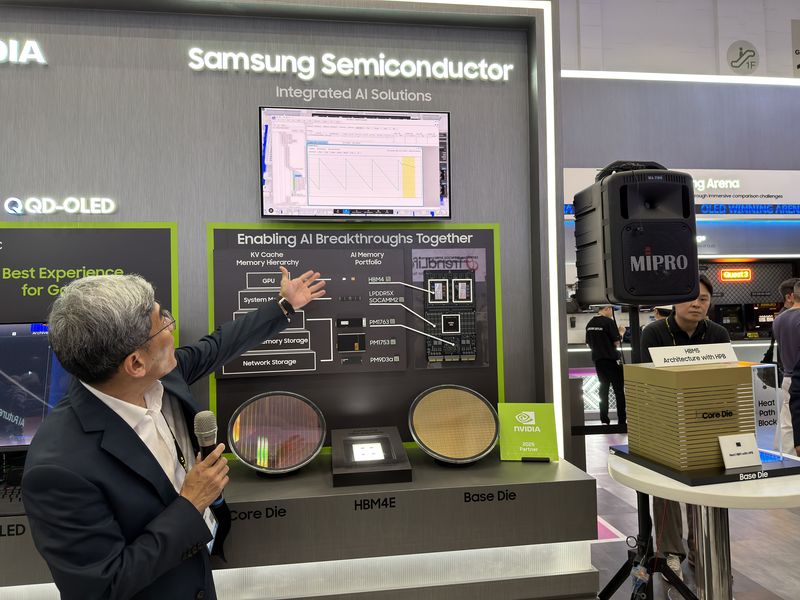
At the COMPUTEX Taipei 2026 venue in Taipei, Taiwan, on the 2nd, Jae-hyuk Song, CTO of Samsung Electronics Co., Ltd.'s Device Solutions Division (DS Division), unveiled the HBM5 mockup for the first time.
The newly revealed HBM5 is notable for being the first to apply Heat Path Block (HPB), a next-generation thermal management technology. HPB is designed to address heat issues that can arise as memory performance is improved. Samsung Electronics Co., Ltd. has already completed implementation and verification of HPB based on HBM4E, and now plans to apply the technology in earnest starting with HBM5 to further enhance performance.
Song explained, "For HBM5, we are reviewing a die-to-die interface that brings some functions of the Graphics Processing Unit (GPU) over to the base die to reduce bottlenecks." He added, "That means heat will concentrate in certain areas of the base die, so we are developing technology that efficiently dissipates heat by applying an HPB structure."
The adoption of HPB appears to reflect, at least in part, customer demand. Song said, "When positioning any technology at the beginning, we naturally listen to customer requirements." He added that there is strong demand from customers for lower heat and reduced power consumption.
Samsung Electronics Co., Ltd. plans to leverage its strengths as an IDM spanning memory, foundry, and packaging by proactively applying a 2nm-class leading-edge process to the HBM5 base die. The company aims to improve both power efficiency and bandwidth at the same time.
At the event, Samsung Electronics Co., Ltd. also displayed the actual wafer and chipset for HBM4E, which it became the first in the industry to sample ship at the end of last month. Samsung Electronics Co., Ltd.'s HBM4E combines a leading-edge 1c DRAM core die with an in-house foundry 4nm base die, operates at 14Gbps per pin, and achieves up to 16Gbps, or bandwidth of up to 4TB/s.
The company declined to disclose the timing of mass production for the 7th-generation HBM4E and HBM5, saying it was "difficult to reveal." Song said, "We plan to respond flexibly in line with customer demand and market conditions." He added, "Considering that we are already supplying samples of HBM4E, development has progressed to a fairly advanced stage." Meanwhile, market research firm Omdia forecasts that the global HBM market will more than triple, growing from about $58.9 billion this year to about $198.3 billion in 2029.
[email protected]