[Editorial] Soaring Prices Make an Urgent Response to the Inflation Shock Essential
- Input
- 2026-06-02 18:25:49
- Updated
- 2026-06-02 18:25:49
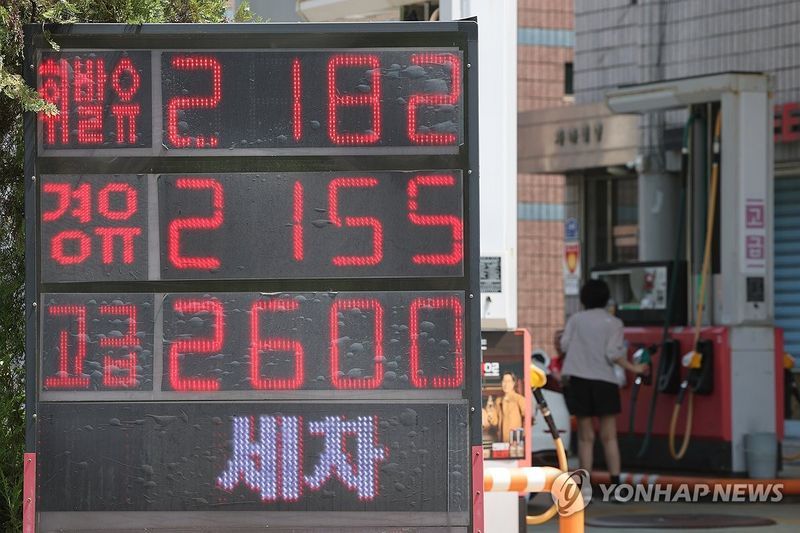
According to consumer price trends for May released by the Ministry of Data and Statistics on the 2nd, the consumer price index stood at 119.92, with 2020 as the base year of 100, up 3.1% from the same month last year. That was the highest increase since March 2024, when agricultural prices surged because of poor harvests. Consumer inflation had appeared to stabilize, falling from 2.3% in December last year to 2.0% in January and February this year, but it rose again to 2.2% in March, 2.6% in April, and 3.1% in May.
The biggest cause was the rise in global oil prices. As supply concerns deepened amid the prolonged war in the Middle East, petroleum prices jumped 24.2%. That alone added 0.92 percentage points to overall inflation. The increase in petroleum prices was the highest since July 2022, shortly after the Russo-Ukrainian War began. Some analyses suggest that if the government had not implemented fuel tax cuts and a cap on petroleum prices, inflation would have reached 3.7%.
The problem is that higher petroleum prices spread across the broader economy. When crude oil prices rise, production costs in manufacturing increase, and so do prices for agricultural, livestock and fishery products, logistics, dining out, and services. Household purchasing power weakens, and corporate investment sentiment inevitably cools. If high inflation persists for a prolonged period, it could also weigh on the economic recovery.
This latest rise in prices was, to some extent, foreseeable. Since the war in the Middle East began, instability has continued in global commodity markets. The government has also introduced measures to stabilize prices, but their effectiveness is limited as the conflict drags on. On top of that, the won-dollar exchange rate has been hovering above 1,500 won for days, putting further pressure on import prices. For an economy that relies heavily on imports for energy and raw materials, this is a double burden.
The Bank of Korea is also closely monitoring the renewed rise in inflation. Shin Hyun-song, governor of the Bank of Korea, said at a press briefing after the Monetary Policy Board meeting on the 28th of last month that "it is necessary to raise the benchmark interest rate at an appropriate time." He also signaled again on the 1st of this month that a monetary policy adjustment could be considered.
However, this price increase is closer to a supply-shock inflation caused by the sharp rise in global oil prices than to demand-driven inflation from an overheated economy. In such a situation, there are limits to bringing prices down through a benchmark rate hike. That is why government-level support measures, including energy and tax assistance and protection for vulnerable groups, must be carried out in parallel.
President Lee Jae-myung also said at the State Council of South Korea that "without price stability, economic growth, reduced polarization, and sustainable development are all impossible," and called for measures to stabilize grocery prices. The government is also pushing to expand the release of reserve supplies, increase discounts on agricultural and livestock products, broaden tariff quotas, and extend fuel tax cuts.
Price stability is the starting point of livelihoods. The lower the income, the greater the share of spending on food and energy, and the more severe the impact of inflation. Monetary and fiscal authorities must move quickly to block inflationary anxiety at an early stage through a refined policy mix that includes preemptive and cooperative responses, while also coming up with effective measures to ease the energy and living-cost burden on vulnerable households hit hardest by high prices.