Chinese EVs Build Entire Supply Chains Across ASEAN, Raising Questions Over the Auto Market's Future
- Input
- 2026-06-02 18:17:01
- Updated
- 2026-06-02 18:17:01
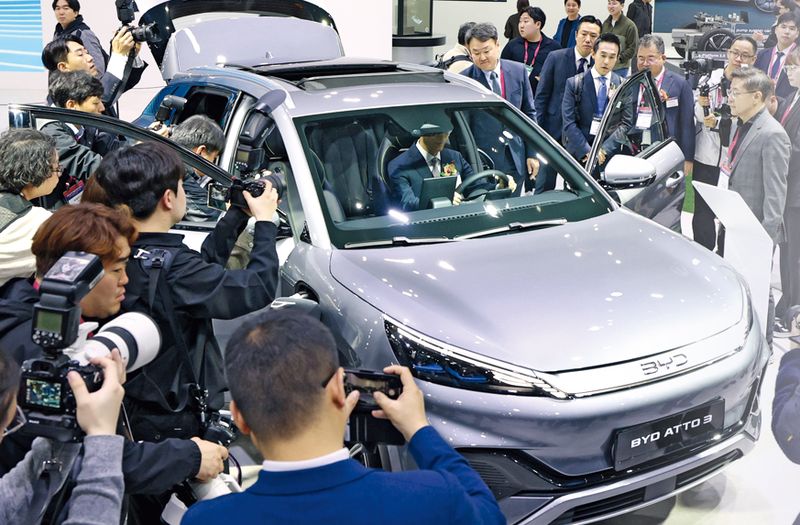
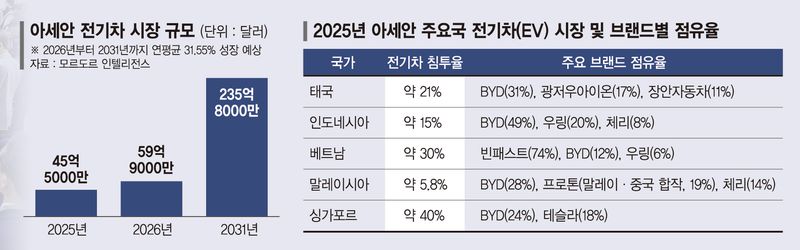
According to local media and industry sources on the 2nd, Chinese EV makers such as BYD are seeing profitability weaken as domestic demand slows and price competition intensifies, but they are rapidly expanding their influence in the Association of Southeast Asian Nations (ASEAN) market. Analysts say the volume that cannot be absorbed in mainland China is flowing in large quantities to Thailand, Indonesia and Singapore, allowing Chinese brands to dominate the regional EV market. In some countries, their growth is so strong that it is threatening Toyota Motor Corporation, the long-time leader of ASEAN's auto market.
By contrast, Hyundai Motor Company, which has viewed ASEAN as a future growth engine, is said to be caught in the middle between premium Japanese cars and Chinese EVs. In fact, the utilization rate at Hyundai Motor Company's local plant in Indonesia has already fallen below 50%, putting the company on alert.
As ASEAN countries are pushing the transition to EVs as a national priority amid high oil prices caused by the Iran war, the rise of Chinese EVs is expected to continue for the time being.
■ BYD Accelerates Its ASEAN Push
BYD, China's top EV maker, posted revenue of 150.23 billion yuan, or about 33.7326 trillion won, in the first quarter of this year, down 11.82% from a year earlier. Industry observers say the decline reflects a domestic market entering a restructuring phase after the Chinese government scaled back tax benefits and incentives for EV buyers. As a result, BYD and other Chinese EV makers are targeting ASEAN as a key market to offset weak domestic demand and are stepping up aggressive marketing.
Major ASEAN markets are already turning into a showcase for Chinese EVs. In Thailand, the largest auto producer in Southeast Asia, Chinese brands have effectively taken over the EV market. BYD's flagship models, the Atto 3 and Dolphin, are reportedly holding a 70% to 80% share of Thailand's battery electric vehicle market. Backed by the Thai government's EV subsidy policy, they are quickly eroding the position of existing Japanese internal combustion engine vehicles.
Change is also visible in Indonesia, where Japanese brands control more than 80% of the overall auto market. According to the Indonesian Automotive Manufacturers Association, BYD sold 6,274 vehicles in April on a retail basis, ranking third nationwide behind Toyota Motor Corporation and Daihatsu. Its share of the overall auto market reached about 4.8%. When Chinese brands such as Wuling, with 1.7%, and Chery, with 1.6%, are added, their combined share comes close to 10%. By contrast, Hyundai Motor Company, which once ranked first in Indonesia's EV market, came in only 10th in wholesale sales.
Even in Singapore, where income levels are high, BYD is competing with Tesla. In April, BYD's market share in sales exceeded 30% for the first time. Last year, it sold 11,184 vehicles and overtook Toyota Motor Corporation, which had long held the top spot, to rank first in annual brand sales for the first time.
■ Chinese EVs Bet on Full Local Production
The price competitiveness of Chinese EVs is not limited to exporting finished vehicles. To take advantage of tariff-free benefits within ASEAN, they are also actively building local supply chains. This allows them to bypass tariff barriers on Chinese EVs in the United States and the European Union while securing production competitiveness in Southeast Asia.
Boston Consulting Group (BCG) said Chinese EV makers' overseas expansion is evolving beyond simple exports and moving into local production. The firm noted that they are strengthening their push into the ASEAN market by relocating supply chains for batteries and core components as well.
After its plant in Thailand, BYD has also confirmed that it will complete and begin operating a local factory in Indonesia this year with annual production capacity of 150,000 vehicles. According to JPMorgan Chase, a total of 14 new-energy vehicle plants under construction by major Chinese automakers, including BYD, Chery and Changan Automobile, at overseas bases including Southeast Asia will be in place by 2026.
■ Hyundai Motor Company's Factory Utilization Falls to 47%
Under this offensive by Chinese companies, Hyundai Motor Company, which has used ASEAN as a forward base, has been put on the defensive. It is facing double pressure as competition with Chinese EV makers is added to the challenge from Japanese companies that already dominate the internal combustion engine market. Hyundai Motor Company has built a flexible production system in Indonesia that can manufacture internal combustion engine, hybrid and battery electric vehicles.
Hyundai Motor Indonesia's factory utilization rate stood at 47.3% last year. That is far below India at 94.2% and the United States at 100%. Compared with the period when the plant posted a utilization rate of more than 110% just two years after opening, the decline has been steep.
An industry source said, "Chinese automakers are rapidly building not just a simple export business, but the entire EV ecosystem, starting with batteries, across ASEAN regions such as Indonesia and Thailand." The source added, "With production stability and incentives from local governments, they have secured price competitiveness, and they are also strengthening their competitiveness in automotive semiconductors and autonomous driving technologies, so their influence in the ASEAN market is likely to continue for some time."
[email protected]