Petroleum Prices Rise 24.2% as Holiday Travel Demand Adds to Inflation
- Input
- 2026-06-02 18:15:29
- Updated
- 2026-06-02 18:15:29
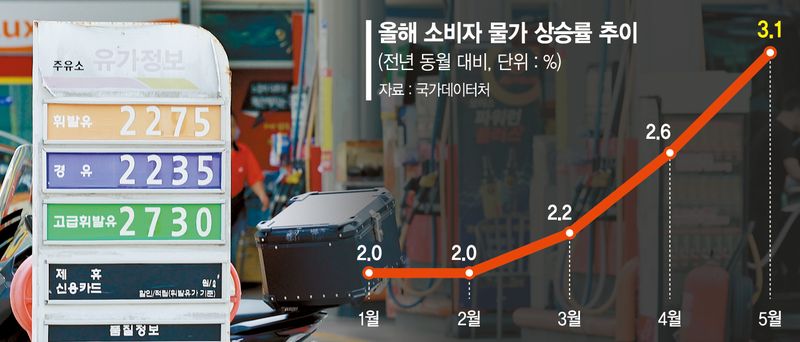
■ Inflation rises on high oil prices and travel demand
According to the 'Consumer Price Trends for May' released by the National Data Office on the 2nd, consumer prices rose 3.1% from a year earlier last month. It was the first time in 2 years and 2 months that inflation had returned to the 3% range, since March 2024.
Petroleum products were the main driver of the increase. They rose 24.2% from a year earlier, lifting overall inflation by 0.92 percentage points. That was the sharpest rise in 3 years and 10 months, since July 2022, when the war in Ukraine was in its early stages. By item, gasoline rose 23.1% and diesel climbed 33.3%, both marking the biggest increases for the same period. Kerosene also rose 21.7%, its steepest gain since February 2023.
The government believes inflation would have been even higher without fuel tax cuts and a price cap system. Min Kyung-shin, director of price policy at the Ministry of Economy and Finance, said, "Without the policy effects, consumer prices in May would have risen to about 3.7%." He added, "The fuel tax cuts and price cap are estimated to have eased upward pressure by about 0.6 percentage points."
Service prices also played a major role in adding inflationary pressure. They rose 2.8% from a year earlier, the highest level since December 2023. Public services increased 1.8%, while personal services rose 3.7%. Among them, services excluding dining out climbed 4.4% and pushed up overall inflation. The increase in travel demand during the May holidays also appears to have driven up personal service prices. Last month, overseas package tours rose 26.3% and car rental fees increased 25.7%. International airfares surged 33.5%, the highest increase since statistics began in 1995.
Prices of farm, livestock and fishery products rose 2.2% from a year earlier, reversing the decline seen in March and April. Analysts said reduced shipments due to rising temperatures and a base effect contributed to the turnaround. By item, rice rose 13.5%, eggs 10.2%, cutlassfish 15.1% and yellow corvina 14.6%. In contrast, radishes fell 27.5%, onions 18.5% and cabbages 43.9%.
Lee Doo-won, a commissioner at the National Data Office, said, "Rising tensions in the Middle East widened the increase in petroleum prices, while seasonal travel demand also picked up and drove up personal service prices." He added, "Farm, livestock and fishery products also turned higher."
■ Burden of inflation felt more sharply
The inflation burden felt in daily life was even greater. Everyday living costs, which reflect prices of food and household essentials, rose 3.3% from a year earlier, the highest level since April last year. That was above the 3.1% increase in consumer prices for the same period. Food prices rose 2.1%, while prices in non-food categories climbed 4.2%. Core inflation, which excludes volatile food and energy prices, increased 2.5%.
The government is closely watching the possibility that inflationary pressures could persist due to high oil prices and summer weather conditions. It plans to make stabilizing grocery prices, which directly affect household budgets, its top policy priority and respond with all available tools, including discount support and expanded supply.
Deputy Prime Minister and Minister of Finance and Economy Koo Yun-cheol said at the State Council of South Korea on the same day, "We will place grocery prices and the cost of living at the top of our policy priorities and use every available measure, including discount support, lower delivery prices and expanded supply, to stabilize prices." He added, "We will also proactively manage the risk that food prices and ingredient costs could become unstable due to summer weather conditions such as heat waves and heavy rain."
[email protected] Kim Chan-mi, Jeong Sang-gyun, Seo Young-joon Reporter