Retail Investors Bet on a KOSDAQ Rebound, Buying One Stock for 455.7 Billion Won in a Week
- Input
- 2026-06-02 18:14:23
- Updated
- 2026-06-02 18:14:23
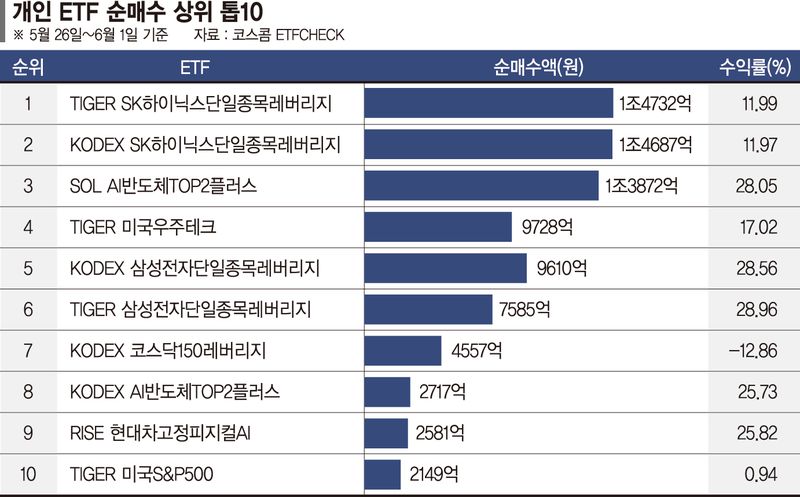
According to ETF Check by Koscom Corporation on the 2nd, retail investors posted a net purchase of 455.7 billion won in the KODEX KOSDAQ 150 Leverage ETF from the 26th of last month through the 1st of this month. It was the only one among the top 10 ETFs by net retail buying to post a negative return over the past week, at minus 12.86%, yet it ranked seventh in net purchases. Given that the KOSDAQ 150 Index fell 7.11% during the same period, the inflow appears to reflect investors viewing the decline as a buying opportunity.
A similar trend was seen in the KOSDAQ market itself.
Over the same period, retail investors bought a net 718 billion won in the KOSDAQ market. Foreign investors also bought 1.0155 trillion won, while institutions sold a net 1.573 trillion won. With the KOSDAQ index down 9.57% during the period, the inflow is being interpreted as money moving in on the view that the deeper drop created a buying opportunity.
Still, retail money remains centered on AI and semiconductor ETFs. Six of the top 10 ETFs by net retail buying during the period were AI- and semiconductor-related products. Total inflows into those products came to 6.3203 trillion won.
In particular, leveraged single-stock ETFs tied to SK hynix and Samsung Electronics Co., Ltd., as well as AI semiconductor ETFs, ranked near the top in net buying.
Market watchers say some retail investors are betting on a rebound as the KOSDAQ's decline deepens. Last month, the KOSPI rose 28.45%, while the KOSDAQ fell 9.86%.
As the KOSPI continued to strengthen on the back of large semiconductor stocks, the KOSDAQ, which has a heavier concentration of growth stocks, underperformed amid pressure from rising bond yields. With valuations now less expensive, money appears to be flowing in from investors who see room for a rebound if interest rates stabilize or policy support emerges.
Brokerages also believe the KOSDAQ could stage a relative rebound if bond yields begin to stabilize. As rate pressure eases, the valuation burden on growth stocks would also lighten, potentially setting up a catch-up rally that narrows the performance gap between the KOSPI and the KOSDAQ.
Daishin Securities researcher Kyung-min Lee said, "The KOSDAQ's relative weakness, which began in September 2023, has recently intensified. That is due to heavier valuation pressure from surging bond yields and a deeper concentration in large-cap stocks," adding, "This also means relative price appeal has increased. With much of the rate-hike concern already priced in, a rebound could be strong between June and August if geopolitical risks ease."
Policy expectations are also seen as a variable. Daishin Securities said the market could see renewed interest in a KOSDAQ revaluation, citing the possible release of guidelines for the KOSDAQ entry and exit system in June or July and the launch of a premium index in October. The KOSDAQ entry and exit system is a plan to classify companies within the existing KOSDAQ market according to certain standards, and analysts say its details could affect supply and demand for growth stocks.
The interest-rate path remains another key factor. Some analysts also note that recent inflation pressures spreading to transportation costs and everyday living expenses could weaken expectations for rate cuts.
Kim Myeong-sil, a researcher at iM Securities, said, "We need to leave open the possibility that rate hikes in July and a prolonged tightening stance could continue."
[email protected] Bae Han-geul Reporter