Foreign reserves fall by $900 million amid exchange rate defense; ranking stays 12th for third straight month
- Input
- 2026-06-04 06:00:00
- Updated
- 2026-06-04 06:00:00
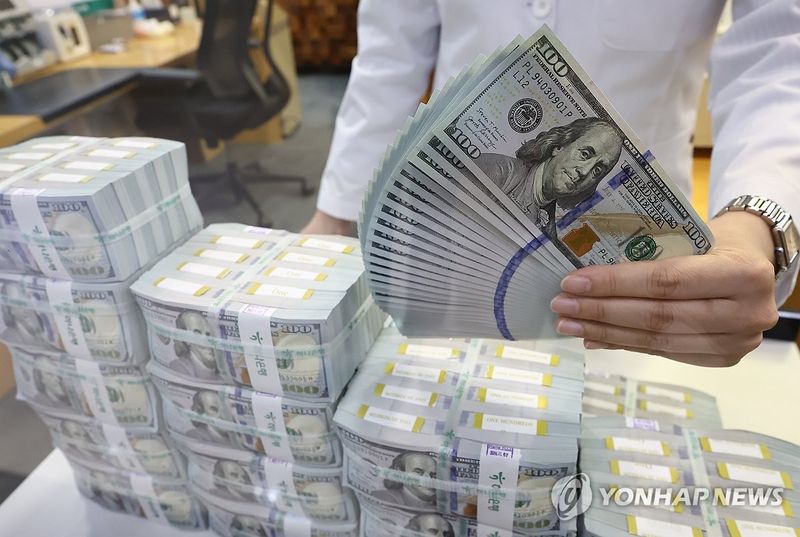
According to the Bank of Korea on the 4th, South Korea's foreign reserves stood at $426.99 billion at the end of May. That was down $880 million from the end of the previous month.
Foreign reserves had previously fallen to a near five-year low of $404.6 billion at the end of May last year. They then rose for six straight months through November, before turning downward in December. This year, they have fluctuated month by month, falling by $2.15 billion in January, rising by $1.72 billion in February, dropping by $3.97 billion in March, and increasing by $4.22 billion in April.
A Bank of Korea official explained that the latest decline was also the result of "foreign exchange swaps with the National Pension Service (NPS) and market stabilization measures," which had been the main cause of declines in previous months.
Among the reserve assets, securities totaled $380.68 billion, down $3.39 billion. Special drawing rights and the IMF position, which are claims held by IMF member countries through capital contributions and loans, each fell by $30 million and $60 million, respectively. Deposits, however, rose by $2.59 billion, partially offsetting the decline. Gold was unchanged at $4.79 billion.
If the sharp rise in the won–dollar exchange rate does not subside, foreign reserves will inevitably continue to be depleted. With the Middle East crisis driving up global oil prices and weakening the currency of energy-dependent South Korea, there is room for additional foreign exchange market stabilization measures.
According to Seoul Money Brokerage Services Ltd., the average won–dollar exchange rate in May was 1,490.11 won. In particular, the rate has closed in the 1,500-won range for 12 consecutive trading days from the 15th of last month through the 2nd of this month.
South Korea's foreign reserves, which are used to compare rankings with major countries, stood at 12th in the world at the end of May. The country fell one spot from 9th in January to 10th in February, then dropped to 12th in March, where it has remained for three months.
China ranked first with $3.4105 trillion, followed by Japan with $1.383 trillion, Switzerland with $1.0823 trillion, Russia with $758.7 billion, India with $690.7 billion, Taiwan with $602.5 billion, Germany with $599.2 billion, Saudi Arabia with $474.8 billion, Italy with $456.1 billion, France with $449.4 billion, and Hong Kong with $442.1 billion.
[email protected] Kim Tae-il Reporter