"Wow, Samsung Electronics is up again"... The index is at an all-time high, so why is only my account in the red?
- Input
- 2026-06-03 06:07:00
- Updated
- 2026-06-03 06:07:00
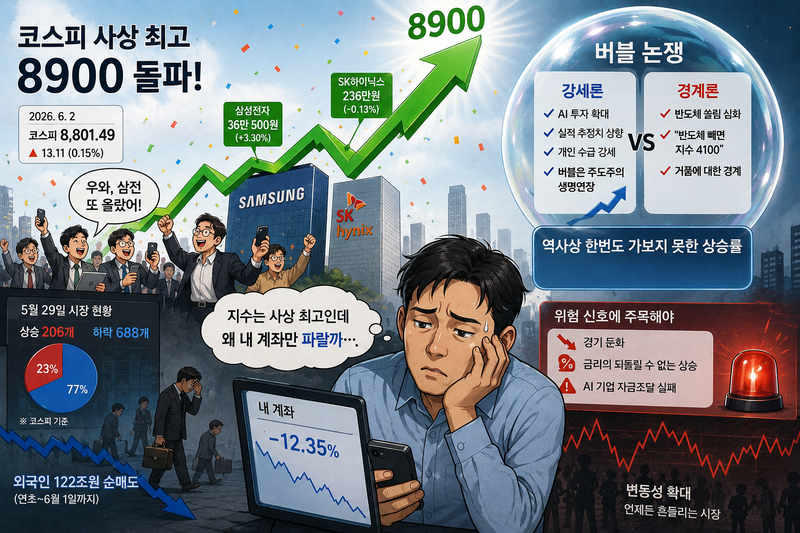
After seeing the breaking news about the KOSPI hitting an all-time high, Kim thought, "Everyone is making money except me. " But that statement is only half true. On the 2nd, the KOSPI climbed above 8,900 for the first time ever, yet most stocks were weak except for semiconductor and AI-related names.The trigger was NVIDIA Chief Executive Officer (CEO) Jensen Huang's direct mention in his keynote at GTC Taipei on the 1st that Samsung Electronics and SK hynix's HBM4 would be used in the next-generation AI chip, "Vera Rubin. 41 percent, and its market capitalization topped 2,000 trillion won for the first time. But the index was lifted not by the "market as a whole," but by just a handful of large-cap names.The money Kim's colleague made and the money Kim failed to make are, in fact, not the same market story. ■Who created 8,800?. 55 percent on the 29th, 206 stocks rose while 688 fell.Two out of every three declined, yet the index still hit a record high. It was like a class average going up because two or three students scored 100 while everyone else failed.
Looking only at the average makes it seem like "everyone did well," but most report cards were disastrous. The flow of money makes this even more obvious.From the start of the year through the 1st of this month, foreign investors sold a net 122 trillion won worth of shares on the KOSPI Market alone. That is why talk of foreign investors "taking the money and running" never stops.They say it is due to rebalancing, but it also raises the question of whether Korean stocks are simply not attractive enough for long-term investment. Against this backdrop, securities firms' research centers have been repeatedly raising their target prices for Samsung Electronics and SK hynix.
Around the market, people are fueling stock FOMO, saying there are now only limited places for money to go. Competition among exchange-traded funds (ETFs), which securities firms are aggressively rolling out, is also adding to market volatility.
A market source said, "ETFs have become mainstream, so the base has widened, but concentration and volatility have also increased. " The ETF bought to diversify can, paradoxically, end up concentrating money into a single stock.
The same goes for foreign capital. In the Korean stock market, buying Korean shares is, in effect, not very different from buying Samsung Electronics and SK hynix.
■So, is this a bubble or not? It is the obvious question. As the index moved above 8,800 and Samsung Electronics' market capitalization surpassed 2,000 trillion won, concerns that this may be a bubble also grew.
Even among experts, however, opinions are split, and the point of disagreement is interesting. Bullish analysts argue that "there is a reason expensive things are expensive." Lee Eun-taek, a researcher at KB Securities, said the current KOSPI is rising faster and more strongly than the 1986-1989 Three-Lows Boom, the strongest period in its history, and that the driver is upward revisions to earnings estimates stemming from AI investment. In other words, not only have stock prices risen, but expectations for future profits have climbed even faster, easing valuation pressure.In fact, Kim Jae-seung, a researcher at HYUNDAI MOTOR SECURITIES CO. , LTD.
, said, "We are raising our year-end KOSPI target to 9,750 points," and added that "if a bull market scenario materializes, with non-semiconductor sectors also showing strength on the back of money rotation, 12,000 points could be the upper end of the range. " In the market, some also compare this semiconductor rally with the Dot-com bubble of 2000.
What is interesting is not just the comparison itself, but the interpretation that "it may not be over yet. " Still, it is difficult to conclude outright that this is now the final stage.
KB Securities has emphasized that a bubble can actually extend the life of leading stocks and create historical outliers in the process. Kim Min-kyu, a researcher at KB Securities, said, "The rate of increase in Korean semiconductor stocks has surpassed levels never before seen in history," adding that "a bubble extends the life of leading stocks.
" On top of that, expectations for earnings improvement from expanding AI investment, along with still-strong retail demand, are seen as factors that could prolong the rally. The opposing view is no less strong.
Recently, one analyst sparked controversy by publishing an opinion piece arguing that "if you exclude semiconductors, the index is really 4,100. " The claim is that today's 8,800 is an illusion created by two or three semiconductor stocks, and that once they are stripped out, the market's true face is only about half as strong.
That is exactly the same as the earlier observation that two out of three stocks fell. Investors pushed back, asking, "Then should we strip NVIDIA, Apple, and Meta out of the New York stock market too?" and "Are you saying we should take the japchae out of japchae rice?" Their rebuttal is that the U.
S. market is also driven by core names, so why is only Korea being singled out? ■How long will this rally last? The market is now focused on how long the bubble can last.
A bubble does not collapse simply because it has risen sharply. A balloon does not burst on its own just because it has been inflated.It bursts only when someone pricks it with a needle or when the person pumping air into it lets go. That is why the market should be watching signals rather than numbers.Warning signs include an economic slowdown, an irreversible rise in interest rates, and AI companies' failure to secure funding. In the end, what matters is less "how much higher can it go" than whether the force supporting the bubble can be sustained.
Still, warnings are emerging that the market will change from here. The early stage of the rally was a market where "those who could not buy regretted it," but the later stage becomes a market where "even those who are holding feel uneasy.
" In fact, the market has recently been swinging back and forth several times a day, shaking investors. Even within the uptrend, repeated sharp corrections may appear, making it hard to tell whether this is the peak or the beginning of another leg higher.
Paradoxically, excessive short-term trading may end up hurting returns. On days when prices rise, it stirs anxiety about whether to sell now.
On days when they fall, it tempts investors to wait just a little longer and buy at the bottom.
[The Financial News] On the day the Korea Composite Stock Price Index (KOSPI) broke through the 8,900 level, another screenshot appeared in the group chat of office worker Kim, 43. It read, "Samsung Electronics at 360,000 won. " Kim's account holds neither Samsung Electronics nor SK hynix.
[email protected] Kim Hyun-jung Reporter