While Korea Was Locked in a Bonus Fight, Japan's Labor Unions Focused on Survival
- Input
- 2026-06-01 11:00:00
- Updated
- 2026-06-01 11:00:00
■ Labor relations are holding back national competitiveness
On the 1st, the Korea Employers Federation released a report titled 'Implications of Toyota's Labor-Management Relations' and directly criticized the structural problems in Korea's labor relations.
KEF identified three major problems in recent Korean labor relations: distributive bargaining centered on demands for corporate profits, growing confusion at industrial sites caused by the implementation of the revised labor union law, and the spread of strike-first thinking and radical labor actions.
It said labor unions at major Korean conglomerates are focusing on short-term profit sharing, including demands for bonuses equal to 10% to 30% of operating profit.
KEF warned that such excessive demands for profit sharing could seriously drain the funds needed for research and development and future technology investment, both of which are essential during a period of industrial transformation. In the month after the revised labor union law took effect, 1,011 subcontractor unions, representing about 146,000 members, demanded bargaining with 372 primary contractors. The KCTU has also called for a general strike and a large-scale downtown rally on July 15, under the slogan of winning direct bargaining with primary contractors.
Internationally, Korea's labor relations also receive poor marks. In the 2025 IMD Business School national competitiveness ranking, Korea placed 27th out of 69 countries overall, but ranked only 53rd in the labor market category. In a survey conducted by IMD from February to May 2025 on what makes Korea attractive to business leaders around the world, 'high education levels' ranked first at 82.9 percent, while 'effective labor relations' came in last among 15 items at 5.3 percent.
KEF explained, "Recent Korean labor unions have been focusing on short-term profit distribution rather than long-term survival or investment for a win-win relationship between labor and management." It added, "Protecting vested interests centered on regular workers at large companies, while fixating on distributive bargaining, is likely to deepen the dual structure of the labor market and increase social friction."
■ From 'spring wage offensive' to 'spring innovation offensive'
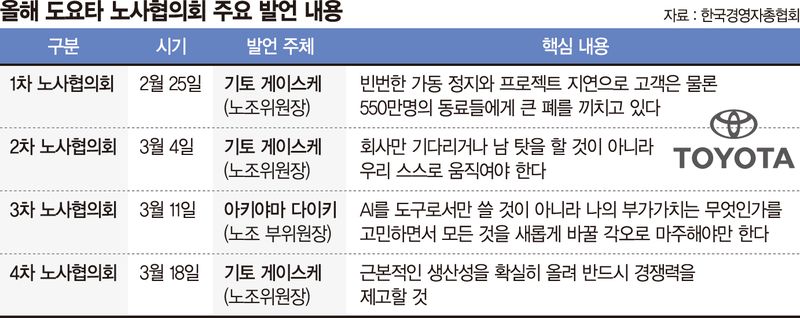
By contrast, Toyota's labor and management are seen as having sought a path of mutual growth through this year's labor-management council meetings. At the first meeting on Feb. 25, union chief Keisuke Kito said, "Frequent shutdowns and project delays caused by quality problems are causing great inconvenience not only to customers but also to the 5.5 million colleagues working in the automotive industry." He added, "We must change ourselves without being bound by the existing framework."
Toyota has recently faced a series of quality problems, including issues involving small cars, diesel engines and fraudulent crash-test certification, as well as a recall of the fifth-generation Prius. Before demanding a bigger share, the union itself acknowledged the reality the company is facing with a sober eye.
The union also stressed the need for a fundamental overhaul of work methods to improve productivity. At the second meeting on March 4, Kito urged the union to take the lead in innovation, saying, "We should not just wait for the company or blame others. We need to move on our own."
In particular, unlike Hyundai Motor Company Labor Union and others, which sent management a list of demands including guarantees on employment and working conditions related to artificial intelligence, Toyota's union took a flexible stance on AI adoption as well.
At the third labor-management council meeting on March 11, vice chairman Daiki Akiyama emphasized, "We should not treat AI merely as a tool. We need to face it with the resolve to change everything anew, while thinking about what skills I can offer and what my added value is."
Lee Dong-geun, standing vice chairman of KEF, said, "Recently, there has been a growing number of cases in which labor circles are fighting for excessive profit distribution, such as demands for a share of operating profit or net profit." He added, "Even in the global auto industry, where one company dominates both sales and operating profit, the union has first thought about a survival strategy amid an unprecedented sense of crisis and resolved to move first, leading to company-wide change. That offers important lessons for labor relations in Korea."
[email protected] Kim Dong-chan Reporter