Bond Yields Rise Sharply, Outpacing Japan and the UK; Bets on Price Declines Hit Record High
- Input
- 2026-06-01 18:15:18
- Updated
- 2026-06-01 18:15:18
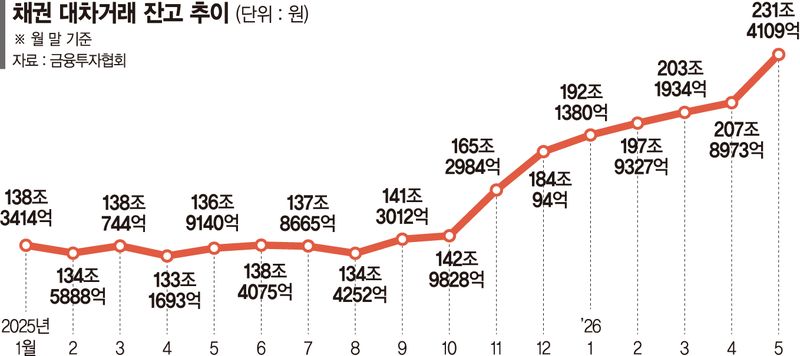
According to the Korea Financial Investment Association (KOFIA) on the 1st, the balance of bond lending transactions stood at 231.6725 trillion won on the 28th of last month, up by more than 23 trillion won in a month and setting a new all-time high. It edged down slightly to 231.4109 trillion won on the 29th, but remained at a very high level. Compared with the end of May last year, when the figure was 136.914 trillion won, it has surged by nearly 100 trillion won.
Bond lending is a transaction in which investors borrow bonds in advance and sell them when they expect prices to fall, then buy them back later at a lower price to profit. It is often referred to as bond short selling. Institutions typically use it to hedge against bond price losses, and a larger balance is generally interpreted as a stronger bet on falling bond prices and rising yields.
Investor sentiment appears to have weakened sharply as government bond yields have surged. Korean Treasury Bond yields rose steeply last month, reaching their highest level in two and a half years. The 3-year Korean Treasury Bond yield climbed to as high as 3.766% on a closing basis, while the 10-year and 30-year yields also jumped to 4.239% and 4.204%, respectively.
Korean Treasury Bond yields are rising faster than U.S. Treasury bond yields. The 3-year Korean Treasury Bond yield rose from 2.953% at the end of last year to 3.731% at the end of last month, a gain of 26.35%. Over the same period, the 3-year U.S. Treasury bond yield increased 14.41%, from 3.546% to 4.057%.
Yoon Yeo-sam, a researcher at Meritz Securities Co., Ltd., said, "Given inflation vulnerability and fiscal soundness, bond investment anxiety should be higher in Japan or the UK than in South Korea, but Korean yields have risen the most." He added, "A high interest rate level does not necessarily mean this is a point where investors must flee."
Brokerages expect two rate hikes in the second half of this year. Still, the consensus is that the upside in bond yields will be limited, as uncertainty over monetary policy has already been priced in.
Kim Ji-man, a researcher at Samsung Securities, said, "Considering last month's Monetary Policy Board dot plot, the likelihood of two rate hikes this year has increased." He added, "Forward rates have already priced in more than four or five hikes, so we view this as an overshooting situation."
"Because changes in market expectations tend to be more volatile than reality, a temporary spike in rates cannot be ruled out," he said. "However, conditions do not support rates staying above current levels for a prolonged period."
Kim Seong-su, a researcher at Hanwha Investment & Securities Co., Ltd., also said, "The 3-year Korean Treasury Bond yield is expected to stabilize lower as uncertainty over monetary policy eases after a rate hike in the second half of the year." He added, "As the market enters a phase in which the future rate path becomes clearer, the excessively widened spread versus the benchmark rate may partially normalize."
[email protected] Seo Min-ji Reporter