Japan's Kioxia Shares Top 70,000 Yen for the First Time, With Some Forecasts Calling for 200,000 Yen
- Input
- 2026-06-01 16:48:55
- Updated
- 2026-06-01 16:48:55
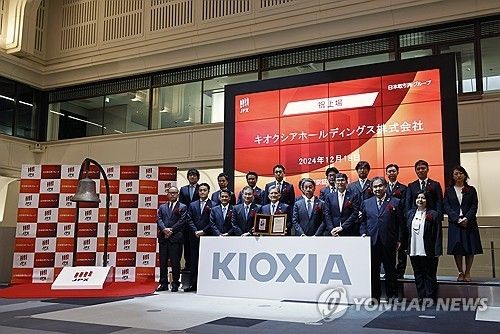
[Financial News, Tokyo = Reporter Seo Hye-jin] Kioxia Holdings, a Japanese semiconductor company, was re-rated as an AI beneficiary and saw its share price break above 70,000 yen for the first time on the 1st. Compared with its IPO price, the stock has risen about 50-fold, and some investment firms are now projecting further upside, with target prices as high as 200,000 yen. They cited surging demand for high-performance memory driven by the spread of AI data centers.
On the Tokyo Stock Exchange that day, Kioxia shares closed at 72,500 yen, up 6,650 yen, or 10.10%, from the previous trading day. It was the first time the stock had moved above 70,000 yen since its listing. Even after already rising to about seven times its level at the start of the year, buying continued.
Kioxia was listed on the Tokyo Stock Exchange on Dec. 18, 2024. Its IPO price was 1,455 yen, and it closed on its first day at 1,606 yen, up 10.4% from the offer price. In just a little over a year and a half since then, the stock has surged roughly 50-fold, lifting it to a level comparable with Japan's leading companies.
What makes the latest rally especially notable is that it has been supported not just by expectations, but by improving earnings.
For fiscal 2025, covering April 2025 to March 2026, Kioxia reported consolidated sales of 2.3376 trillion yen, operating profit of 876.2 billion yen, and net profit of 559.6 billion yen. Those figures were up 37%, 93.4%, and 110.4%, respectively, from a year earlier. The improvement was driven by stronger demand for NAND flash memory as AI data centers expanded.
For the first quarter of this year, from April to June 2026, the company projected sales and operating profit would rise 74.5% and 117%, respectively, from the previous quarter. The operating margin is expected to reach 74%.
The market expects full-year operating profit this year to reach about 4 trillion yen. That would exceed the projected operating profit of Toyota Motor Corporation, long regarded as a symbol of Japanese manufacturing. Analysts say this suggests Japan's industrial center of gravity is shifting from automobiles to semiconductors.
As earnings forecasts are revised up rapidly, target prices are also being raised one after another.
Aretaiya Capital Hong Kong recently set a target price of 200,000 yen for Kioxia in a report titled, "Late to the party, but the finale is still far away." That is about three times the stock's closing price on the day.
The report said demand for enterprise solid-state drives (SSD) and 3D NAND will rise sharply over the medium to long term as AI spreads.
Warren Lau, an analyst at Aretaiya Capital, said Kioxia has a unique advantage among NAND competitors because it has a new cleanroom that can support production expansion and market share gains. He also pointed to the potential for profit growth and greater shareholder returns.
Goldman Sachs also upgraded its investment rating from "neutral" to "buy" and raised its target price from 48,000 yen to 93,000 yen. The firm said AI demand is likely to remain strong for the time being while supply growth stays limited.
Shuhei Nakamura, a researcher at Goldman Sachs, explained that supply-demand pressure is likely to continue through 2028.
Still, some in the market are warning about overheating. Memory is a classic cyclical industry that remains highly sensitive to supply and price changes, so analysts say it remains to be seen whether the current earnings surge will lead to a lasting structural shift.
The Nikkei reported that market attention is growing over whether Kioxia's share price will keep rising as bullish investors expect, or whether gains will be capped as skepticism grows about AI and expanded semiconductor capital spending.
[email protected] Seo Hye-jin Reporter