Tiger Research CEO Daniel Kim Says Korea Still Has a Chance to Become Asia's 'Crypto Hub'
- Input
- 2026-06-01 13:36:57
- Updated
- 2026-06-01 13:36:57
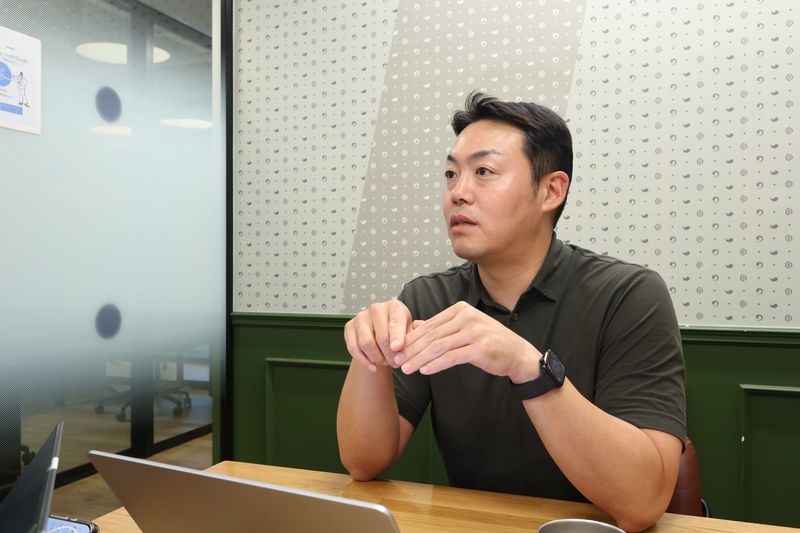
[Financial News] The crypto market is shifting from retail trading led by individual investors to an institutional infrastructure race involving financial firms and big tech companies. In particular, alliances and rivalries around security token offerings (STOs), stablecoins and custody are now accelerating.
Daniel Kim, CEO of Tiger Research, an Asia-focused Web3 research and advisory firm, said on the 1st that Korea's crypto market is now entering what he called a "regulatory design war," in which players are trying not only to secure market share but also to influence the regulatory standards that will eventually be finalized.
Tiger Research was founded in 2022 as a Web3 research and advisory firm. According to Kim, revenue has doubled every year since its launch, while both headcount and business scope have expanded. Tiger Research also serves as the official research partner for Korea Blockchain Week 2026 (KBW 2026).
A recent Tiger Research study tracking 196 partnerships across 150 domestic institutions found that competition in the local market is centered on three fronts: STOs, stablecoins and custody. The report said there is still no dominant hub in Korea's crypto institutional market, and that multiple camps are forming at the same time to gain the upper hand before regulations are finalized.
The tie-up between financial institutions and crypto exchanges has been especially notable. Hana Bank said it plans to acquire a 6.55% stake in Dunamu Inc., while Hanwha Investment & Securities Co., Ltd. announced a 3.90% stake purchase. Samsung Securities, Samsung SDS and Samsung Card also disclosed a combined 4.0% stake acquisition. Mirae Asset Consulting has also signed a deal to acquire a 92.06% stake in Korbit. Tiger Research interpreted these moves as an effort to secure key customer touchpoints where stablecoins, custody, STOs and real-world assets (RWAs) will be distributed.
Kim explained that traditional banks and securities firms are seeking stakes in exchanges because they want to secure the main distribution channels for digital asset finance, including stablecoins, custody and RWAs. He also described the recent alliance among Naver, Dunamu and Hana Bank as a positive sign and a strategic shift, saying it reflects the capital and scale needed to compete in global markets.
He took a cautious view of claims that the gap between domestic and overseas markets has widened too much. Kim said the United States is also struggling with issues such as whether stablecoin issuers should pay interest and with the details of pending legislation. He added that the gap between Korea and overseas markets is more like a warm bath and a cold bath than boiling water and ice water, meaning there is still plenty of room for opportunity in Korea.
Kim previously worked at global IT companies such as Microsoft (MS) and Amazon Web Services (AWS), as well as at a hedge fund. He said that in the past, the market was dominated by retail investors, so narrative-driven research aimed at attracting public attention was mainstream. Today, however, data analysis that solves concrete business problems for institutional clients is the key.
Tiger Research is developing a data business that analyzes the usage patterns of domestic investors' on-chain data from non-custodial wallets in anonymized, aggregated form. Kim explained that this is not information that identifies specific individuals by name, but pattern analysis based on public blockchain metadata. He said it can be used to understand the characteristics of Web3 users in Korea. He added that global stablecoin issuers and DeFi protocols considering ways to attract Korean users are also showing interest in such data.
A global distribution network and an Asia-focused network are also part of Tiger Research's competitive edge. Its research is published in five languages — Korean, English, Chinese, Japanese and Indonesian — and distributed through major media outlets and platforms in each country. Kim said the company aims to establish itself as a cross-border Web3 knowledge hub by combining rich local knowledge from across Asia with broad expertise in macro-level governance analysis.
[email protected] Kim Mi-hee Reporter