Samsung Electronics and SK hynix Set the Stage... HD Hyundai Heavy Industries Union Demands 30% of Operating Profit as Performance Pay
- Input
- 2026-06-02 05:59:00
- Updated
- 2026-06-02 05:59:00
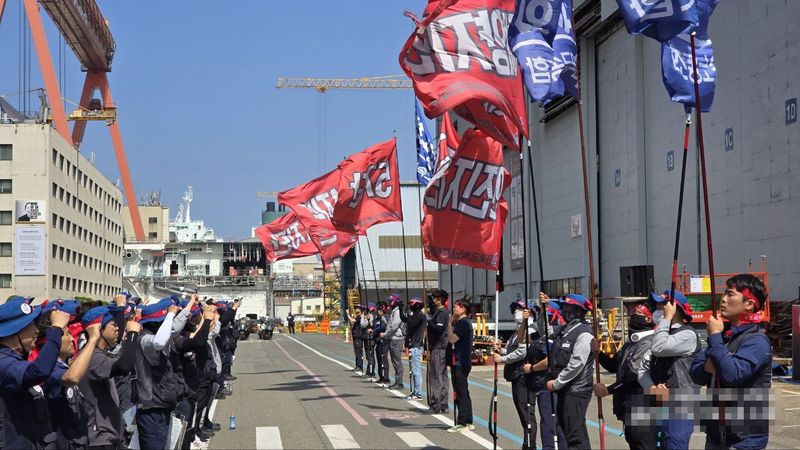
[Financial News] The HD Hyundai Heavy Industries labor union will meet with management on June 2 and begin full-scale negotiations on wages and the collective bargaining agreement. After the union delivered its proposal to management last week, the key issue this year has emerged as an unprecedented demand: to distribute at least 30% of operating profit as performance pay. The "N% of operating profit" bonus model, first set in motion by Samsung Electronics and SK hynix, is now spreading beyond semiconductors and into the shipbuilding industry.
The performance-pay shift sparked by Samsung Electronics and SK hynix is now reaching shipbuilding.
According to industry sources on the 2nd, the integrated HD Hyundai Heavy Industries union formally delivered its demands for this year's wage and collective bargaining talks to management on May 20. At the center of the proposal is a call to "fairly share at least 30% of operating profit as performance pay." It is the first time since the company’s founding that the union has specified a concrete percentage of operating profit as the source of performance pay. HD Hyundai Heavy Industries' separate operating profit for last year is estimated at about 2 trillion won. Based on that figure, 30% would amount to roughly 600 billion won, or about 7.5 million won per person if divided among the union’s roughly 8,000 members.
Until now, wage talks have focused on traditional methods such as fixed base-pay increases and larger bonuses. This time, however, the union is calling for a structural shift by directly linking company performance to performance pay.
The union's proposal goes beyond performance pay. On wages, it is demanding a fixed monthly base-pay increase of 149,600 won, excluding the 35,000 won annual step increase, a 100% increase in bonuses, and a 2 billion won contribution for operating expenses to maintain vacation facilities. Separate demands include expanding the scope of ordinary wages, hiring new employees, improving the calculation standards for performance pay, eliminating wage discrimination and integrating wage systems, adjusting pay gaps by seniority, abolishing the use of individual evaluations for fixed-term workers after low ratings, reaching union agreement on reforms to the office worker personnel system, and raising special leave and mutual aid benefits.
What stands out is the central bargaining proposal from KMWU and the joint proposal from the Shipbuilding Industry Labor Union Alliance. KMWU has set as common agenda items "protecting labor rights and employment when AI is introduced" and "retirement age linked to pension eligibility." The Shipbuilding Industry Labor Union Alliance has also made "hiring regular workers in numbers greater than the number of regular employees retiring" and "protecting labor rights and employment when AI is introduced" its shared demands.
The Shipbuilding Industry Labor Union Alliance has already asked KOSHIPA to form a consultative body focused on youth hiring and AI adoption. As artificial intelligence and automation are rapidly being introduced into shipyard operations, the union is preemptively pushing for safeguards to protect jobs during the technological transition.
Distribution Politics in the Shipbuilding Supercycle
The essence of this round of talks is the "politics of distribution" over who will take how much of the gains from the shipbuilding supercycle. Securities firms expect HD Hyundai Heavy Industries' operating profit on a consolidated basis to rise from about 2 trillion won last year to the mid-3 trillion won range this year. For HDKSOE as a whole, operating profit reached 3.9045 trillion won last year, up 172.3% from a year earlier.For management, caution is unavoidable, as structural labor-cost increases could erode long-term profitability even if the order boom continues. The union is demanding both compensation for the pain of restructuring endured during downturns and a fair share of current gains. The performance-pay model that began in the semiconductor industry has become a benchmark.
Samsung Electronics labor union reached a dramatic agreement with management on May 21, just over an hour before the deadline for a general strike. The key point was a plan to pay 10.5% of business performance in company stock as a special management performance bonus for the Device Solutions division, in addition to the existing 1.5% operating profit-sharing incentive (OPI). In effect, 12% of business performance has been institutionalized as the bonus pool.
SK hynix had already decided to allocate 10% of operating profit to performance pay and removed the cap entirely. As expectations grew that per-person bonuses could reach hundreds of millions of won this year amid the semiconductor boom, pressure for broader compensation has intensified across industry. Right after the Samsung Electronics deal, the Korea Employers Federation warned that "this agreement reflects Samsung Electronics' unique circumstances" and that "labor should not generalize it and spread excessive performance-pay demands across the entire industry."
This year's labor-management talks at HD Hyundai Heavy Industries involve more than performance pay. In April, the Gyeongnam Regional Labor Relations Commission recognized Hanwha Ocean as the employer of the union at its catering subcontractor, the Welive Branch of the Metal Workers' Union, adding to management's burden over the scope of performance-pay recipients. On May 21, however, the Supreme Court Grand Bench upheld a lower court ruling against the KMWU HD Hyundai Heavy Industries In-house Subcontractors' Branch in its lawsuit seeking collective bargaining with HD Hyundai Heavy Industries, concluding that the primary contractor is not obligated to bargain collectively with a subcontractor union.
Still, it remains unclear how that Supreme Court ruling will affect similar disputes in the future, given that the scope of "employer" has been legally expanded under the Yellow Envelope Act. The HD Hyundai Heavy Industries labor union is reportedly pushing for simultaneous bargaining between primary and subcontractor unions this year, which could change the structure of negotiations from the past.
[email protected] Kang Gu-gwi Reporter