"KOSPI Has More Room to Rise" ... Why Are Experts Worried?
- Input
- 2026-06-01 07:00:00
- Updated
- 2026-06-01 07:00:00
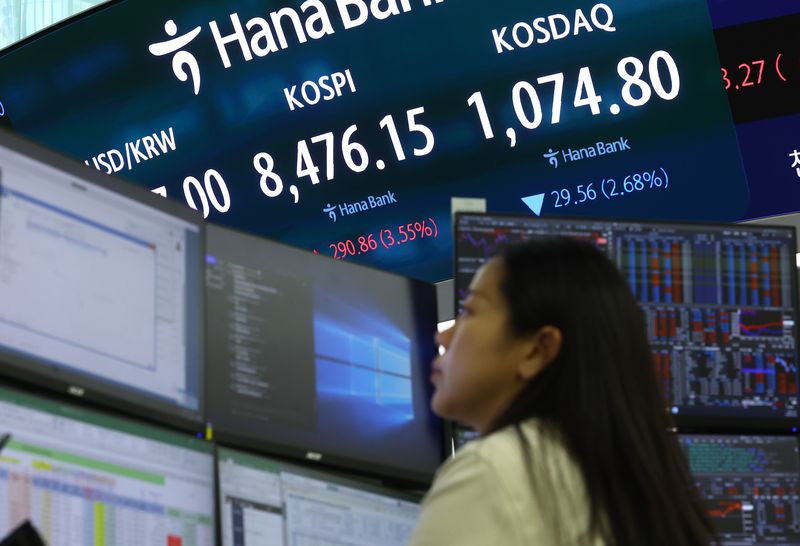
[Financial News] Warnings are emerging that the real risk in the so-called "Samsung Electronics and SK Hynix" rally lies in interest rates. In past major bubble collapses, sharp rate increases were the trigger.
According to the securities industry on the 1st, analysts say the moment the U.S. 10-year Treasury yield breaks above historical highs could become a key variable in the collapse of the artificial intelligence (AI) bubble.
Before the Great Depression in 1929, during the Nifty Fifty boom in the 1970s, and just before the dot-com bubble burst in 2000, markets all saw interest rates surge to levels they had never experienced before. Just last month, global stock markets briefly corrected after the U.S. 10-year Treasury yield topped 4.5%.
Lee Eun-taek, a researcher at KB Securities, emphasized, "Bubbles do not collapse simply because valuations are high." He added, "The breakdown began when rising interest rates, at levels investors could not absorb, were combined with fears of inflation."
The collapse of the dot-com bubble in 2000 is often cited as a representative case. At the time, the Federal Reserve (Fed) began raising rates in 1999, and by 2000 the United States 2-Year Treasury Yield had climbed above 6.5%. That was the highest level since 1995. In the end, KOSPI turned sharply lower in early 2000, and the Nasdaq also fell steeply in March that year.
The Nifty Fifty bubble burst in the 1970s followed a similar pattern. In 1966, the U.S. benchmark rate stood at 4.5%, while the 2-Year Treasury Yield reached 4.9%, levels not seen since the Great Depression. Then in 1973, the benchmark rate surged to 9%, breaking another historical high and bringing down the stock market bubble as well.
A similar pattern appeared before the Great Depression in 1929. To cool an overheated stock market, the Fed raised rates by 100 basis points at once in August 1929. The 6% rate was the highest since WWI and the first rate level the market had seen after the 1920s rally.
Brokerages believe the current AI rally will also ultimately hinge on interest rates. In particular, they are watching the moment the U.S. 10-year Treasury yield breaks above 5%, as market sentiment could shift abruptly. That would be a rate range the market has not experienced since before the Global Financial Crisis in 2007. If inflation also reaccelerates, analysts say the market could enter a full-scale danger zone.
Lee explained, "The real risk is the moment core inflation rises again and investors start to feel that prices will no longer come down easily."
Still, analysts say the chances of the U.S. 10-year Treasury yield rising above 5% and core inflation climbing back above 3% right away are not high. Lee said, "Even in the fastest case, those conditions are more likely to appear after this fall." He added, "That means there is still room for further gains through the third and fourth quarters, or until year-end."
Heo Jae-hwan, a researcher at EUGENE INVESTMENT & SECURITIES CO., LTD., said, "The concentration on AI data centers and the sharp rise in semiconductor stocks leave a sense of discomfort in the back of my mind." He noted, "Similar concentration in a single industry was also evident during the railway boom and the dot-com bubble."
He added, "Even during past bubble phases, the concentration in certain industries and the influx of retail investors intensified at the peak." He said the current AI investment frenzy is also reproducing the same kind of overheated pattern seen in those bubble periods.
[email protected] Choi Du-seon Reporter