"Foreign Investors Sell, Retail Investors Buy"... In the Semiconductor Rally's 'KRW 70 Trillion Battle,' Who Will Win? [Salary Workers' Ups and Downs]
- Input
- 2026-06-01 05:39:09
- Updated
- 2026-06-01 05:39:09
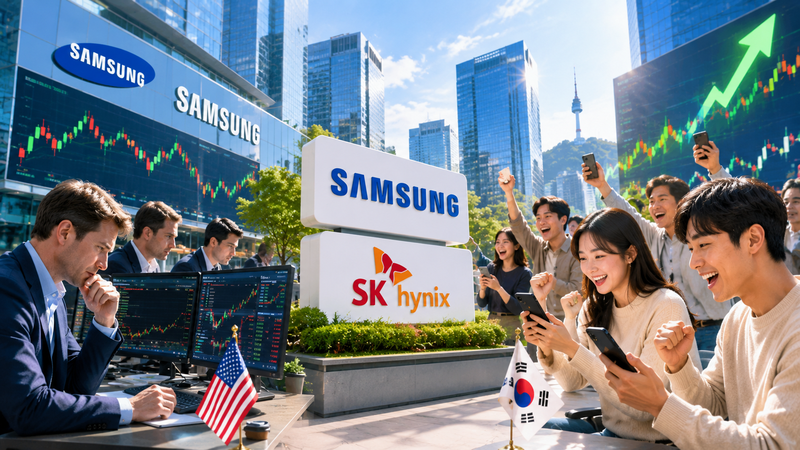
[Financial News] "Is it still okay to get into SK hynix now?" "Wouldn't Samsung Electronics be the better choice?"
That was the conversation overheard at a restaurant during lunchtime recently. As the topic turned to major semiconductor stocks, one worker after another pulled out a smartphone to check a stock app. After Samsung Electronics and SK hynix surged, semiconductor stocks have become part of everyday office conversation. Some asked whether it was still safe to buy while foreigners were selling, while others said the AI rally still seemed to have room to run.
As the semiconductor rally continues, retail and foreign investors are moving in opposite directions on Samsung Electronics and SK hynix. Individual investors have been buying the two stocks heavily, while foreigners have shown a strong net selling bias. In the same semiconductor market, retail investors appear to be betting on further gains, while foreigners are leaning toward profit-taking.
Retail investors buy, foreigners sell
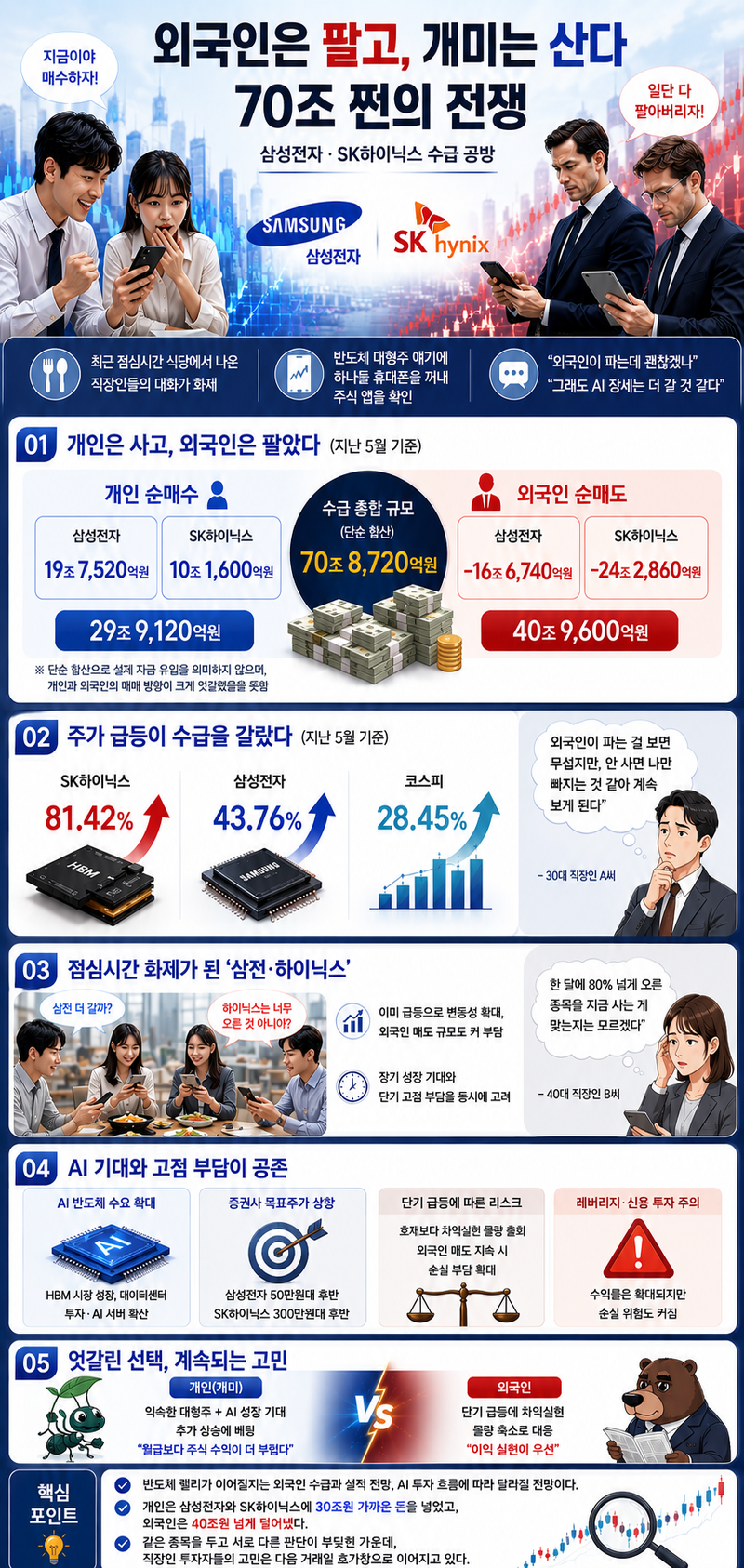
According to the financial investment industry on the 1st, retail investors posted net purchases of KRW 19.752 trillion in Samsung Electronics and KRW 10.16 trillion in SK hynix in May. Combined, net buying in the two stocks reached KRW 29.912 trillion.
By contrast, foreigners net sold KRW 16.674 trillion worth of Samsung Electronics and KRW 24.286 trillion worth of SK hynix during the same period. They sold KRW 40.96 trillion worth of the two stocks alone.
If retail net buying and foreign net selling are simply added together, the total comes to KRW 70.872 trillion. That does not mean KRW 70 trillion in fresh money flowed into the market. Rather, it shows how sharply retail and foreign investors diverged in their trading of Samsung Electronics and SK hynix.
The split in trading flows reflects the sharp rise in stock prices. So far this month, SK hynix has climbed 81.42%, while Samsung Electronics has risen 43.76%. Both outpaced the KOSPI's 28.45% gain over the same period. As the semiconductor giants drove the index higher, retail investors bet on further upside, while foreigners appear to have trimmed positions and taken profits.
A male office worker in his 30s said, "It feels like a market that's hard to keep up with on a salary alone." He added, "It's scary when foreigners are selling, but if I don't buy, I feel like I'm the only one missing out, so I keep watching it."
A favorite stock-market topic among office workers: 'Samsung Electronics and SK hynix'
The semiconductor rally has also entered everyday office conversation. On the morning commute, more people can be seen looking at securities company apps on the subway, and at work, comments such as "Will Samsung Electronics keep going up?" and "Hasn't SK hynix risen too much?" are being exchanged.
A female office worker in her 40s said, "Samsung Electronics and SK hynix have risen so much that it feels less like a simple stock discussion and more like a comparison of salaries." She added, "Some people say they made tens of millions of won with SK hynix, and it makes me think I should have just kept my money in deposits."
Still, buying after the rally has become a burden. Because the stocks have already surged, daily price swings have widened, and foreign selling remains substantial. For office worker investors, the situation requires weighing long-term growth expectations against short-term concerns about a top.
The same worker said, "I understand that demand for AI semiconductors is strong, but I don't know if it's right to buy a stock that has risen more than 80% in a month." He added, "I keep looking at the order book even during work, and it's exhausting."
"It's disappointing, but I don't think it's for me" — AI hopes and peak-price concerns
Expectations surrounding Samsung Electronics and SK hynix are tied to demand for artificial intelligence semiconductors. SK hynix has a strong position in the High Bandwidth Memory (HBM) market, while Samsung Electronics is expected to expand supply of next-generation HBM. Rising global investment in data centers and the spread of artificial intelligence servers are also being cited as factors supporting memory demand.
Securities companies are also raising their target prices. Some domestic securities firms have set Samsung Electronics' target price in the high KRW 500,000 range and SK hynix's target price in the high KRW 3 million range. The revisions reflect expectations for improved earnings and an upward trend in memory prices.
But a target price does not guarantee actual stock performance. When a stock rises sharply in a short period, profit-taking can come first even if positive news emerges. In periods of continued foreign selling, the shares accumulated by retail investors can turn into a source of losses.
Investors using margin trading or leveraged products are especially vulnerable to volatility. Recently, single-stock leveraged products based on Samsung Electronics and SK hynix have also appeared, giving retail investors more options. They can magnify gains, but they can also magnify losses.
Foreigners sell, retail investors hesitate
The reason retail investors are buying Samsung Electronics and SK hynix is simple. They are the most familiar large-cap stocks in the Korean market, and expectations remain high that demand for AI semiconductors will keep growing. As stock prices move during working hours and stories of profits spread around, the urge to hit the buy button only grows stronger.The question is whether the reason for buying is a belief in strong companies or simply fear of missing out. Both stocks are benefiting from expectations of an improved semiconductor cycle, but at already elevated prices, the same news can trigger sharp swings.
On the subway ride home, Ahn Duk-geun looked at a securities company app and said, "At work, all I hear about is people making money, but when I actually try to buy, foreigners are selling, so it only gets more confusing." He added, "My salary comes in once a month, but stocks shake my mind several times a day."
Whether the semiconductor rally continues will depend on foreign fund flows, earnings outlooks, and the pace of AI investment. Still, the recent trading pattern has shown a clear trend. Retail investors poured nearly KRW 30 trillion into Samsung Electronics and SK hynix, while foreigners pulled out more than KRW 40 trillion. As opposing views collide over the same stocks, office worker investors are carrying their worries into the next trading day's order book.
[email protected] Han Seung-gon Reporter