Sharp Rise in Carbon Credit Prices Raises Alarm in Power and Steel Industries Over Cost Burden
- Input
- 2026-05-31 18:14:40
- Updated
- 2026-05-31 18:14:40
■ Power generators turn to emissions-cutting investment
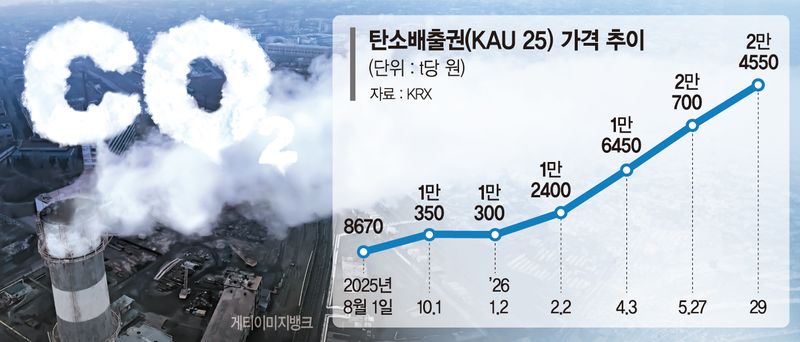
According to industry sources on the 31st, the recent trend in carbon credit prices is being viewed as higher than the market had initially forecast.
An official from the power generation industry said, "We expected some price volatility, given the planned policy changes, including the start of the fourth planning period and the expansion of paid allocation in the power sector." The official added, "However, recent prices appear to be forming at a somewhat higher level than market expectations."
Another factor behind the price increase is said to be companies' preemptive scramble to secure credits ahead of settlement periods. Another source said, "The carbon credit market has recently shown signs of overheating, driven by factors such as high bid limits in paid allocation auctions, which are pushing prices higher." The source added that companies are responding by monitoring market conditions and managing both credit procurement and costs.
Still, some say the price increase itself has meaning in terms of normalizing the system. Carbon credit prices need to stay above a certain level for companies to have stronger incentives to invest in actual emissions reductions, such as facility upgrades and a shift to low-carbon power sources, rather than relying on credit purchases.
In fact, state-owned power generation companies are strengthening their reduction plans in line with the tougher Nationally Determined Contribution (NDC). Korea Southern Power, for example, recently raised its 2035 greenhouse gas reduction target from 62% to 72%. As reduction measures, it proposed expanding renewable energy, increasing Energy Storage System (ESS) capacity and pumped-storage power generation, expanding hydrogen co-firing power generation, and converting coal-fired power generation to Liquefied Natural Gas (LNG).
A Korea Southern Power official explained, "When the government announced its 2035 NDC, it set the power sector's reduction target at 68.8% to 75.3%." The official said the target had to be raised to strengthen emissions-cutting efforts and align with government policy. "Buying credits cannot amount to real reductions," the official added. "We need to cut emissions at the source through facility investment and equipment replacement."
Other state-owned power generation companies are also adjusting their reduction targets to match the higher goals.
■ Steel industry says price signals alone are not enough for transition
The steel industry, meanwhile, agrees that carbon credit prices need to rise, but stresses the practical limits. Steel is a representative hard-to-abate industry, since its blast furnace-based production system makes it difficult to sharply reduce emissions in the short term.
An official from the steel industry said, "Because of the nature of the process, steel is a representative hard-to-abate industry, and it is difficult to complete the transition based on price signals alone." The official added, "What matters is that the system be operated in a predictable and balanced way so that carbon prices do not remain merely a cost burden, but instead lead to investment in actual emissions-reduction technologies."
What worries the steel industry is not carbon pricing itself, but the conditions for transition. Higher credit prices increase the incentive to consider emissions-cutting investment, but it is difficult to quickly change a blast furnace-centered production structure. Transitioning to low-carbon processes such as Electric Arc Furnace and hydrogen reduction steelmaking requires massive investment and time. Price signals can lead to real investment only if they are supported by stable carbon-free electricity, hydrogen infrastructure, and demand for low-carbon products.
Some also say it is too early to conclude that the price increase will immediately translate into a sharp burden across all industries. That is because surplus credits from the third planning period remain, and the burden varies depending on each sector's and company's holdings and reduction capacity. One industry source said, "It is burdensome that carbon credit prices have more than doubled in less than a year, but they are still low compared with other countries." The source added, "The burden can differ by sector and company, so it is too early to say the situation is uniformly difficult." In the end, industry believes that government market management and transition support must go hand in hand if rising carbon credit prices are not to remain merely a cost burden.
Meanwhile, the government is also discussing sector-specific transition support measures ahead of the establishment of the Korea Green Transformation Strategy (K-GX). Related ministries, including the Ministry of Economy and Finance and the Ministry of Climate, Energy and Environment, are reviewing green transition tasks and fiscal, tax, and financial support measures for sectors such as steel, Petrochemicals, cement, and semiconductor.
[email protected] Park Ji-young Reporter