Mounting Dependence on Manufacturing Deepens as Support for Service Industry Bill Gains Traction
- Input
- 2026-05-31 18:11:51
- Updated
- 2026-05-31 18:11:51
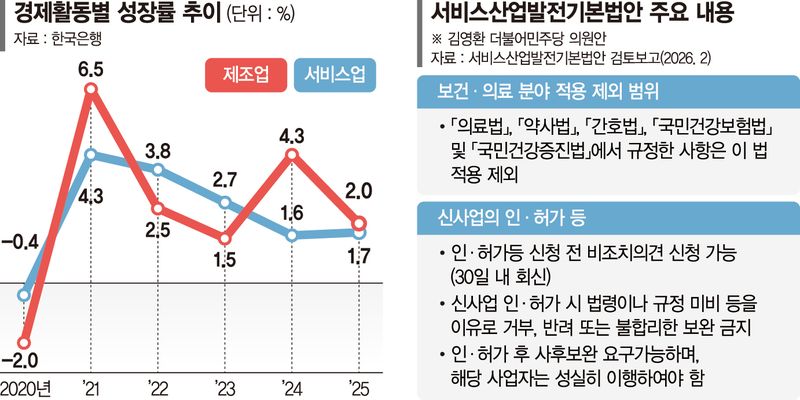
According to the Ministry of Economy and Finance on the 31st, a total of four bills to enact the Framework Act on Service Industry Development have been introduced in the 22nd National Assembly. They were jointly sponsored by Joonbyeong Yoon and Kim Young-hwan of the Democratic Party of Korea, and Song Eon-seok and Choi Eun-seok of the People Power Party. The bills were submitted to the Economic and Finance Subcommittee of the Finance, Economy and Planning Committee in March.
The ministry said public hearings had been held in the past, but this year marks the first time the issue has been discussed in earnest at the subcommittee level. With the first related bill introduced in 2011, some say the chances of passage in the National Assembly are now within sight after 15 years. Until now, the bills were repeatedly scrapped because the inclusion of the health care sector sparked controversy over the commercialization of medical services.
Jung Tae-ho, the Democratic Party lawmaker serving as the ruling party’s secretary on the committee, said, "Now that the health care sector has been excluded, the bill has a higher chance of passing." Park Soo-young’s office of the People Power Party said, "The opposition has not yet reached a unified position, and the matter is expected to be discussed again in the second half of the year after the local elections."
At the heart of the bill is a shift in the regulatory framework. The legislation includes language stating that "unreasonable regulations should be improved, and where laws are unclear, interpretation should prioritize industrial promotion." The aim is to reduce the difficulties new services face when they collide with existing legal frameworks, as seen in cases such as TADA and LawTalk.
The bills proposed by both ruling and opposition lawmakers also include a clause that would prevent the government from rejecting or dismissing applications for permits and approvals for new business models on the grounds of gaps in the law.
A ministry official explained, "The bill is intended to shift regulation for new businesses from a positive system, where anything not explicitly allowed by law is prohibited, to a negative system, where activities are allowed in principle unless specifically banned." The official added, "Some bills also include a pre-clearance opinion system for permits and approvals, which allows companies to ask the government in advance about possible legal issues or sanctions before launching a new business, thereby reducing uncertainty."
The push by the government and the ruling party to advance the bill stems from the structural weakness of the service sector. As of 2024, services accounted for 44% of nominal gross domestic product, making it a key industry, but it is still seen as lagging behind manufacturing in both growth and productivity. According to the Bank of Korea, manufacturing grew 4.3% in 2024 and is projected to grow 2.0% in 2025, while services rose only 1.6% and 1.7%, respectively. The Korea Development Institute (KDI) also forecast that service-sector growth this year will remain at 3.3%, about half of manufacturing’s 6.4%.
The productivity gap is also wide. Labor productivity per worker in South Korea’s service sector stood at just 68.9% of the OECD average, ranking 27th, while manufacturing reached 122%, ranking 6th.
Experts say passage of the bill could become a catalyst for expanding service exports. According to the WTO, South Korea’s share of the global services export market fell to 1.6% in 2024, ranking 18th, down from 1.8% and 16th in 2022. That suggests there is significant room to improve competitiveness through institutional reform.
Jung Sun-young, deputy head of the Macroeconomic Analysis Team at the Bank of Korea, said, "In the service industry, technological convergence has been delayed by regulatory barriers between sectors, but enactment of the bill would create room to ease them." She added, "It could also serve as a control tower for coordinating regulations across ministries." She emphasized that "a higher-level legal foundation is needed to match the manufacturing-service convergence trend, and export competitiveness should be expanded through convergence across industries."
[email protected] Choi Yong-jun Kim Chan-mi Reporter