"Is It Too Late for Samsung Electronics and SK hynix?" The Market's Answer Was Unexpected
- Input
- 2026-05-31 07:00:00
- Updated
- 2026-05-31 07:00:00
[Financial News] "Is it too late to buy Samsung Electronics and SK hynix now?"
As the KOSPI surges, investors have been asking that question day after day. Contrary to concerns that the stocks have already run too far, the securities industry sees the AI semiconductor supercycle as only now entering a full-scale phase.
According to the securities industry on the 31st, the KOSPI has more than tripled over the past year, but corporate earnings have risen even faster.
Samsung Securities said that during the same period, forward earnings per share (EPS) for KOSPI-listed companies jumped 245%, while the forward price-to-earnings ratio (PER), which reflects valuation pressure, fell 12%. In other words, although the market has soared, companies are making much more money, so stocks are not as expensive as many had thought.
Market participants are now focusing on changes in earnings forecasts for Samsung Electronics and SK hynix. FnGuide projects the two companies' combined operating profit for 2026 at about 604.6 trillion won. That is roughly eight times higher than last year's level of 78 trillion won, in just one year. The operating profit forecast for 2027 has already risen to around 796 trillion won.
Kim Dong-young, a researcher at Samsung Securities, analyzed that "the recent rise in the KOSPI was driven not by valuations, but by a sharp increase in corporate earnings," adding that "an earnings-momentum strategy remains valid."
Behind this trend is the competition among global big tech companies to invest in AI. The annual capital expenditures (CAPEX) outlook for five major big tech firms — NVIDIA, Microsoft, Meta, Amazon.com, Inc., and Google — has expanded from about $350 billion a year ago to $740 billion now, or about 1,115 trillion won. As competition to build AI infrastructure continues, demand for semiconductors, especially high-bandwidth memory (HBM), is also rising steadily, analysts say.
Analysts also say that the burden of high interest rates, which has recently been raised in the market, has not necessarily led to stock declines in past cases. During the 2004-2007 period, when the China supercycle continued, and in 2017, during the U.S. rate-hike cycle, surging corporate earnings outweighed rate pressures, leading to a strong KOSPI bull market.
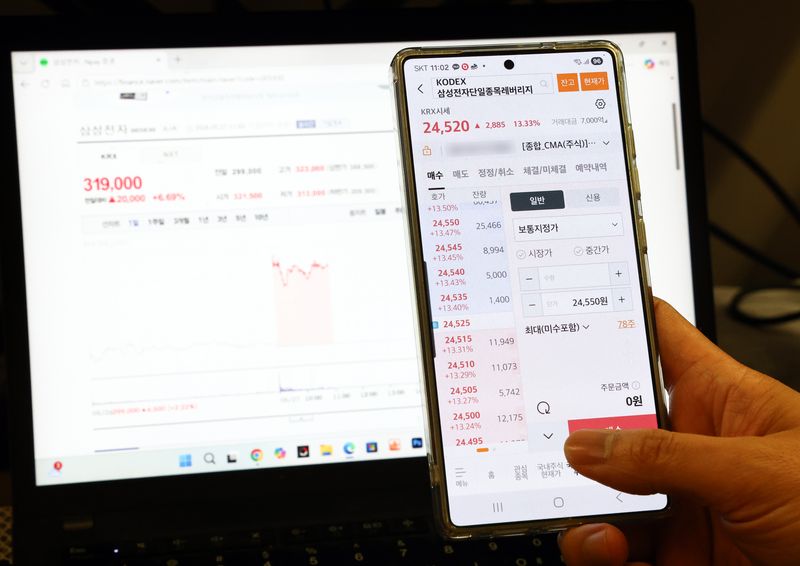
Investment funds from individual and institutional investors are still concentrated on Samsung Electronics and SK hynix. With expectations growing for expanded AI servers and a sharp increase in HBM demand, some even say the domestic stock market is effectively moving as a "Samsung Electronics and SK hynix market." The fact that trillions of won in trading volume have flowed into the recently listed leveraged ETFs tied to the two stocks is being interpreted in the same way.
One securities industry official said, "In the past, semiconductor stocks rose on expectations alone, but now we are in a phase where both expanded AI investment and upward earnings revisions are being confirmed at the same time," adding that "as long as the investment race among global big tech companies continues, the earnings-driven market centered on Samsung Electronics and SK hynix could last much longer than expected."
[email protected] Choi Du-seon Reporter