"I Might Miss the Samsung Electronics and SK hynix Open"... Office Workers Worry About 9 a.m. Meetings: "I Make More Than My Salary" [The Joys and Sorrows of Salary Workers]
- Input
- 2026-05-31 08:00:00
- Updated
- 2026-05-31 08:00:00
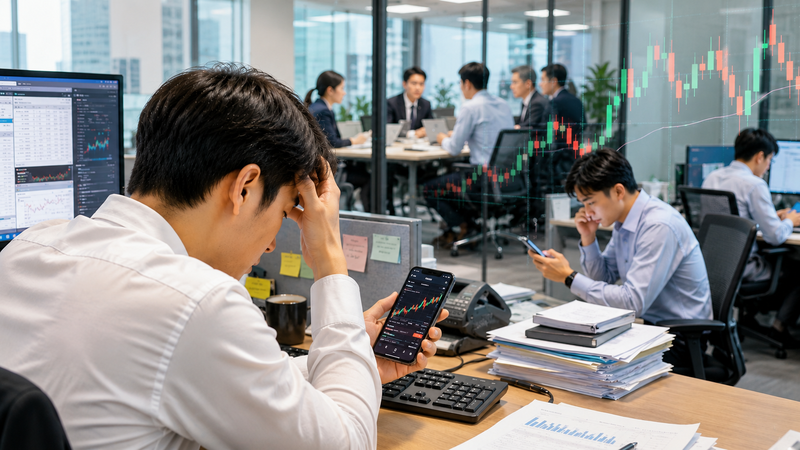
[Financial News]"Even when I'm in a meeting, if a phone alert goes off, my hand moves first."A salaried worker in his 30s, identified as A, now flips his phone over when he enters a conference room. Even so, he said that when a stock alert sounds, he still checks whether the screen has lit up. "I tell myself I'll just look once and put it away, but after I see whether it's red or blue, I end up looking at another stock," he said."Checking stock apps during work hours has become a habit."he added.
As stock investing has become part of daily life for office workers, more people are finding their work hours overlapping with intraday market checks. The domestic stock market opens at 9 a.m. and closes at 3:30 p.m., which is mostly during office hours. As intraday volatility grows, alerts from stock apps, group chats, and order books increasingly seep into the gaps between tasks.
At 9 a.m., the stock app opens along with the workday
Right after arriving at work, A checks his brokerage app before turning on the company messenger. He said that if U.S. stocks moved sharply the previous day, or if there was news involving large-cap names such as Samsung Electronics or SK hynix, he feels anxious even before the market opens.
He said,"If a morning meeting is scheduled for 9 a.m., I get nervous for no reason."He added, "If I miss the first 10 minutes of trading, I feel like I've missed something." He continued, "If I'm in profit, I can't stop because I think it might go higher. If I'm in the red, I can't stop because I think it might recover."
Another office worker in his 40s, identified as B, had a similar experience. "I can't keep HTS open on one side of my work monitor, so I look at it on my phone," he said. "If the team leader walks by behind me, I pretend I'm just checking KakaoTalk." B added, "On days when my losses are big, I can't even absorb the content of work emails properly."
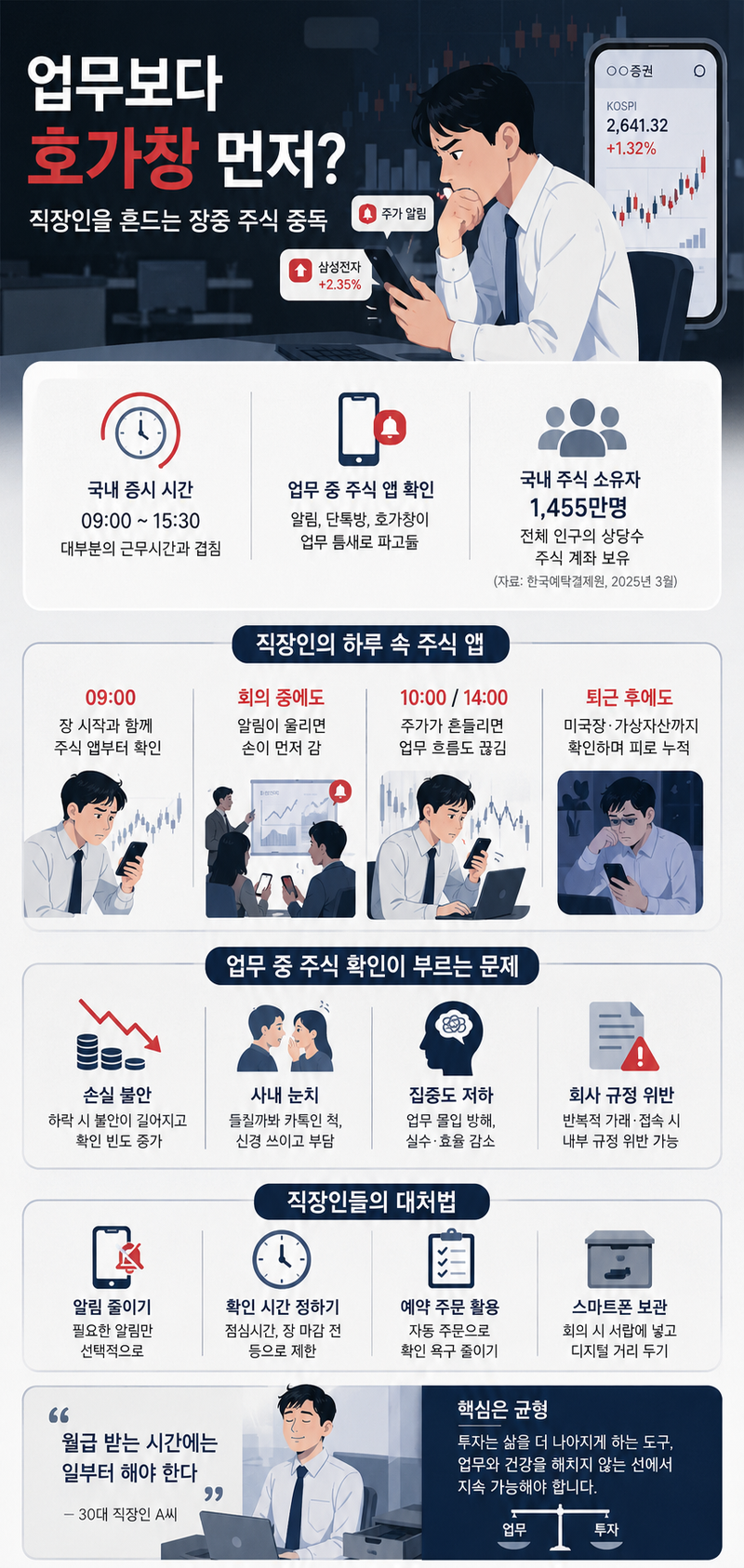
Stock investing by domestic retail investors has already become commonplace. According to the 'Status of Shareholders in Listed Companies with December Fiscal Year-End 2025,' released by Korea Securities Depository (KSD) in March, the number of shareholders in listed companies, excluding duplicate holders, stood at 14,558,479. That means a large share of the population is now linked to stock accounts.
As more people invest in stocks, talk about the market is no longer unusual inside companies.During lunch, people ask, "Did you see Samsung Electronics today?" and "Is hynix going up again?"The problem is that the conversation does not stay confined to lunchtime. Because the market moves throughout the trading day, the concern follows workers back to their desks.
Work focus shaken by a single alert
Checking stock apps during work is not just a matter of curiosity. On days when investors are losing money, anxiety lingers longer. On days when they are in profit, they check the screen more often, worried they may miss the right time to sell. Once they join stock discussion rooms or group chats, the amount of information they feel compelled to monitor only increases.
A salaried worker in his 30s, identified as C, said, "At first I only checked during lunch, but these days I make sure to look at 10 a.m. and 2 p.m.""If the stock price swings at those times, my work flow gets interrupted too," he said. "There have even been times when I went to the bathroom just to look at the order book, even though nothing urgent was going on."He added.
Another reason people keep checking is intraday volatility. When large-cap stocks such as Samsung Electronics and SK hynix move sharply in a single day, investors find it hard to wait until the market closes to see the result. In particular, office workers who use margin trading or short-term strategies tend to check prices during work hours because they fear losses could grow.
According to the Korea Financial Investment Association (KOFIA), margin loan balances stood in the 29 trillion won range as of the 26th. When more investors are buying stocks with borrowed money, a drop in share prices is no longer just a paper loss. If concerns over collateral ratios or forced selling are added, intraday price checks can become even more frequent.For office workers who also check U.S. markets and cryptocurrency prices after work, the investment day becomes even longer.They check the domestic market during the day and overseas markets at night. A said, "I look at the U.S. market at night and the domestic market during the day, so there is no time to rest." He added, "I can't tell whether I'm investing in stocks or whether stocks are holding on to me."
Loss anxiety lasts longer than profit bragging
At the office, stock talk usually starts with someone who made money. When people say things like, "I bought it yesterday and made 10%," or "You still haven't bought that stock?" those who are sitting on losses become even more impatient. The reason office workers keep opening their apps during work hours is not only the hope of profit, but also the fear of falling behind.
B said, "When someone in the office says they made money, I end up checking my own account for no reason." He added, "Even while I'm working, I keep wondering whether I sold too late or too early." He said, "In the end, checking doesn't change anything, but not checking makes me even more anxious."
The bigger the losses, the more people start worrying about how they are seen at work. If a boss or colleague catches them looking at a stock app, it can create the impression that they are neglecting their duties. One office worker in his 20s said, "Even if I only look for a moment, I worry that if someone sees me, I'll look like someone who spends all day on stocks."
Checking stocks during work hours is also a sensitive issue for companies.While personal investing itself cannot be banned, repeatedly trading during work hours or accessing investment sites on a work PCcan lead to a violation of internal rules.For financial firms or companies with strict security policies, it can also raise issues related to employee trading and the use of information.
A habit of checking the order book that remains even after reducing alerts
Office workers are trying to find their own ways to cope. Some reduce price alerts to just two or three a day, or decide to check the app only during lunch and right before the market closes. Others place limit orders in advance to cut down on intraday monitoring. But on volatile days, those rules are easily broken.
C recently turned off most of his brokerage app alerts. "When I turned them off, I felt even more anxious for the first few days," he said. "Still, it was better than having them go off all the time." He added, "If I keep checking during work hours, it doesn't feel like I'm making more money. It feels like I'm ruining both my job and my stocks."
For office workers who feel it is hard to build assets on salary alone, stock investing has become a practical option. But when intraday price checks eat into work hours, investment fatigue spills beyond the account balance. Losses turn into anxiety, profits into bigger expectations, and in between, concentration at work starts to wobble.
On days when he has meetings, A now leaves his phone in his desk drawer. "At first I was anxious, but after the meeting, there was nothing I could do about the price that had already passed," he said."These days, I feel again that when it's time to get paid, work has to come first."he said.
[email protected] Han Seung-gon Reporter