Even when they were called "I Love Starbucks" and mocked for their soybean paste-soup loyalty, regular customers did not budge. Their hurt may be more severe than falling sales [Worthwhile Issue]
- Input
- 2026-05-31 07:00:00
- Updated
- 2026-05-31 07:00:00
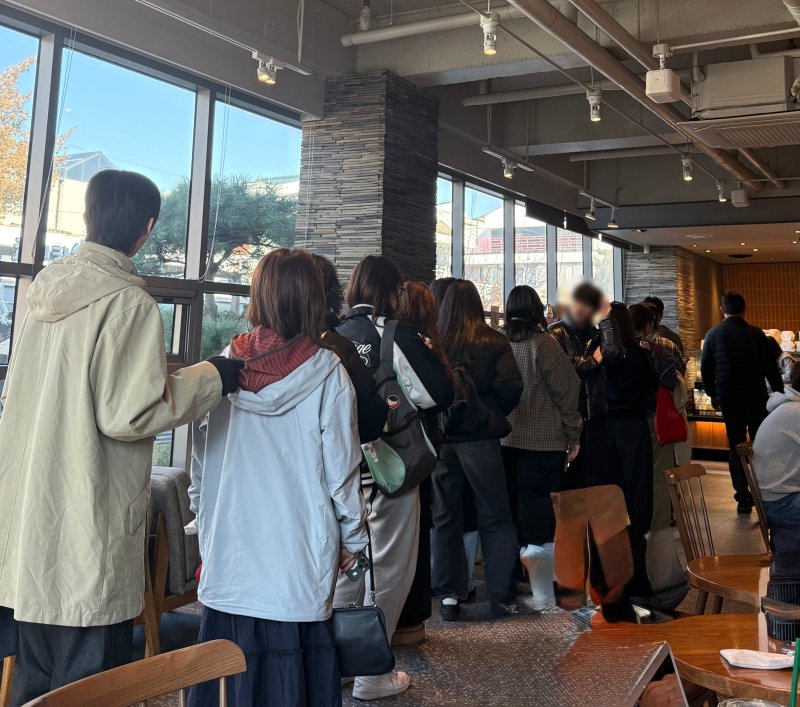
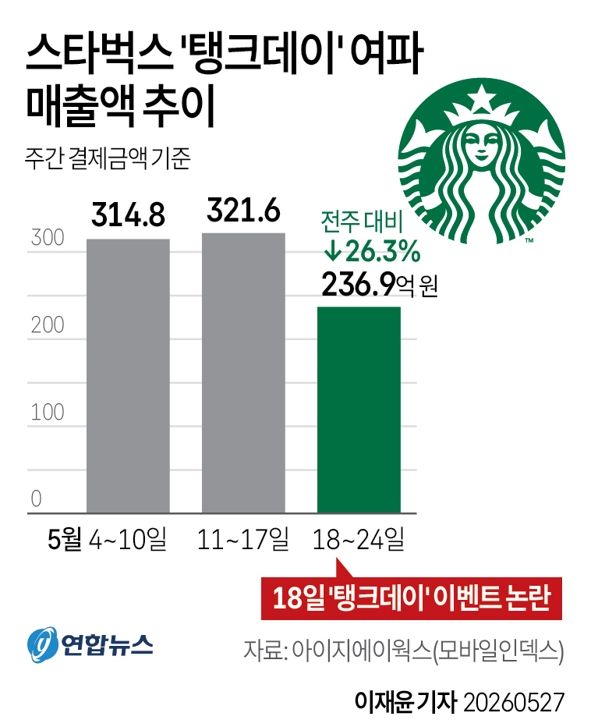
[Financial News]"Sales can recover someday. But if regular customers leave, it becomes a different story."Starbucks Korea is still struggling to shake off the fallout from the controversy over its "Tank Day" campaign tied to May 18. Even after the CEO was dismissed and Shinsegae Group Chairman Chung Yong-jin issued a public apology, negative indicators have continued, including lower card spending, user losses on the app, and a drop in gifticon sales rankings.
In this situation, experts say another warning sign should not be overlooked. More dangerous than a short-term sales decline is the fact that Starbucks' core strength, its loyal customer base, appears to be weakening.
A clear example is the cancellation of Buddy Pass, Starbucks' monthly subscription service that symbolizes its regular customers. On social network services and online communities, users are posting how to remove the Starbucks tumbler logo, sharing refund experiences for prepaid balances, and exchanging Buddy Pass cancellation confirmations and instructions.
When asked about trends in Buddy Pass subscribers, a Starbucks official said, "We have never disclosed data on subscription numbers since launching the Buddy Pass service," and did not provide related figures.
Experts, however, say Starbucks needs to take the situation seriously, as the break with regular customers signals more than a temporary boycott. It may indicate a deeper rupture in the brand relationship.
An asset carefully built through the regular-customer economy and the subscription economy
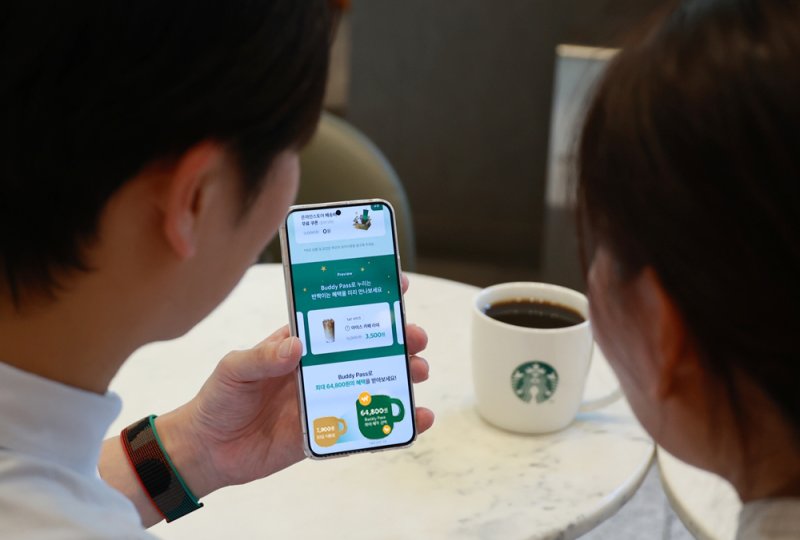
Starbucks' Buddy Pass is a form of the subscription economy. This model refers to a structure in which consumers pay regularly and continue using a service over time.
Economists explain that one reason consumers like the subscription economy is the reduction in search costs. In other words, they do not have to think every day about which cafe to visit and can repeatedly choose a familiar brand.
Psychology offers a similar explanation. It is linked to the "Need for cognitive closure," the desire to reduce complex choices and reselect a brand that has already been satisfying.
For companies, this means stable revenue.
The impact of the subscription economy on companies can be seen in Coupang's case, where member attrition followed last year's personal data leak.
Coupang, Inc., the parent company of Coupang, said on the 6th that it posted an operating loss of 354.5 billion won in the first quarter of this year, its largest loss in four years and three months.
During the first-quarter earnings conference call that day, Chairman Bom Kim said, "The one-time cost of the compensation program related to the data breach will have an impact," and added, "Even if customers return to normal, it will take time for a fundamental recovery."
One remark in particular drew attention. He stressed, "Many of those who canceled their paid membership, the Wow Membership, have come back and started spending at Coupang again at levels similar to before the incident," adding, "The business fundamentals remain solid."
The fact that he specifically mentioned the Wow Membership among canceled members appears to underscore the importance of regular customers.
This is where the core meaning of the subscription economy comes into focus: regular customers. Companies offer discounts and reward points, and consumers keep coming back to use those benefits. Over time, they become more than buyers and turn into supporters of the brand.
Starbucks also introduced Buddy Pass to strengthen this structure. For 7,900 won a month, customers can get discounts on handcrafted beverages and food items, along with free delivery benefits.
The actual effect was also shown.
According to data Starbucks released last year, Buddy Pass users visited more than 50% more often on average per month than before joining, and the average benefit per user was 23,300 won a month, more than twice the subscription fee. During the pilot run, purchase amounts and visit frequency rose by 61% and 72%, respectively.
This shows that Buddy Pass was not merely a discount program, but a lock-in strategy designed to keep regular customers tied to Starbucks.
Why Buddy Pass cancellations are even more dangerous
The reason companies have invested so heavily in subscription services is simple. Customers they have already secured are far more valuable than new ones.
Through subscribers, companies can secure stable cash flow. At the same time, they can accumulate customer data and use it for marketing tailored services. In that sense, the loss of customers who once signed up for a subscription can do more damage than just the loss of subscription fees.
Experts offered a negative assessment, saying the damage from losing regular customers could be greater for Starbucks than for Coupang.
Park Joo-geun, CEO of Leaders Index, said, "Coupang and Starbucks are different. Coupang is an infrastructure business with few substitutes, but Starbucks has too many substitutes."
Professor Lee Eun-hee of Inha University's Department of Consumer Studies also said, "Taste becomes habit and is imprinted unconsciously in consumption." She added, "Some customers may try other brands and come back, but consumers who are firmly committed to a boycott are difficult to win back."
The competitive environment Starbucks faces today is also different from the past. As of the end of last year, Mega MGC Coffee operated more than 4,000 stores, while Compose Coffee had about 3,100. That far exceeds Starbucks' roughly 2,100 stores.
In a market full of substitutes, the loss of loyal customers means more than a simple drop in sales.
This also brings to mind Howard Schultz, Starbucks' founder, who said Starbucks sells not coffee but a culture.
Park said, "For Starbucks regulars, going to Starbucks every morning was itself a lifestyle. This controversy damaged that culture and loyalty." He added, "Once a brand damages the habits and identity of its regular customers, recovery is not easy."
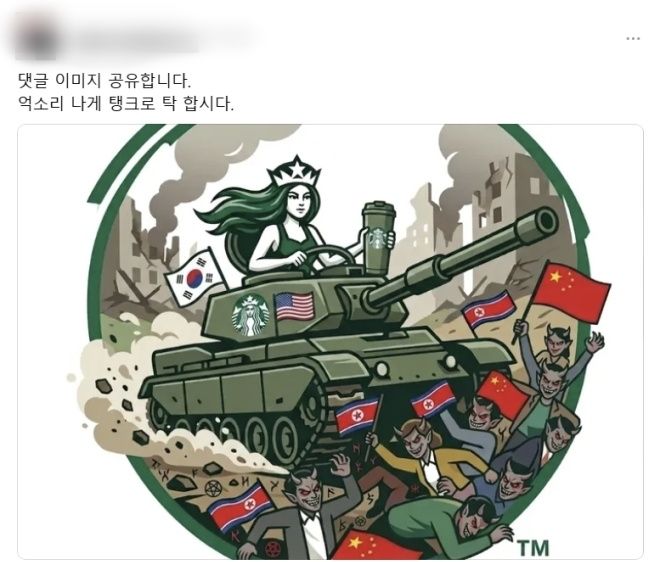
In that sense, the Tank Day event itself was a problem, but some say the follow-up response made things worse.
Park said, "After the Tank Day controversy emerged, Starbucks allowed it to spill into political and ideological debate." He added, "Once a brand starts being consumed as a political symbol, the distance felt by loyal customers can grow even larger."
A warning from Japan... the headquarters says, "Please wait"
Some in the industry point to the moves of Starbucks' U.S. headquarters as a bigger variable. They cite the example of Japan.
In the past, Starbucks also operated in Japan through a joint venture with a local partner. Then in 2014, it invested about $900 million to secure all of Starbucks Japan's shares. At the time, Starbucks bought the remaining 60.5% stake in Starbucks Japan through a tender offer and turned it into a wholly owned subsidiary.
Japan was then the second-largest market outside the United States, and Starbucks took back control in order to directly manage brand strategy and growth.
Park said, "When Starbucks settles into a local market, it lets local partners run operations. But because brand value is a core asset, there is an incentive for headquarters to step in directly if there is growing concern about damage." He added, "The Japan case is a representative example showing that headquarters can change strategy at any time if it deems it necessary."
For that reason, attention is now focused on what the U.S. headquarters may do next regarding the recent situation in Korea. Korea currently has the third-largest number of stores, after the United States and China, surpassing Japan.
In 2021, Shinsegae Group acquired the 50% stake in Starbucks Korea held by Starbucks' U.S. headquarters and secured management control. At the time, market speculation suggested that the contract included a call option allowing the U.S. headquarters to buy back the stake if certain conditions were met in the future.
However, the contract details were not disclosed, so the existence of such a call option and the conditions for exercising it have not been confirmed.
A global Starbucks spokesperson based in Seattle also gave Financial News only a general statement about the controversy, saying, "This should never have happened. We know that this caused deep sorrow and offense to the victims, their families, and everyone who contributed to Korea's democratization." The spokesperson added, "We deeply apologize for the inappropriate marketing carried out in Korea on May 18, a day of great historical and humanitarian significance, as it coincided with the anniversary of the May 18 Gwangju Democratization Movement."
The spokesperson added, "Starbucks Korea has immediately suspended the campaign and is working to strengthen internal controls, improve evaluation standards, and conduct company-wide training to prevent a recurrence."
On future steps such as exercising a call option, the company only said, "We have nothing to say about the current partnership situation," and added, "If there are any further measures or new facts, we will provide more details."
The key to overcoming the crisis is, ultimately, regular customers
Experts agree that what Starbucks needs now is not a large-scale marketing push, but a restoration of trust.
Professor Lee advised, "Right now, the bigger the event, the more likely it is to backfire." She added, "It is important to quietly strengthen product competitiveness and steadily build small changes that customers can actually feel."
In other words, Starbucks needs to restore the customer experience through its core business, including new drinks, new menu items, and better service.
Park also said, "The brand identity must be made clear, and efforts should be made to restore the image." He added, "There are cases where political leanings are being tied to the Starbucks brand in stores or online, and firm action, including legal measures, is needed."
We cover only the news that is truly worth using. From politics, economy, society, and culture, we examine a wide range of issues from a fresh, sharp, and sometimes contrarian perspective. To keep reading [Worthwhile Issue] comfortably, please subscribe to the reporter page.
[email protected] Seo Yoon-kyung Reporter