"Should I sell Samsung Electronics and SK hynix to pay off my mortgage?"... With rates seen in the 8% range, are 'Youngkkeuljok' and leveraged investors planning an exit strategy?
- Input
- 2026-05-29 10:21:55
- Updated
- 2026-05-29 10:21:55
[Financial News] As the Bank of Korea (BOK) signals a base rate hike this year, the burden on Youngkkeuljok is expected to grow even heavier. Market rates have already been rising on inflation concerns tied to the prolonged Middle East war, and if a rate hike becomes reality, the strain of repaying principal and interest is likely to increase further.
According to the dot plot released on the 29th by the Monetary Policy Board of the Bank of Korea at its May Monetary Policy Direction Meeting, 19 of the 21 dots were placed above the current base rate of 2.50%. In the dot plot, each of the seven board members presents a forecast for interest rates over the next six months using three dots.
Only two forecasts expected the base rate to remain at its current level six months from now, while the most common projection, with 10 dots, was 3.0% a year. This was followed by seven forecasts for 2.75% and two for 3.25%.
In other words, most board members are forecasting a base rate hike within the year. In response, BOK Governor Shin Hyun-song effectively made a rate hike official this year at a press briefing after the board meeting the previous day, saying, "Whether viewed through inflation, growth, exchange rates or real estate, the path is clear," and "I believe it will be necessary to raise the base rate at an appropriate time in the future."
"A hike within the year, the path is clear" — BOK governor sends a firm tightening signal
Financial markets expect the BOK to raise the base rate twice within the year. Some forecasts say the central bank could raise the rate by 0.25 percentage point from 2.50% to 2.75% as early as the Monetary Policy Board meeting in July.
Cho Yong-gu, a researcher at Shinyoung Securities Co., Ltd., said, "The bank made its rate-hike stance clear from the perspectives of inflation, growth and financial stability, and it also mentioned the positive effects on the trickle-down effect." He added, "With the dissenting opinion in favor of a hike and the median dot plot at 3.00%, two hikes this year, including one in July, have effectively become a foregone conclusion." He also predicted that "after the August Monetary Policy Board meeting, the dot plot will be revised upward and the terminal rate will reach 3.25% in the first quarter of next year."
Market rates rose across the board after the BOK's hawkish signal. In the Seoul bond market the previous day, the yield on 5-year Korean Treasury Bonds rose 0.042 percentage point from the day before to 3.992% a year. The 10-year yield climbed 0.045 percentage point to 4.147%.
"Mortgage loan rates could rise to the upper 8% range" — interest burden set to increase
As market rates rise, bank lending rates are also coming under upward pressure. The financial bonds that serve as the benchmark for fixed-rate mortgage loans have already been climbing due to geopolitical risks in the Middle East and other factors. As of the previous day, the 5-year financial bond yield for AAA-rated paper stood at 4.280%, up 0.229 percentage point from the end of March, when it was 4.051%. With a BOK rate hike now looming, further upward pressure is likely.
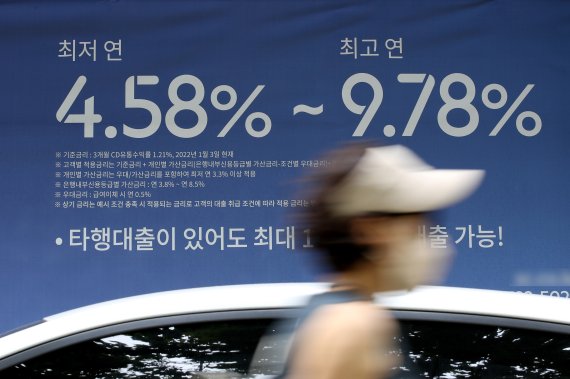
According to the financial sector, the fixed-rate 5-year mortgage loan rates at the five major banks — KB Kookmin Bank, Shinhan Financial Group (Shinhan), Hana Bank, Woori Bank and NH NongHyup — were recorded at 4.25% to 7.11% as of the 28th. The lower end of mortgage loan rates at some banks has already exceeded 5%. If rate hikes begin in earnest, the upper end of mortgage loan rates could approach 8%.
The problem is that borrowers who took out variable-rate mortgage loans with heavy leverage may be hit first by the rate shock. Borrowers who invested with borrowed money will also face a heavier interest burden. With unsecured loan rates at banks also rising across the board into the mid-to-high 5% range, there are concerns that if stock market volatility expands as well, borrowers could face a double burden of rising interest costs and investment losses at the same time.
[email protected] Kim Hee-sun Reporter