Ji Ye Eun says, "Even 0.1 cm can spread" ... Why thyroid cancer is feared [Health Talk]
- Input
- 2026-05-29 05:49:50
- Updated
- 2026-05-29 05:49:50

[Financial News] Actress Ji Ye Eun has revealed that she once battled thyroid cancer. Thyroid cancer is known for having a good prognosis, but size alone does not determine how dangerous it is. If changes such as a lump in the neck, hoarseness, or difficulty swallowing continue, it is important to get tested.
Ji Ye Eun speaks about thyroid cancer
In episode 5 of Netflix's variety show "Yoo Jae-suk Camp," released on the 26th, Yoo Jae-suk told Ji Ye Eun, "You're fully recovered now." Ji Ye Eun replied that she had regained her health, saying, "I'm really fine." She then added, "They said even 0.1 cm can spread. But I was told I had quite a lot of cancer." She was referring to the period when she was diagnosed with cancer after also dealing with hypothyroidism.
What kind of disease is thyroid cancer?
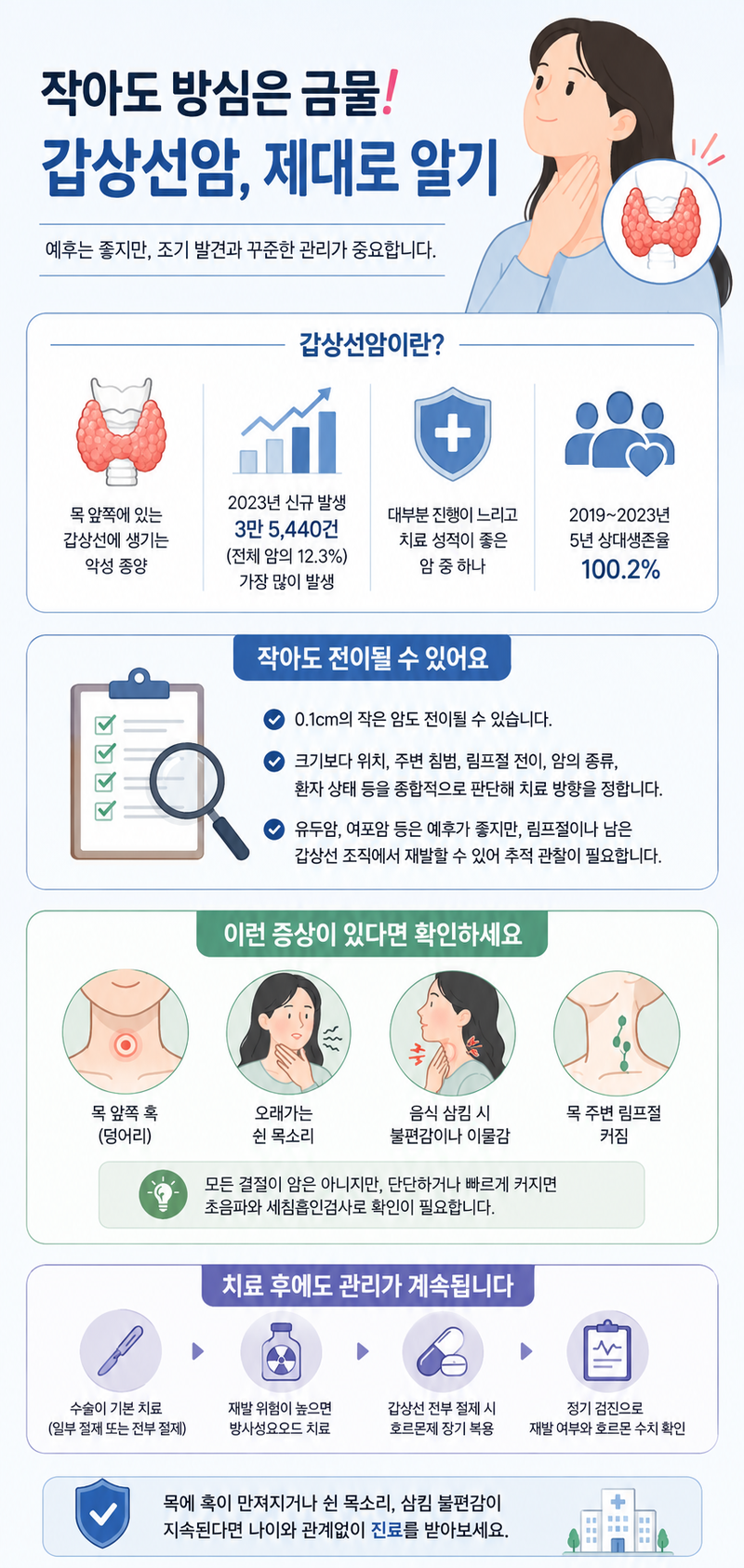
The thyroid is a butterfly-shaped organ at the front of the neck. It produces thyroid hormone, which helps regulate metabolism and body temperature. A malignant tumor that develops there is called thyroid cancer.
According to the National Cancer Information Center, thyroid cancer accounted for 35,440 of the 288,613 new cancer cases in South Korea in 2023. That was 12.3% of all cancer cases, the highest share.
Thyroid cancer usually progresses slowly and tends to have good treatment outcomes. In data released by KCCR in January 2026, the five-year relative survival rate for thyroid cancer from 2019 to 2023 was 100.2%. However, a high survival rate does not mean treatment or follow-up is unnecessary.
Even small tumors matter if location and spread are involved
Even when thyroid cancer is small, lymph node metastasis can still be found. On the other hand, if the tumor is small and there is no invasion of nearby tissue or metastasis, doctors may choose active surveillance instead of immediate surgery. Treatment decisions are based not only on tumor size, but also on location, invasion of surrounding tissue, lymph node metastasis, cancer type, and the patient's condition.
Papillary and follicular thyroid cancers, which are common types of thyroid cancer, are classified as differentiated cancers. They generally have a good prognosis, but they can recur in lymph nodes around the neck or in remaining thyroid tissue. The National Cancer Information Center also notes that because many thyroid cancer patients survive for a long time, recurrence can appear years later, making initial treatment and follow-up important.
Watch for voice changes and swallowing problems
Thyroid cancer often does not cause clear symptoms in its early stages. It is sometimes found incidentally during health checkups or ultrasound exams. However, if you feel a lump in the front of the neck, if your voice becomes hoarse and does not recover easily, or if swallowing becomes difficult or feels obstructed, it is advisable to seek medical attention.
Not all thyroid nodules are cancerous. Many are benign. But if a nodule feels hard, grows quickly, or is accompanied by enlarged lymph nodes in the neck, it can be evaluated with ultrasound and fine-needle aspiration biopsy.
Care after surgery is essential
Surgery is the standard treatment for thyroid cancer. Depending on the extent of the cancer, doctors may remove part or all of the thyroid. If the risk of recurrence is considered high, radioactive iodine therapy may also be added.
If the entire thyroid is removed, thyroid hormone medication must be taken long term. This is necessary to replace the missing hormone and reduce the risk of recurrence. Even after treatment ends, regular checkups are needed to monitor for recurrence and hormone levels.
If a new lump appears in the neck, hoarseness lasts for a long time, or swallowing discomfort keeps recurring, it is safest to see a doctor regardless of age.
[email protected] Han Seung-gon Reporter