Chipflation Takes a Toll on Smartphone Shipments, Which Are Set to Fall 14% [Aftermath of the Memory Price Surge]
- Input
- 2026-05-28 18:29:00
- Updated
- 2026-05-28 18:29:00
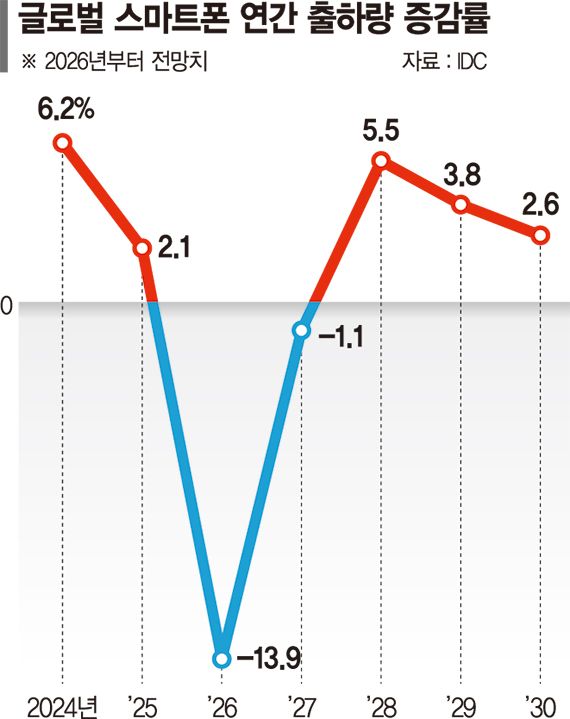
According to market research firm IDC on the 28th, global smartphone shipments are expected to fall 13.9% year on year to 1.09 billion units this year. That would mark the largest annual decline on record. Demand is now projected to weaken even further than the February forecast of a 12.9% drop.
Consumer resistance to purchases is growing because smartphone prices are surging. As memory prices rise on the back of booming demand for artificial intelligence (AI), manufacturers are finding it difficult to lower handset prices.
The year-on-year growth rate in global smartphone shipments is steadily slowing, from 6.2% in 2024 to 2.0% in 2025. Shipments are expected to decline for two straight years through 2027, when they are forecast to fall 1.1%. A rebound is not expected until 2028, when shipments are projected to rise 5.5% as the memory supply shortage eases.
On top of the prolonged shortage of memory semiconductors, higher oil prices and rising transportation costs after the United States–Iran war are adding to cost pressures. The average selling price (ASP) of smartphones is expected to reach $550 this year, a record high.
That is $100 higher than last year. With margins shrinking even when phones are sold, smartphone makers are cutting shipments and shifting their sales strategies away from lower-margin midrange and budget models toward premium devices. In North America, where premium demand is especially strong, smartphone shipments are expected to drop 6.3% this year. Premium models priced above $800 are also expected to account for 60% of all smartphone shipments in the first quarter.
The outlook is also diverging among smartphone makers. Samsung Electronics, which has a high share of premium products such as the Samsung Galaxy S and Samsung Galaxy Z Fold, is seen as having an opportunity to expand its market share. Its strengths are considered to include stable memory supply capabilities, a stronger Samsung Galaxy S26 lineup, and an aggressive position in the midrange and budget segment. Apple Inc. is also expected to cushion the decline in shipments, supported by strong sales of the iPhone 17 series in major global markets, including China.
Even amid the overall market slump, foldable phones are expected to grow 20% this year from a year earlier. That is because Apple Inc. is preparing to enter a market that has so far been dominated by Samsung Electronics and Chinese manufacturers. Apple is set to launch its first Foldable iPhone in the second half of this year. In response, Samsung Electronics will hold Galaxy Unpacked in July, its event for new mobile products, where it will unveil next-generation foldable phones such as the Samsung Galaxy Z Fold 8 and Galaxy Z Flip 8, as well as new form factors including the wider Galaxy Z Fold 8 Wide.
[email protected] Jang Min-kwon Reporter