Growth Forecast Raised to 2.6% This Year as Shin Hints at July Rate Hike [BOK Signals Rate Increase]
- Input
- 2026-05-28 18:28:58
- Updated
- 2026-05-28 18:28:58
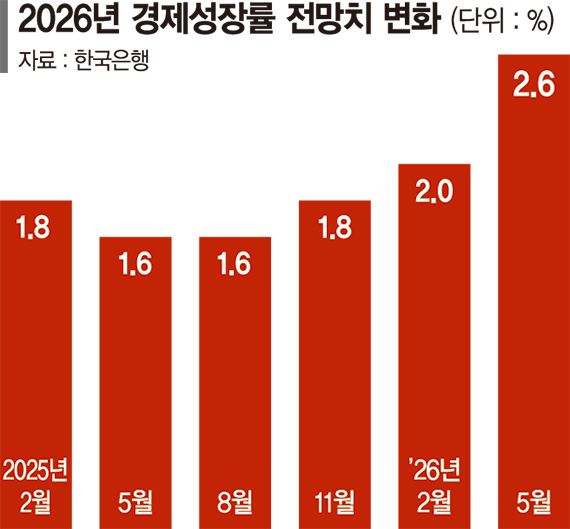
On the 28th, the Bank of Korea revised its forecast for this year's economic growth to 2.6%. That is 0.6 percentage point higher than its February projection of 2.0%. Since last August's 1.6% estimate, the forecast had been raised by 0.2 percentage point in November and again in February. This time, the increase was three times larger.
The upgrade was driven by stronger information technology export momentum, led by semiconductors. Of the upward revision, IT exports contributed 0.7 percentage point, more than offsetting the 0.4 percentage point drag from the Middle East crisis. Government measures, including the supplementary budget, added 0.2 percentage point, while the stock market rally contributed another 0.1 percentage point.
By expenditure, net exports were the clear leader, contributing 0.85 percentage point. In particular, the current account surplus for this year was estimated at $250 billion, about 1.5 times the previous forecast of $170 billion. The revision reflects stronger semiconductor exports and an increase in foreign visitors.
Looking at the components of real gross domestic product (GDP), the growth forecast for goods exports stood at 4.9%. That is more than 2.3 times the previous estimate of 2.1%. Facility investment was raised from 2.4% to 4.4%, while private consumption was lifted from 1.8% to 2.0%. Construction investment was cut by 0.4 percentage point from 1.0%.
A BOK official explained, "In the second quarter, despite the impact of the Middle East crisis and the base effect from the previous quarter, semiconductor exports remain solid, and government policies such as the supplementary budget, along with corporate responses such as inventory use, will cushion the shock and support 0.2% growth." Growth forecasts for the third and fourth quarters were projected at 0.0% and 0.4%, respectively.
The growth forecast for next year was also raised to 2.1% from the previous 1.8%. However, downside risks to growth were cited, including prolonged high oil prices and tightening by major economies, investment adjustments over concerns about the profitability of Artificial Intelligence (AI), and U.S. tariff policy.
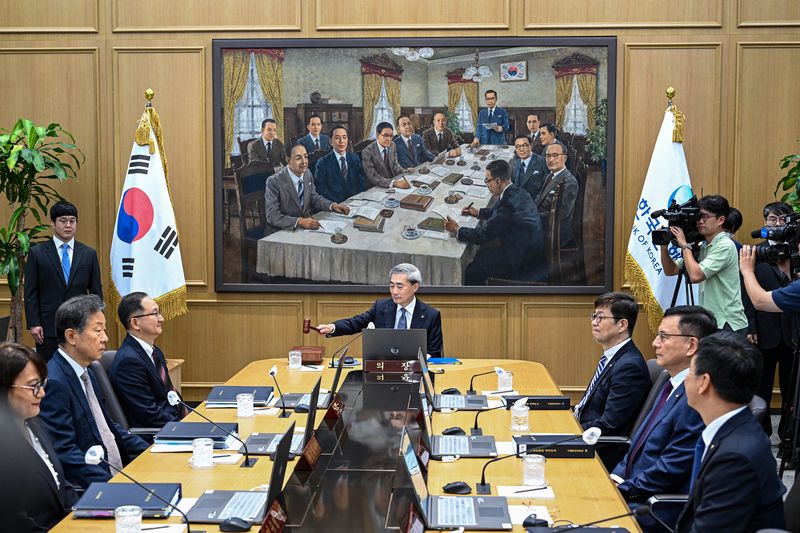
Even with this stronger growth outlook adding to the case for monetary tightening, the Monetary Policy Board kept the benchmark rate at 2.50% a year. The rate has now been frozen for eight straight meetings since it was lowered to 2.50% in May last year.
Hyun Song Shin said, "The timing and pace of any rate increase will be decided by reviewing the extent of upward inflation pressure and the pace of economic improvement, based on incoming data." Markets are viewing July, when the next Monetary Policy Board meeting is scheduled, as the earliest possible time for a hike.
[email protected] Kim Tae-il Reporter