The United States launches another airstrike on Iran during ceasefire talks, hitting again three days later
- Input
- 2026-05-28 11:14:35
- Updated
- 2026-05-28 11:14:35
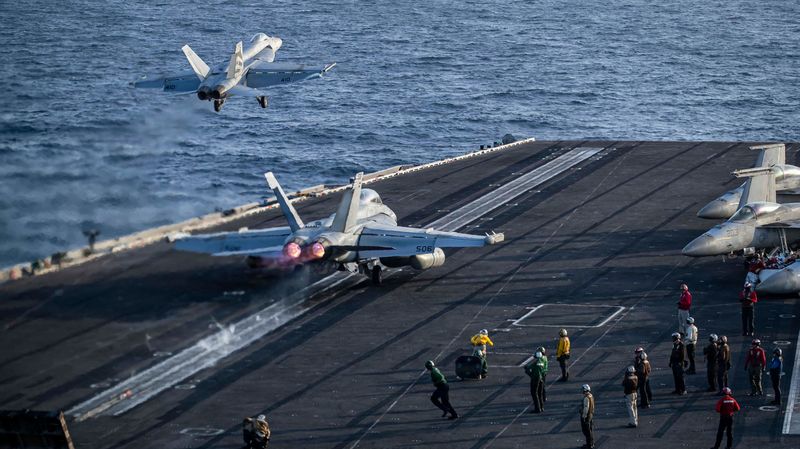
[Financial News] The United States, which has been struggling in ceasefire talks with Iran, struck southern Iran again three days later. The U.S. said the ceasefire had not been broken, while Iran warned that it would retaliate if provoked before the latest attack.
Fox News and other U.S. media outlets reported on the 27th local time, citing U.S. government officials, that the U.S. military had struck one Iranian military facility near the Strait of Hormuz and shot down four Iranian attack drones. Iranian media later reported that at 1:30 a.m. on the 28th, three explosions were heard east of Bandar Abbas in southern Iran, which borders the Strait of Hormuz, and that Iran's air defense systems were activated for several minutes afterward.
A U.S. official said the target was a ground forces control center near Bandar Abbas and claimed Iran had been preparing to launch a fifth drone. He stressed that the Iranian drones had threatened U.S. forces near the Strait of Hormuz and shipping through the waterway. The official said the action was defensive and restrained, and that its purpose was to preserve the ceasefire. Another U.S. official who spoke to CBS also said the ceasefire had not been broken despite the attack.
The United States and Iran, which entered a ceasefire on the 8th of last month, had already clashed near the Strait of Hormuz on the 7th. In a statement released on the 25th, United States Central Command (CENTCOM), which oversees U.S. operations against Iran, said it had struck an Iranian minelaying vessel and missile launchers in southern Iran for "defensive purposes."
Iran threatened retaliation after the airstrike on the 25th, saying the attack violated the ceasefire agreement, but no actual retaliation has been confirmed. Ali Naderi, deputy head of publicity for the aerospace force of the Islamic Revolutionary Guard Corps (IRGC), delivered a warning on Iranian state broadcaster Islamic Republic of Iran Broadcasting (IRIB) on the 27th, just before the U.S. strike. He said, "If the enemy resumes military action, it will face a powerful response unlike anything it has experienced before," adding, "You will see Iran's new combat power on the battlefield." Naderi also said, "Just as the enemy misjudged Iran's missile and drone capabilities, the belief that those capabilities have weakened is also wrong," and explained that "our production lines are now operating at a higher level than before."
U.S. President Donald Trump spoke about the ongoing ceasefire talks to end the war with Iran during a Cabinet meeting at the White House on the 27th. He said, "So far, they have not reached a level that satisfies us."
Trump said Iran wants a deal and added, "It will either happen that way, or we will just have to finish the job." He claimed Iran had lost its military power, saying, "They are negotiating from a position of exhaustion." At the same time, he said, "We will have to see what happens. Maybe we will have to go back and finish it, or maybe we won't need to right now." Earlier, after the war began in February and Iran blocked the Strait of Hormuz, Trump escalated his threats from March until the ceasefire. He claimed he could destroy civilian infrastructure, including Iran's power grid, but has not carried out those threats yet.
[email protected] Park Jong-won Reporter