"A leveraged all-in bet can wipe you out in one shot"...Why 20-something retail investors are being liquidated, and what sets surviving investment veterans apart [In Chi-beom's Stock Investment Boot Camp]
- Input
- 2026-05-30 09:00:00
- Updated
- 2026-05-30 09:00:00

Now ask yourself a question.Are you someone who wants to make money from stocks, or someone who wants to survive to the end and manage the money you have earned? The two may look similar, but they are entirely different. Once you understand that difference, your attitude toward investing will begin to change as well. That is a line from the film The Scam. "In the South Korean stock market, people who come in with money alone are always bound to get crushed."
[Financial News]"Since you're already in, try to hold on somehow."..."We're all still incomplete."That line comes from the still-popular drama Misaeng: Incomplete Life. In go terminology, misaeng refers to a stone that can still live or die. It is neither a dead stone, called saseok, nor a fully alive stone, called wanseong. That is how I see people in their 20s who have entered the stock market. Most of them come in with little money and limited experience. Does a silver spoon who inherited a large fortune go straight to becoming fully complete? For young investors just entering the market, I do not think the size of their money is what matters.
What matters is years of asset-management experience and the ability to survive in the market that you have built over time. Whether you start with little money or a lot, the result is the same if you fail in the market. Whether you invest 50,000 won or 500 million won, one big collapse can drive both balances to zero. The most important thing in investing is not a short-term windfall. It is staying alive long enough to succeed, while building up experience and knowledge until the time comes to take a calculated risk with enough capital.
Stock investing was originally a tool for asset management
Our original wealth-building structure was simple. First, earn money. Second, spend part of it to live. Third, store what remains. Stock investing belonged to that third category. In other words, it was a matter of management: after earning money and covering living expenses, how should the remaining assets be preserved and grown? Stocks were one of the tools for asset management, alongside deposits, bonds, foreign exchange, and real estate.But the way many people think about stock investing today is completely different.

"Earn money and then invest in stocks" vs. "Make money by investing in stocks"
In short, for many people, stocks have become not a tool for asset management, but a way to make money. It is no longer "earn money and then invest in stocks," but "make money by investing in stocks." They no longer see stocks as a way to manage what remains after spending income earned through work or business. Instead, they treat them as a profit-making activity in themselves. By that logic, it is not even strange to start investing with leverage, even without assets.The problem begins there. People use the same term, "stock investing," but they are talking about completely different things. One person sees stocks as asset management, a way to protect and grow what is left. Another sees them as a one-shot chance to change life. The term is the same, but the concept is entirely different. It is a classic case of two people dreaming different dreams under the same roof.
Of course, wanting to make a lot of money from stocks is not wrong in itself. In the market, there are indeed some people who make large sums in a relatively short time thanks to fast information, sharp judgment, and a high tolerance for risk. But once that happens, stocks essentially move into the realm of profit-seeking activity. Some even approach stock investing like buying lottery tickets or playing games. In that case, stocks become a kind of game, like horse racing, boat racing, or bicycle racing, and you have to accept high risk and volatility.
The foundation of asset management: preserving the value of my money
So what is the foundation of asset management when you invest part of your earnings in stocks? Before "getting rich," the foundation of asset management is making sure the value of your money does not erode over time. Cash cannot beat inflation. Something you could buy for 50,000 won today may cost two or three times as much 10 years from now. In fact, Shin Ramyun, which cost about 780 won in 2016, has risen to 1,000 won, an increase of 28%. Annual university tuition has climbed from about 6.675 million won to about 7.273 million won, up 8%, or 600,000 won. What about transportation? Seoul's base taxi fare has jumped from 3,000 won to 4,800 won, a 60% increase, or 1,800 won. Seoul apartment prices have risen even more. The average sale price has surged from about 554 million won to 1.554 billion won, nearly tripling. The rise in Seoul apartment prices has been explosive. That is why we need asset management to preserve the value of our money. In the end, asset management means holding money not as cash, but as assets such as deposits, stocks, bonds, and ETFs, so that its value stays ahead of inflation.
Survival during the asset-management period is the best strategy
Seen this way, investing is not simply about making money grow. It is about experiencing the market, enduring risk, managing failure, and ultimately learning how to survive. In his book The Intelligent Investor, Benjamin Graham defined investing as "an operation which, upon thorough analysis, promises safety of principal and an adequate return."So stock investing is better understood as a tool for protecting and growing money, rather than merely a means of making money.
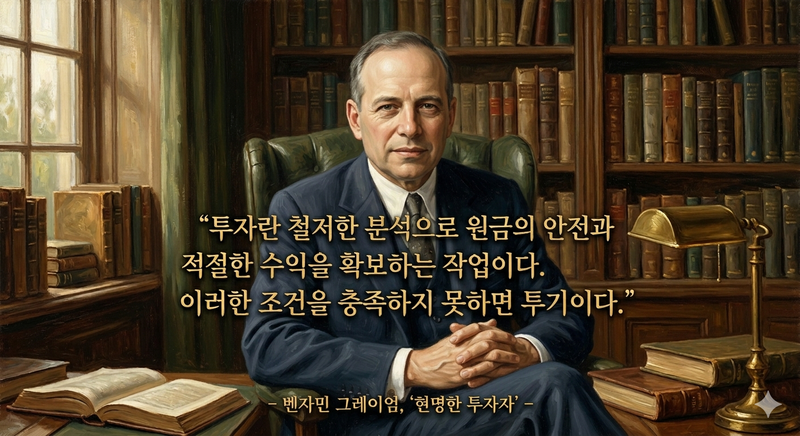
People who have spent a long time in the market can move properly when opportunity comes. They can attempt what is known as a calculated risk. On the other hand, what about those who tried to make money from stocks and collapsed early on because of excessive leverage and frequent speculation? More often than not, they are no longer in the market when the real opportunity arrives.
Will you become rich, or will you stay rich?
Howard Marks, founder of Oaktree Capital Management, has repeatedly said in interviews and lectures that "the concept of surviving on average means nothing. You have to survive every day, which ultimately means surviving even on the worst days in the market, when it crashes."To strengthen your resolve, here are three more pieces of advice from experts. Investment legend Peter Bernstein emphasized, "In general, surviving is the only road to wealth. Let me say that again: survival is the only road to wealth." Warren Buffett compared the importance of surviving the market to car racing in his 2010 shareholder letter. He said, "To finish first, you must first finish the race."
In The Psychology of Money, author Morgan Housel says that "getting wealthy and staying wealthy are different skills." He advises that the most important thing in investing is not an extraordinary return, but the ability to stay in the market.

Now ask yourself again: are you someone who wants to make money from stocks, or someone who wants to survive to the end and manage the money you have earned? The two may look similar, but they are entirely different. Once you understand that difference, your attitude toward investing will begin to change as well. That is a line from the film The Scam: "In the South Korean stock market, people who come in with money alone are always bound to get crushed." Stay in the market long enough to succeed, and build up experience, knowledge, and capital so that you can achieve truly meaningful results.
[About the author]
Executive Director In Chi-beom worked for 30 years in corporate communications, including finance at Samsung Life Insurance, IT at AhnLab, Hancom, and SK Communications, and retail at Samsung Tesco, consistently serving as the head of PR, IR, ESG, and CSR. He is currently focused on writing books on investing and corporate communications at KPI Investment Advisory. He believes that success in stock investing begins above all with automating the right habits for handling money.
[email protected] Kim Seong-hwan Reporter