KOSPI Surges, Expanding the Market Size... Domestic Equity Funds Reach 250 Trillion Won in Net Assets
- Input
- 2026-05-27 18:11:05
- Updated
- 2026-05-27 18:11:05
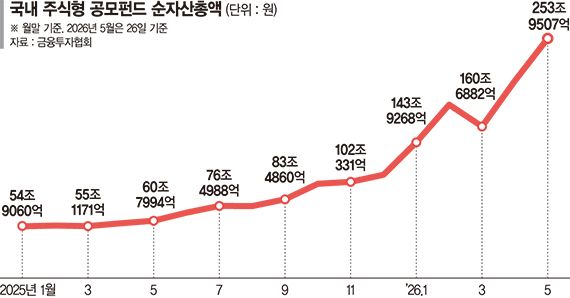
According to the Korea Financial Investment Association (KOFIA) on the 27th, the total net assets of domestic public offering funds stood at 649.0643 trillion won the previous day. That was an increase of more than 67.3715 trillion won, or 11.6%, so far this month.
Net assets refer to the value of assets held in a fund, such as stocks and bonds. They rise when inflows increase and when the value of underlying assets goes up. Equity funds, in particular, showed strong growth. As of the previous day, the net assets of domestic equity public offering funds reached 253.9507 trillion won, up 44.8998 trillion won, or 21.5%, this month alone.
The net asset size of domestic equity funds jumped by more than 100 trillion won in just over four months, from 143.9268 trillion won in January. Compared with the end of May last year, when it stood at 60.7994 trillion won, the figure has swelled by more than 190 trillion won.
The domestic equity public offering fund market has maintained a steep growth trend since the second half of last year, when the KOSPI rose sharply. After crossing 100 trillion won in net assets for the first time on Nov. 3 last year, it surpassed 200 trillion won on the 22nd of last month, just five and a half months later. Compared with overseas funds, the growth has been even more striking. So far this year, net assets in domestic equity public offering funds have jumped 131.8%, far outpacing the 39.8% increase in overseas equity public offering funds.
Brokerage analysts expect the domestic stock market to keep rising, supported by the semiconductor boom driven by artificial intelligence, despite external uncertainties. They say valuations remain attractive because stock prices have not kept pace with the upward revisions in earnings forecasts. Jo Chang-min, a researcher at HYUNDAI MOTOR SECURITIES CO., LTD., said, "KOSPI earnings forecasts are being revised upward sharply, and although semiconductors account for a large share, it is not yet a cause for concern." He added, "The KOSPI's 12-month forward price-earnings ratio (PER) is 7.77 times, near an all-time low, so even applying the historical average valuation makes a move to 10,000 points possible."
Lee Jae-won, a researcher at Yuanta Securities Korea Co., Ltd., also said, "Negative factors such as war will only act as volatility in the broader trend, and the stronger expectation is that they will eventually be resolved, so the KOSPI's upward trend will remain solid." He added, "If external variables also end on a favorable note, exchange-rate volatility will ease, and that would be enough to expect foreign capital inflows."
Key variables include the U.S. stock market, Treasury trends, and a slowdown in the semiconductor industry. Kang Dae-seung, a researcher at SK Securities, said, "U.S. stocks are the benchmark for global risk assets, so if a correction occurs there, Korea could fall as well." He added, "If expectations for the AI capital expenditure cycle fade or the semiconductor industry slows, downward revisions to Earnings Per Share (EPS) and a rise in PER could happen at the same time, quickly increasing valuation pressure."
He also noted, "If the yield on the 10-year U.S. Treasury note breaks above 5%, the appeal of bond investments would increase, and downward pressure on equities overall could intensify."
Meanwhile, bond funds continue to lag. As of the previous day, the amount of domestic bond fund subscriptions stood at 83.2654 trillion won, remaining in the 80 trillion won range since mid-December last year. Bond funds were in the 100 trillion won range as recently as October last year, but as the bond market has weakened, their size has also been on a downward trend.
[email protected] Seo Min-ji Reporter