The bonus war that shook South Korea: Where did empathy, fairness and sharing go? [News analysis from the editorial desk]
- Input
- 2026-05-27 18:08:10
- Updated
- 2026-05-27 18:08:10
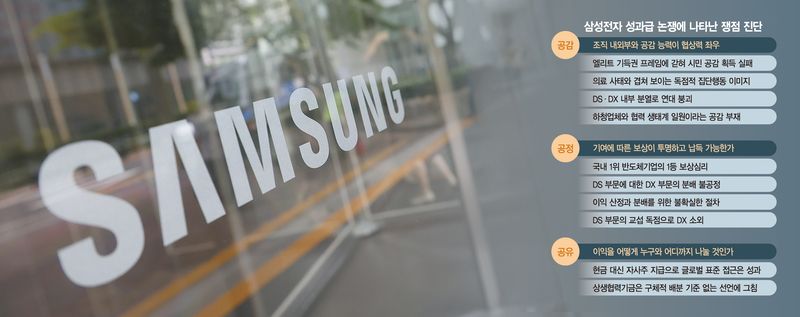
The issue has now moved beyond Samsung Electronics and is spreading into a broader debate over distribution across South Korean society. The second half has already begun. That is why a sober analysis and a serious look at the challenges facing all stakeholders are needed.
■"There is only 'my side,' not 'our side'"
When a union demands bonuses and exercises its right to strike, it is making legitimate use of labor rights guaranteed by the Constitution. If a union is asserting its rights in its own workplace, outsiders may not welcome being told what to do or being lectured from the sidelines. Still, because Samsung Electronics is seen as a flagship company, public opinion cannot be ignored. Empathy with multiple stakeholders drives the battle for public support.
The recent medical crisis comes to mind. The clash between the government and the medical community over increasing medical school enrollment triggered nationwide turmoil. Separate from whether the enrollment dispute was justified, public opinion viewed the medical community with suspicion, seeing elitism and a desire to protect vested interests. The image of a group using its monopoly position to protect its own share failed to win social sympathy. Samsung Electronics labor union also became trapped in a frame that portrayed it as an elite vested-interest group with exclusive power. Its collective action, backed by the threat that "the company's production lines cannot run without us," failed to win public empathy.
The more allies a group has who share both its motives and its cause, the easier it is to win sympathy. Samsung Electronics labor union took a path different from that of conventional unions. Traditional labor movements usually put livelihood protection first in negotiations. They do not normally push demands beyond what society considers acceptable. Existing unions also use solidarity as a bargaining advantage. Beyond their own interests, they invoke the rights of non-regular workers, subcontracted workers, or socially vulnerable groups. That form of solidarity has drawn criticism for politicizing unions, but it has helped them avoid the isolation that comes from collective self-interest.
The fact that Samsung Electronics has split into two camps under one roof also helped fuel the conflict. Even if employees from DS and DX had formed a united front, their bargaining power would still have been limited. Instead, they were consumed by infighting. At one time, employees at Samsung affiliates looked up to Samsung Electronics and even belittled themselves as being in the lower ranks of Samsung. Now DS sits at the top of that hierarchy. As family members turned against one another, solidarity disappeared, leaving only internal conflict within Samsung. The interests of the thousands of suppliers and subcontracted workers that support Samsung's ecosystem were never on the bargaining table in the first place.
■A divided view of fairness
The basic principle behind sharing profits is meritocracy. But conflict arises because the standards used to judge individual ability vary. The bonus dispute at Samsung Electronics is a textbook example.
Distributional fairness is not simply about how much I received. If I feel that the compensation I received for my contribution to the company is lower than what others got, strong dissatisfaction follows. That is a core idea in Equity Theory. In this sense, the real comparison for the DS union was outside the company. It is highly plausible that the talk of a 10% bonus tied to operating profit at SK hynix triggered Samsung Electronics' own bonus dispute. Pride was at work: why should the No. 1 company, Samsung Electronics, receive less than the No. 2 company, SK hynix?
The sense of relative deprivation in the DX Division is even greater. Corporate management does not run on a single year's profit and loss. There was a time when profits generated by DX supported investment and operations while DS was struggling with losses. Different business units, but one legal entity. That is where the argument for DX employees claiming equal entitlement to share in profits begins. But the real negotiation table is unforgiving. Bonuses are distributed to those who contributed, based on the money earned this year. At that point, any sense of common ground between DS and DX collapses.
The decision-making process within Samsung's organizational culture also deserves a hard look. The union focused on the lack of transparency in how company profits were generated, how much they amounted to, and what standards were used for distribution. This refers to Samsung Electronics' bonus calculation method, Economic Value Added (EVA). Employees say they cannot see how EVA is calculated and are simply informed of the result, which is why they call it "black-box EVA." If that criticism is persuasive, then the union's demand for a 10.5% share of operating profit cannot be dismissed outright. People are often more upset about procedural unfairness than about receiving less than others.
While management was criticized for a lack of transparency, the DS union cannot escape criticism either, as it monopolized the bargaining process and violated procedural norms. As the super-enterprise union centered on DS, the largest organization within Samsung Electronics, led the talks, the sense of exclusion felt by DX employees left a deep wound.
■Why and how much should be shared?
The Samsung Electronics bonus dispute reached its peak over the method of sharing profits.
At the start of negotiations, it seemed bonuses would be paid in cash. In the end, the tentative agreement opted to pay part of the bonus in company stock and restrict its sale for a certain period. Cash payments are the norm for bonus systems at domestic companies. But short-term cash rewards have many side effects. Employees tend to focus on quarterly results just to secure this year's cash payout. By contrast, global big tech companies often pay bonuses in company stock rather than cash. They also tie bonuses to the achievement of difficult sales targets. Such compensation systems are seen as effective for a company's long-term value because they create the sense that management and labor are in the same boat, working for the company's growth. The tentative agreement reached at the last minute by Samsung Electronics management and labor adopted this type of compensation, so it did not stray from global standards.
The issue of sharing bonuses between management and labor was settled at a compromise level, but a larger challenge remains: sharing with outside stakeholders. A prime example is the "Mutual Growth Cooperation Fund" included in the agreement. This fund was inserted into the deal during mediation by the Minister of Employment and Labor. Yet there are no concrete details about it. Another round of debate is likely to emerge over how profits will be allocated among suppliers and which subcontractors will benefit.
■The road to balancing performance and distribution is still long
The Samsung Electronics bonus dispute has left society with many unresolved tasks.
First, there is the challenge of breaking away from the mix of seniority-based pay and performance-based pay. Because the two principles have been blended into custom, the standards for calculating bonuses have expanded and contracted like a rubber band. Companies present themselves as global players and emphasize performance-based rewards, but when it comes time to distribute the money, egalitarian calls to share it equally resurface. Establishing transparent personnel evaluations and compensation standards is urgent.
The criteria for measuring individual contribution are also vague. The golden rule of capitalism has been that "you are rewarded in proportion to your contribution." But there are many ways to interpret that phrase. Meritocracy is often seen as the result of a person's ability, parental support, and luck combined. Apply that formula to Samsung Electronics. The contribution to profits is a joint product of the efforts of skilled employees, state support for semiconductor policy, and the boom in AI demand. Yet some union members at Samsung Electronics will see individual skill as the main source of profit. The gap in how stakeholders view profit contribution is simply too wide.
It is also time to confront the debate over profit sharing in the age of Artificial Intelligence. As AI replaces human labor and boosts efficiency, concepts such as a "Basic Society" and a "Benefit-sharing model" are coming to the surface. These ideas are still unfamiliar, and related legislation has repeatedly failed. But the question of who should share in the productivity gains created by AI, and how, will only grow louder. The Samsung Electronics bonus dispute is a preview of that much larger debate.
In the end, sharing the gains requires growth. Distribution without growth leads to nihilism. How many companies can steadily generate trillions of won in operating profit every year and then share 10% of that as a large bonus pool for employees? In South Korea, there are only about 30 companies in the 1 trillion won operating profit club each year. Most of them see results swing with the business cycle. Moreover, even when profits are high, a large workforce shrinks the per-person share. In practical terms, only Samsung Electronics and SK hynix can afford to hand out bonuses worth hundreds of millions of won. The whole country may have been excited by the Samsung Electronics bonus dispute, but for most office workers it remains a mirage.
[email protected] Reporter