Hyundai Motor Company and Kia Stall in Europe in April, Losing Share to Chinese Brands
- Input
- 2026-05-27 15:44:27
- Updated
- 2026-05-27 15:44:27
■ Hyundai Motor Company down 7.8%, Kia up 2.8%... EVs drive the split
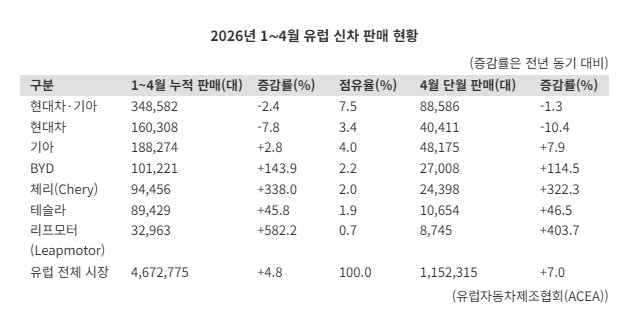
According to the European Automobile Manufacturers' Association (ACEA) on the 27th, Hyundai Motor Company and Kia sold 348,582 vehicles in Europe from January to April, down 2.4% from the same period last year. Their combined market share fell to 7.5%, down 0.5 percentage point from a year earlier.
The two brands showed sharply different results. Hyundai Motor Company sold 160,308 units in the four-month period, down 7.8%, and its market share fell 0.5 percentage point to 3.4%. Kia, by contrast, sold 188,274 units, up 2.8%. Its market share stood at 4.0%, down only 0.1 percentage point.
The gap was even clearer in April alone. Kia sold 48,175 vehicles, up 7.9% from a year earlier, while Hyundai Motor Company sold 40,411, down 10.4%. Hyundai Motor Company, which had rebounded late in the first quarter, returned to double-digit declines once the end-of-quarter push effect faded.
Electric vehicles were the key factor behind the diverging fortunes of Hyundai Motor Company and Kia. Lee Ho-geun, a professor in the Department of Future Automotive Engineering at Daedeok University, said, "Kia's EV2 has seen sales expand to nearly 10,000 units in just over two months, raising expectations for annual sales of 50,000 to 60,000 units, but Hyundai Motor Company is in a relatively difficult position." He added, "Performance such as acceleration and driving has generally become standardized, so lineup differentiation is now more important."
The broader European market, meanwhile, showed solid growth over the same period. New vehicle registrations in the European Union (EU) rose 4.2% year on year to 3,794,280 units from January to April. Demand for eco-friendly vehicles supported the market. Hybrid vehicles remained the most preferred powertrain, with a 38.2% share, and battery electric vehicle (BEV) share climbed sharply to 19.7% from 15.3% a year earlier. By contrast, the combined share of gasoline and diesel vehicles fell to 30.2% from 38.1%.
■ BYD up 143%, Chery Automobile up 338%... Pressure from Chinese cars becomes reality
Hyundai Motor Company and Kia's stagnation is drawing attention because it reflects structural pressure tied to the rise of Chinese brands rather than a simple market slowdown. BYD sold 101,221 vehicles in Europe from January to April, up 143.9% from a year earlier, while Chery Automobile jumped 338.0% to 94,456 units. Leapmotor also surged 582.2% to 32,963 units.Tesla also rebounded, with sales rising 45.8% to 89,429 units over the same period. Hyundai Motor Company and Kia still lead in absolute volume, but the sharply different growth trends are fueling concerns that their market share could be eroded over the medium to long term.
Cho Cheol, a senior research fellow at the Korea Institute for Industrial Economics & Trade (KIET), said, "With European EV sales up about 30% in the first quarter and Chinese brands growing especially fast, Hyundai Motor Group is being pushed back." He added, "European consumers see Hyundai Motor Company as the brand most similar to Chinese cars, so China's rise is having a direct impact." He also noted, "Some brands, such as SAIC Motor, are being affected by the European Union's countermeasures, but BYD is not being held back very effectively. It is not easy to stop Chinese cars without tariffs at the level of the United States."
The outlook for this year is not bright either. Lee said, "It is hard to catch up on value for money, and China has also advanced in manufacturing technology, so a sharp strategy such as building service networks or adding local production bases is needed." He added, "They are not being overtaken because of a clear performance gap, but the rest of this year and next year could be even more difficult."
Cho said, "The immediate task is not to expand production capacity, but to build competitiveness against Chinese brands." He added, "The company needs to move in a direction that raises brand value, but differentiation is not easy because the perception has taken hold in Europe that Chinese cars offer more high-spec features."
[email protected] Kim Dong-chan Reporter