OpenAI, as a Korean partner, helps build cybersecurity systems
- Input
- 2026-05-27 14:35:33
- Updated
- 2026-05-27 14:35:33
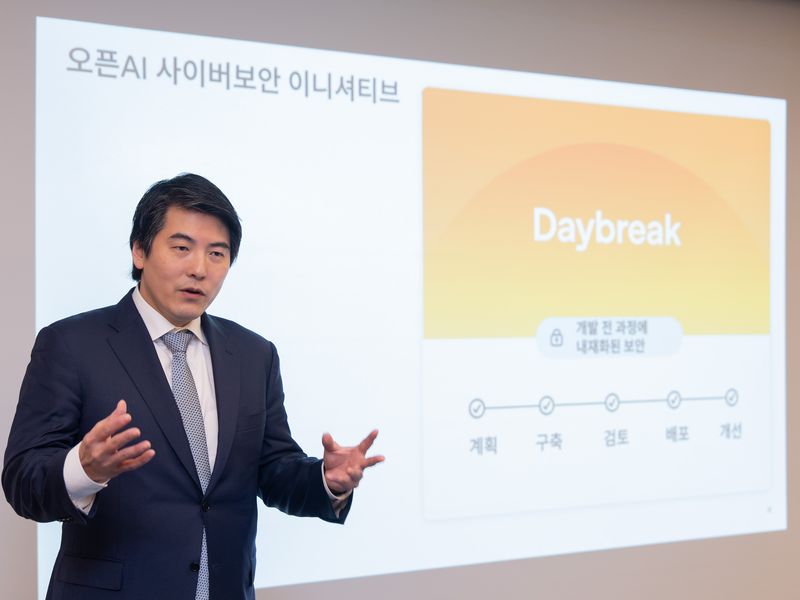
[Financial News] OpenAI has formed a cybersecurity partnership with the Korean government and will provide access to its latest security-focused artificial intelligence (AI) models. As AI technology advances and cybersecurity becomes increasingly important, Korean government agencies and companies are expected to strengthen their in-house security capabilities through this collaboration.
At a meeting in Seoul's Seocho-gu on the 27th, Jason Kwon, Chief Strategy Officer (CSO) at OpenAI, said, "Rather than keeping advanced cybersecurity capabilities in the hands of a few, we launched Daybreak so trusted defenders can secure their systems." He added that the initiative would help broaden access to such capabilities.
The cybersecurity initiative Daybreak, unveiled by OpenAI last month, goes beyond the traditional approach of finding and fixing vulnerabilities. It aims to strengthen cyber defense capabilities from the software design stage.
The effort is similar to Project Glasswing, a cybersecurity framework centered on responding to Anthropic's Mythos, which has been rolled out for U.S. companies. South Korea had sought to join Project Glasswing, but the effort faced difficulties because the program was run in a closed manner centered on the United States.
When asked how Daybreak differs from Project Glasswing, CSO Kwon emphasized that OpenAI can offer broader access in terms of its computing capabilities.
Korean government agencies and companies are expected to begin building full-scale cyber defense capabilities by participating in the OpenAI Korea Cyber Action Plan, which is part of Daybreak.
Specifically, under the plan, Korean government ministries, public institutions, and companies in key industries will take part in the Trust Anchor Certificate Program (TAC). In particular, the Korean government, together with Japan, became the third to join GTAC, the government-focused TAC program, after the United States and Canada. Discussions are now under way for participation by European countries.
Kwon explained, "We will demonstrate the latest cybersecurity-focused models to government officials and expand access to those models for qualified institutions and authorities." He added, "The plan also includes expanding the TAC program to major companies that handle core national industries." However, the companies participating in TAC from the private sector have not yet been disclosed.
Beyond cybersecurity, OpenAI is expanding its cooperation with domestic institutions in areas such as public infrastructure, policy finance, and corporate innovation.
On the 26th, it signed a memorandum of understanding on global climate change and disaster response cooperation with K-water and agreed to jointly review the use of AI in water management and the establishment of an intelligent water disaster response system. It also signed a memorandum of understanding for mutual cooperation to revitalize the AI ecosystem with KOTEC, agreeing to support the growth and innovation of domestic AI startups, including by building an AI-based technology evaluation system.
Meanwhile, according to OpenAI, domestic use of its coding tool, OpenAI Codex, is rising rapidly. Weekly active users in South Korea have increased tenfold from the beginning of the year, and the country has emerged as one of the top five globally in terms of OpenAI Codex usage and engagement.
[email protected] Juwon Kwon Reporter