OpenAI to Provide South Korea With Its Latest AI Cybersecurity Framework...First in Asia
- Input
- 2026-05-27 11:11:07
- Updated
- 2026-05-27 11:11:07
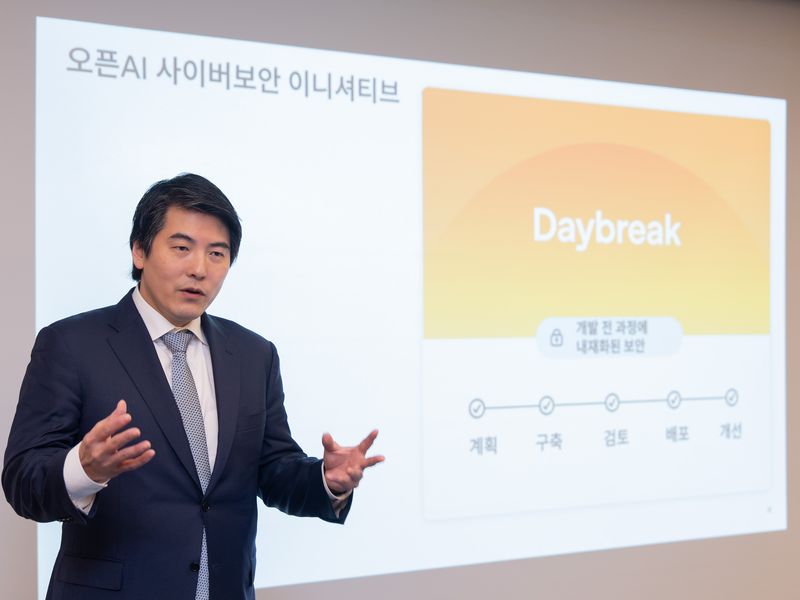
[Financial News] OpenAI said on the 27th that it will launch the "Korea Cyber Action Plan" to help the South Korean government, public institutions, and companies expand access to OpenAI's latest high-performance artificial intelligence (AI) cyber models. South Korea will become the first country in Asia, along with Japan, to join OpenAI's security program for governments and institutions.
At a press conference held on the 27th at JW Marriott Hotel in Seocho-gu, Seoul, Jason Kwon, Chief Strategy Officer (CSO) at OpenAI, said, "The latest cyber AI capabilities should not remain in the hands of a few. Korea's key defense stakeholders should be able to use them to strengthen collective security and public safety." He added, "Through the Korea Cyber Action Plan, OpenAI will work closely with the government, public institutions, and companies to help strengthen Korea's capabilities in cybersecurity."
The Korea Cyber Action Plan is an action program designed to help government agencies, public institutions, and domestic companies gain broad access to Daybreak, OpenAI's cybersecurity initiative and advanced AI-based cyber defense capabilities. Specifically, it includes providing briefings and demonstrations of the latest cyber AI capabilities, expanding access to advanced cyber models for the South Korean government and related public institutions through the Trusted Access for Cyber (TAC) program, and extending the TAC program to major domestic companies that handle key national industries.
OpenAI has formalized the participation of South Korean public institutions in the government-focused TAC program through verification. It also plans to expand the TAC program within South Korea so that major companies in key industries can strengthen their cyber defense capabilities.
OpenAI described this cooperation in cybersecurity as one of the key examples of how advanced AI is being used to solve real-world social and industrial problems in South Korea. In other words, by enabling verified defense entities, institutions, and relevant authorities to access AI models with advanced cyber capabilities on a trust-based basis, it aims to support stronger resilience at the national and institutional levels.
OpenAI also said it is broadening cooperation with domestic institutions not only in cybersecurity, but also in areas such as public infrastructure, policy finance, and corporate innovation, to support social problem-solving and industrial innovation through AI technology. On the 26th, OpenAI signed an MOU with K-water on global climate change and disaster response cooperation to promote AI use in water management and review the development of an intelligent water disaster response system to address worsening water-related disasters caused by climate change. It also signed a Memorandum of Understanding for Mutual Cooperation to Revitalize the AI Ecosystem with KOTEC, agreeing to expand AI use in the public sector by supporting the growth and innovation of domestic AI startups, including through the development of an AI-based technology evaluation system.
Meanwhile, OpenAI said the use of OpenAI Codex, a tool for coding, is expanding rapidly in South Korea. Weekly active users of OpenAI Codex in South Korea have increased tenfold from the beginning of the year, and the country has become one of the top five globally in terms of usage and engagement. In particular, more than half of OpenAI Codex requests in South Korea come from non-development tasks such as document writing, analysis, research, and operations, showing that AI is becoming foundational infrastructure for real work and public services.
[email protected] Juwon Gyu Reporter