"Korean Nuclear-Powered Submarine '40-Year Project' Launched... Wartime Operational Control Transfer Timing to Be Decided in October" [South Korea's Nuclear-Powered Submarine Roadmap Announced]
- Input
- 2026-05-26 18:20:24
- Updated
- 2026-05-26 18:20:24
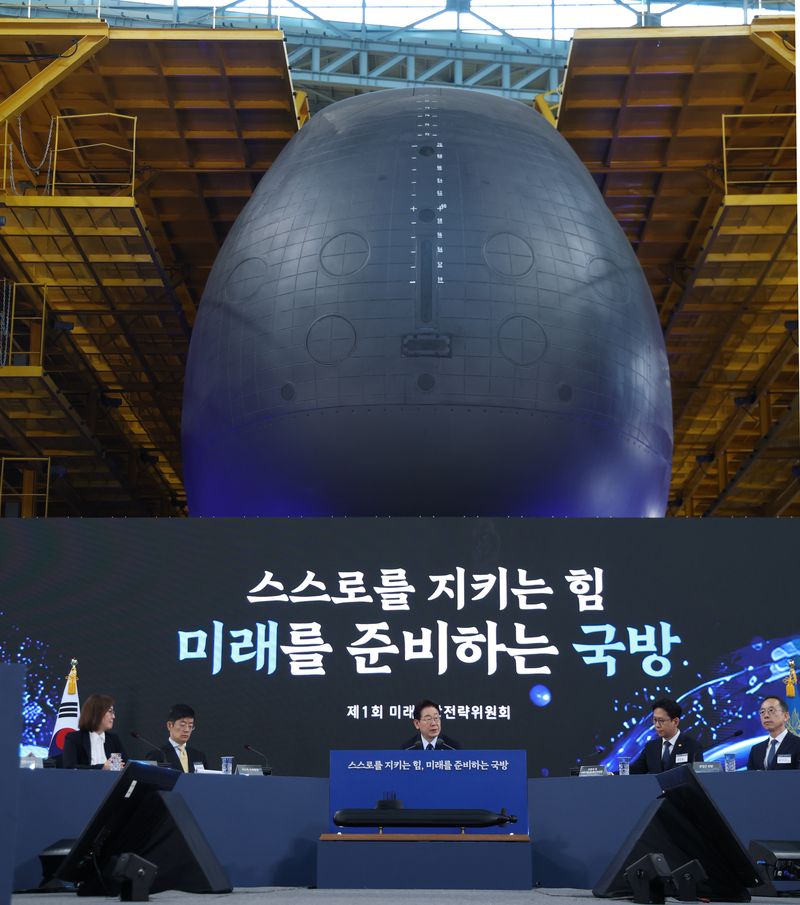
At the meeting on the 26th, President Lee received a report from Defense Minister Ahn Gyu-back on the South Korean nuclear-powered submarine project, named the Jangbogo N Project. The Ministry of National Defense said, "We will launch the first nuclear-powered submarine in the mid-2030s and achieve operational deployment in the late 2030s or later."
The ministry explained that the nuclear-powered submarine program will be pursued as a national industrial development project spanning more than 40 years, linking shipbuilding, nuclear power, and defense. It also expects the project to create more than 40,000 jobs.
Additional working-level negotiations between South Korea and the United States on securing nuclear fuel, the biggest hurdle to introducing nuclear-powered submarines, will begin next month. A kickoff meeting will be held to implement the security-related agreements reached by Lee and U.S. President Donald Trump at last year's South Korea–United States summit. The Joint Fact Sheet (JFS) agreed by the two leaders includes key security consultation items, such as approval for building South Korea's nuclear-powered submarine. Allison Hooker, U.S. State Department undersecretary for political affairs, is expected to lead a U.S. delegation to South Korea in the coming weeks to discuss the details further.
Consultations with the International Atomic Energy Agency (IAEA) on inspecting the low-enriched nuclear fuel to be supplied for South Korea's nuclear-powered submarine have already begun. Rafael Mariano Grossi, the IAEA director general, said publicly on the 15th of last month that discussions with South Korea had already started on how to inspect the nuclear material to be used in the submarine.
However, Grossi said, "The South Korean government has made clear its intention to pursue nuclear-powered submarines through cooperation with the United States, but there are still areas that need to be clarified, including actual construction and nuclear fuel supply."
In its report to the president, the Ministry of National Defense said, "In close communication with the United States, we will secure low-enriched uranium, the nuclear fuel needed for the propulsion system of the nuclear-powered submarine." Given that South Korea does not have domestic uranium enrichment facilities, importing low-enriched uranium directly from the United States or sourcing it from a third country such as France has also been discussed. In its announcement, however, the ministry limited the supply source to U.S.-made nuclear fuel.
Under the current U.S.-ROK Civil Nuclear Cooperation Agreement, South Korea is barred from enriching uranium for military purposes. However, as the United States has agreed to support an expansion of South Korea's enrichment authority, the path toward domestic production may be opened later through a special agreement approved by the U.S. Congress.
The ministry also made clear that it intends to build the nuclear-powered submarine domestically. It excluded the Philadelphia Shipyard, which President Trump had called for immediately after last year's South Korea–United States summit, from consideration.
The timing of the transfer of wartime operational control, one of the biggest security issues between South Korea and the United States, will be finalized through talks between the two defense ministers at the Security Consultative Meeting (SCM) scheduled for October. Although the two sides have some differences over the timing, they plan to resolve them through consultation.
The ministry is pushing a roadmap to complete the second-stage verification, Full Operational Capability (FOC), this year and then finish the transfer by 2028, the final year of the Trump administration, after the last third-stage assessment, Full Mission Capability (FMC).
[email protected] Kim Kyung-soo Reporter