Will the Era of Korean Nuclear-Powered Submarines Begin? Attention Focuses on HD Hyundai and Hanwha Ocean in the Order Battle
- Input
- 2026-05-26 16:23:23
- Updated
- 2026-05-26 16:23:23
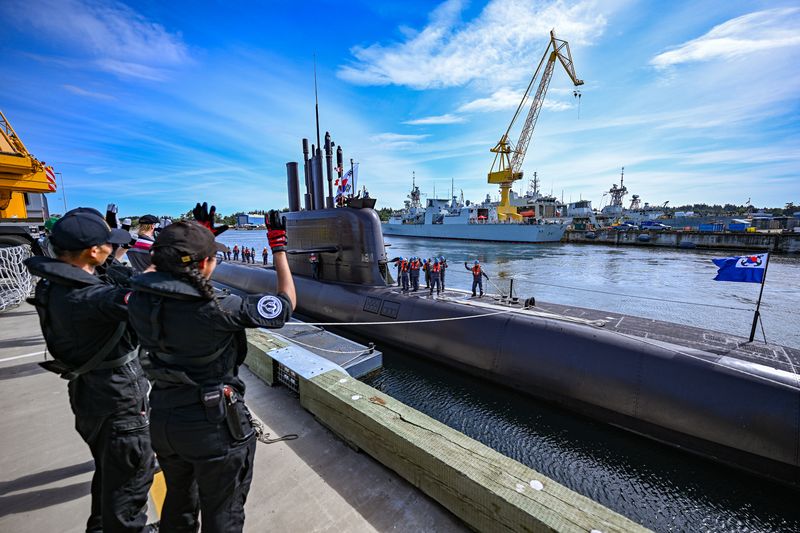
[Financial News] As President Lee Jae Myung moves to flesh out plans to introduce nuclear-powered submarines, attention is turning to the order battle between two of Korea's leading defense companies, HD Hyundai Heavy Industries and Hanwha Ocean. While both companies have been cautious about announcing specific business plans, they have expressed strong confidence in their submarine-building capabilities.
With the Future Defense Strategy Committee chaired by President Lee Jae Myung on the 26th presenting a blueprint to build nuclear-powered submarines domestically and deploy them in the late 2030s, fierce competition between HD Hyundai Heavy Industries and Hanwha Ocean is expected to unfold.
If the submarines are built in Korea as planned, the country would be able to establish an integrated system covering technology, parts, operations, and maintenance. Given the cost of nuclear submarine construction for the USN, the project is expected to become a mega-scale undertaking requiring an enormous budget of up to 500 billion won per vessel. The company that wins the contract could secure both future core technologies and profitability. If South Korea acquires nuclear-powered submarines, it would become the seventh country in the world to do so, after the United States, Russia, China, the United Kingdom, France, and India.
Some in the industry say Hanwha Ocean has the edge thanks to its extensive submarine-building experience. Since its predecessor, Daewoo Shipbuilding & Marine Engineering, the company has won orders for a total of 23 submarines and is widely regarded as a leading submarine builder. In particular, the ADD is known to have assigned Hanwha Ocean the conceptual design work for a nuclear-powered submarine in 2022. In general, naval vessel projects proceed in the order of conceptual design, basic design, detailed design, and then construction of the first submarine.
A Hanwha Ocean official said, "As this is the point at which the government has announced its basic plan for nuclear-powered submarines, we will do our best if we are assigned the necessary role in accordance with the government's follow-up guidance and procedures."
HD Hyundai Heavy Industries, for its part, says it also has sufficient order-winning capability. The company has won orders for six Dosan Ahn Changho-class submarines and one Dosan Ahn Changho-class submarine Batch-I vessel, and it has recently strengthened its global presence by signing an MOU with Peru on joint submarine development and construction.
An HD Hyundai official emphasized, "Developing nuclear-powered submarines requires the full concentration of all technologies and capabilities in Korea's defense industry, and HD Hyundai is ready to play a key role." The official added, "We are leading next-generation nuclear propulsion ship technologies such as SMR and have strong technical capabilities in the submarine sector as well. We will actively cooperate with the government project and contribute to strengthening our country's maritime security."
Still, the industry is also leaving room for the possibility of building a 'One-Team' system, separate from the order competition. The main reasons cited are that propulsion-system technology and fuel sharing for nuclear-powered submarines fall squarely within highly restricted security and control areas, and that the cost of large-scale facility modernization and relocation for construction would be substantial. Given the infrastructure and technical capabilities involved, some say a national-level cooperation model, similar to the Canada submarine procurement project now under way, is needed.
A defense industry source said, "There has already been an overheated competition between HD Hyundai and Hanwha over the KDDX project, worth more than 7 trillion won." The source added, "For a national mega-project like nuclear-powered submarines, it is important to establish a structure in which the two companies can divide roles efficiently and cooperate."
[email protected] Kim Dong-ho Reporter