What He Aimed for After the Iran War Ended: Trump's Abraham Vision
- Input
- 2026-05-26 10:06:27
- Updated
- 2026-05-26 10:06:27
"A bid to reshape the Middle East order beyond ending the war"
According to The Wall Street Journal (WSJ), Reuters and others on the 25th local time, talks between the U.S. and Iran are being delayed by disagreements over banning Iran from possessing nuclear weapons and easing sanctions on Iran. Citing sources from a mediating country, WSJ reported that the U.S. is demanding clearer upfront commitments to limit Iran's nuclear program, while Iran is seeking concrete guarantees on sanctions relief and the release of frozen assets.
Trump, however, caused a stir that day by unveiling a so-called "big deal" plan linking ceasefire talks with Iran to a postwar restructuring of the Middle East order. He argued that "all countries should immediately sign the Abraham Accords." He also raised the possibility of Iran joining the agreement, saying, "If Iran signs a deal with the United States, it will also be honored to become part of the world coalition." He added, "Given the efforts the United States has made to solve this very complex puzzle, it should be mandatory for all countries to join the agreement immediately."
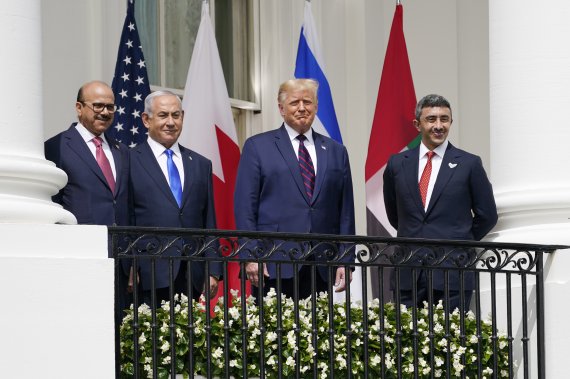
Trump said he had spoken by phone that day with the leaders of Saudi Arabia, Qatar, Pakistan, Türkiye, Egypt and Jordan, and that he had collectively asked them to join the Abraham Accords. The agreement, signed in 2020 during Trump's first term, is a Middle East diplomatic deal centered on normalizing relations between Israel and Arab countries. The United Arab Emirates (UAE) and Bahrain were the first to join, followed by Morocco and the Republic of the Sudan. Since returning to office, Trump has made expanding the agreement a key foreign policy goal.
Analysts say Trump's renewed mention of the Abraham Accords reflects several calculations. First, it can be read as a message that if he has held back from another attack on Iran and moved toward ceasefire talks, Middle Eastern countries should also pay a diplomatic price. In particular, it suggests an intention to turn the ceasefire and nuclear talks with Iran into a catalyst for reshaping the Middle East order, rather than simply ending the war. The strategy appears aimed at stabilizing the region by tying postwar Middle Eastern countries into a security and economic bloc linked to Israel.
"A move to counter China and ease domestic backlash"
Some also see it as a way to counter China, which has been expanding its influence in the Middle East. According to Time, China has overtaken the U.S., the United Kingdom and the eurozone to become the Gulf region's largest trading partner, and Chinese telecom giant Huawei is playing an important role in key technologies and 5G network development in Middle Eastern countries. In security terms, however, the U.S. still maintains overwhelming influence in the region. The conservative U.S. think tank Hudson Institute described the Abraham Accords not simply as a diplomatic agreement, but as a plan to build a U.S.-led economic bloc in the Middle East.
There is also an interpretation that the move could help blunt internal criticism. The New York Times reported that expanding the Abraham Accords could partly soothe hardliners within the Republican Party who have criticized Trump's negotiations with Iran. In fact, Senator Lindsey Graham of South Carolina has repeatedly warned against peace talks with Iran, but he has welcomed the possibility of normalizing relations with Arab states, including Saudi Arabia. He said, "This would be a historic event and one of the most important agreements in history."
"Saudi and Pakistani pushback leaves high real-world barriers"
But the practical obstacles are high. Pakistan reacted immediately.
A Pakistani security source told Reuters, "Trump's remarks are an attempt to use ceasefire diplomacy with Iran to push for an expansion of the Abraham Accords," but added, "The two issues are not connected, and they should not be made to be."
Saudi Arabia also appears unlikely to move easily. Saudi Arabia, home to the Islamic holy cities of Mecca and Medina, views the issue of recognizing Israel not as a simple diplomatic matter, but as one of national security and religious legitimacy. The kingdom has long maintained that it will not join the Abraham Accords without an agreed roadmap for establishing a Palestinian state.
Ali Vaez, who heads the Iran project at the International Crisis Group (ICG), told CNBC, "Trump is trying to frame the Iran nuclear talks as an extension of the Abraham Accords," adding that he is trying to create a structure that benefits both Israel and the Middle East while also persuading hardliners in Washington.
[email protected] Reporter Lee Byung-chul Reporter