"Let’s Make a Double Profit on Samsung Electronics and SK Hynix"... Office Workers Are Buzzing, but Losses Could Double Too [MZ Money Diary]
- Input
- 2026-05-26 05:40:27
- Updated
- 2026-05-26 05:40:27

[Financial News] "Samsung Electronics already seems too expensive, but if it’s a 2x product, maybe I can still catch up."
Office worker investors are abuzz ahead of the launch of single-stock leveraged products that track the daily moves of Samsung Electronics and SK hynix at twice the rate. The products are structured so that both gains and losses swing sharply with the volatility of one stock. Even though they are traded in the form of exchange-traded funds, experts warn that they should not be viewed as ordinary diversified investment products.
A man in his 30s, identified as A, said he recently heard about single-stock leverage products from coworkers. Once news spread that products based on Samsung Electronics and SK hynix were coming to market, related links also began circulating in a stock group chat, he said.
A said, "I regretted only watching SK hynix go up," and added, "Samsung Electronics and SK hynix are familiar names, so I thought they were less risky, but now that they move by two times, I’m torn." Another office worker said, "It feels too late to buy the actual shares, and leverage is scary," but added that "everyone seems to be looking into it at least once."
More than 90,000 people signed up for pre-listing training
On the 27th, 18 single-stock leveraged and inverse products based on Samsung Electronics and SK hynix will be listed on the domestic market. According to the Korea Exchange (KRX) and financial authorities, the lineup includes 16 exchange-traded funds (ETF) and two exchange-traded notes (ETN). The ETFs are being launched by eight asset managers, including Samsung, Mirae Asset, Korea Investment Holdings, KB, Shinhan, Hanwha, KIWOOM Securities Co., Ltd., and Hana Asset Management Company Ltd. The ETNs will be issued by Mirae Asset Securities Co., Ltd.
Investor interest was already visible before the listing. According to financial authorities, nearly 100,000 prospective investors applied for advanced training on single-stock leverage investing from the 28th of last month through the 21st of this month. Of them, 93,188 completed the course.
To invest in single-stock leveraged products, investors must complete one hour each of basic education and advanced education. A minimum deposit of 10 million won is also required. In other words, these are not products that can be bought and sold immediately just because an investor has a brokerage account.
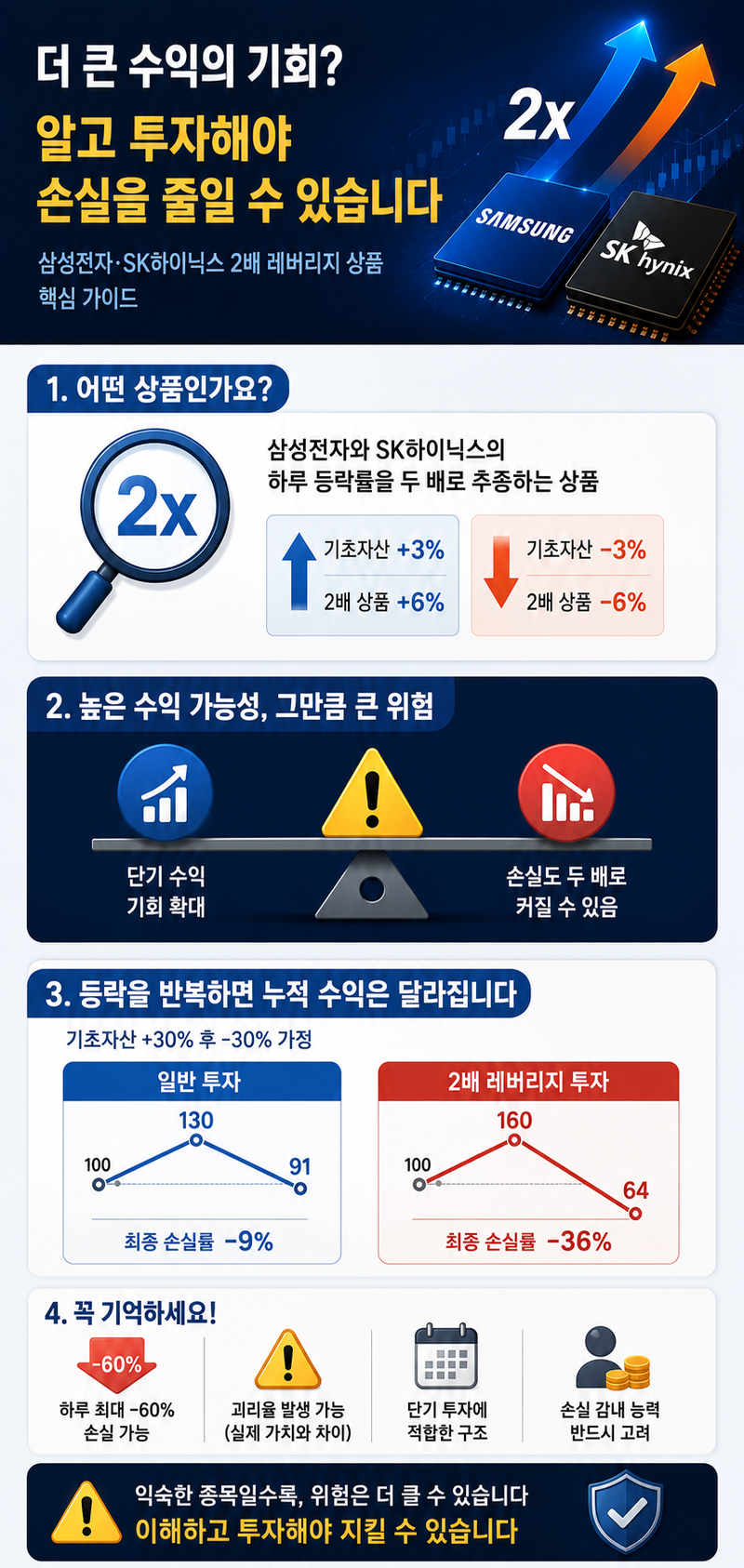
The products aim to track twice the daily rise or fall of the underlying asset. If Samsung Electronics rises 3% in a day, the related 2x product would theoretically seek a gain of about 6%. On the other hand, if Samsung Electronics falls 3%, losses could also double.
"Should I get into Samsung Electronics and SK hynix now?"
The reason office worker investors are paying attention is clear. Samsung Electronics and SK hynix are the most familiar large-cap semiconductor stocks in the domestic market. As expectations continue to build around demand for artificial intelligence (AI) semiconductors and an improvement in the memory chip cycle, regret over missing the two stocks has also grown.
But single-stock leverage is different from ordinary ETFs that spread investments across multiple names. Returns are determined by the rise and fall of just one stock, either Samsung Electronics or SK hynix. Prices can move sharply depending on company earnings, the semiconductor cycle, foreign investor flows, and trends in U.S. tech stocks.
A man in his 40s, identified as B, said, "I kept watching SK hynix go up," and added, "Buying it now feels late, but leverage also makes me think I might be able to catch up all at once." He said, "When I hear that people around me made money, I sometimes feel like I was foolish not to get in."
It is harder to calculate losses than gains
Leveraged products can magnify short-term gains, but they may not be suitable for long-term holding. Because they aim to deliver twice the daily return, cumulative performance can differ from a simple two-times multiple of the underlying asset’s return when prices rise and fall repeatedly.
For example, if an underlying asset rises 30% and then falls 30%, a normal investment would move from 100 to 130 and then to 91, resulting in a 9% loss. But a 2x leveraged product could rise from 100 to 160 and then fall to 64. In that case, the loss would be 36%.
In the domestic market, the price of an individual stock can rise or fall by as much as 30% in a single day from the previous session’s closing price. If the underlying asset hits the daily lower limit, a 2x leveraged product could theoretically lose up to 60% in one day. Financial authorities also advised investors to check the gap between the actual net asset value and the market price, since heavy buying can push the price above fair value.
A man in his 30s, identified as C, said, "I thought Samsung Electronics and SK hynix were familiar names, so maybe they would be fine," but added, "If the daily loss can also be doubled, it doesn’t seem like money I can easily put in."
Meanwhile, the authorities also warned about these investment risks. The Financial Services Commission (FSC) said, "Single-stock leveraged products concentrate investment in a specific stock and amplify gains and losses, so they are not suitable for investors with low loss tolerance or a limited understanding of investment risk."
[email protected] Han Seung-gon Reporter