Performance Bonus Demands Become a Flashpoint for Conflict, Spreading Across Samsung Affiliates
- Input
- 2026-05-25 18:22:07
- Updated
- 2026-05-25 18:22:07
According to the business community on the 25th, the approval rate for the tentative wage agreement at the Samsung Electronics Branch of the Supra-company labor union stood at 87.93% as of 4:30 p.m. The figure is expected to reach around 90% by the 27th, the final day of voting. Since about 80% of the union members in the joint struggle committee, which is leading the negotiations, belong to the DS Division, the agreement is widely expected to pass.
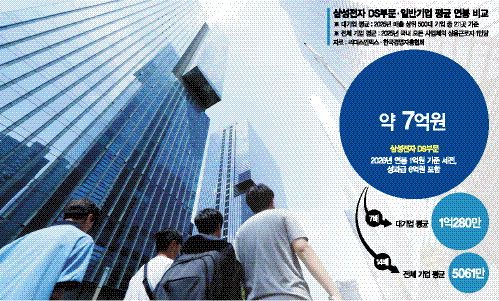
The key point of the tentative agreement is the creation of a new Special Management Performance Bonus for the DS Division. The bonus will be funded by 10.5% of business performance and paid in company stock. Under the new standard, employees in the Memory Business could receive up to 600 million won in performance-based pay on top of their annual Over-Performance Incentive. Based on an annual salary of 100 million won, total pre-tax compensation would approach 700 million won. That is 14 times the average annual income of Korean workers, which stands at 50.61 million won, and it would upend the compensation framework at large companies.
Behind the glittering payout, however, the internal gap is clear. Even within the DS Division, bonuses for the non-memory semiconductors businesses, including Samsung System LSI Division and Samsung Foundry, are expected to remain in the low 200 million won range. The sense of deprivation is even stronger in the DX Division, which handles smartphones and home appliances. Excluding the OPI, stock compensation is expected to remain at around 6 million won, intensifying internal backlash. Donghang Labor Union, which is centered on the DX Division, said it will "file an injunction to suspend the vote on the tentative agreement on the 26th," raising the level of its response.
The backlash is spreading across the group's affiliates. Inside Samsung Display, Samsung SDI, and Samsung Electro-Mechanics, employees are reportedly voicing bitter complaints such as, "Are we Samsung's afterthought?" Their wage increases this year, ranging from 4.0% to 6.2%, are also generally lower than Samsung Electronics' 6.2%. As the semiconductor supercycle is expected to drive record annual operating results of around 1.5 trillion won this year, demands for a complete overhaul of bonus systems across major affiliates are likely to grow even stronger.
[email protected] Im Su-bin Reporter