"Operating profit jumped 17-fold" — fabless firms join the supercycle [Semiconductor supercycle spreads]
- Input
- 2026-05-25 18:22:05
- Updated
- 2026-05-25 18:22:05
According to industry sources on the 25th, Jeju Semiconductor, which focuses on memory chips, posted first-quarter sales of 180.5 billion won, up 273% from a year earlier. Driven by the sales increase, operating profit surged 1,713% to 67.1 billion won over the same period. Both sales and operating profit were the highest since the company was founded. Its profit margin reached 37%.
A Jeju Semiconductor official said, "As the fifth-generation mobile communication technology (5G) and Internet of Things (IoT) markets grow rapidly, sales of memory chips such as Multi-Chip Package (MCP) and DRAM used in those sectors are also strong." The official added, "Demand for memory chips for mobile devices and automobiles is also steadily increasing."
Telechips and Fadu also turned profitable during the period, as both companies posted higher sales and operating profit. Telechips, which makes automotive semiconductors, reported sales of 66 billion won, up 46% from a year earlier. It was the first time quarterly sales had exceeded 60 billion won. The company posted operating profit of 6.1 billion won, swinging from a 2.6 billion won loss in the same period last year. A Telechips official explained, "Development service results for System on a Chip (SoC) projects ordered by major companies were reflected in sales, driving overall growth." The official added, "As semiconductor service results created synergy with our existing automotive semiconductor business, the profit structure also stabilized, which directly led to the turnaround."
Fadu, a company specializing in data center semiconductors, also saw sales rise 210% to 59.5 billion won, a quarterly record. Operating profit came to 7.7 billion won, turning around from a 11 billion won loss a year earlier. Fadu delivered a sharp improvement in performance as construction of artificial intelligence (AI) data centers increased this year and shipments of enterprise solid-state drive (eSSD) controllers used in those facilities also rose.
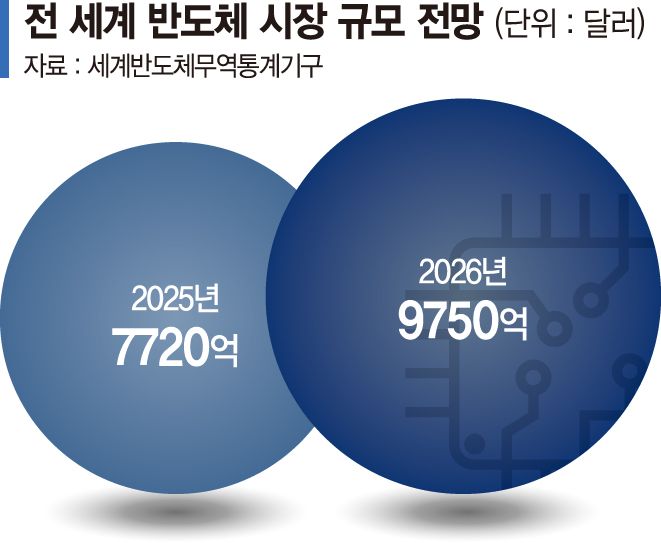
Analysts say these record results from fabless semiconductor companies reflect the fact that the global semiconductor market entered a supercycle this year. According to World Semiconductor Trade Statistics (WSTS), the global semiconductor market is expected to reach an all-time high of $975 billion this year, up 26% from $772 billion last year.
Kim Kyung-ho, chairman of the Korea Fabless Industry Association, said, "With the arrival of the AI era, demand for related semiconductors is rising explosively." He added, "Fabless companies focused on other general-purpose semiconductors are also stepping up Research and Development (R&D) efforts to incorporate AI technology, and in the process they are drawing attention in the stock market as well as posting stronger results."
[email protected] Kang Kyung-rae Reporter