Fabless Firms Ride the AI Boom... Fadu Says It Has Already Surpassed Last Year's Revenue in Q1 [Semiconductor Supercycle Spreads]
- Input
- 2026-05-25 18:17:27
- Updated
- 2026-05-25 18:17:27
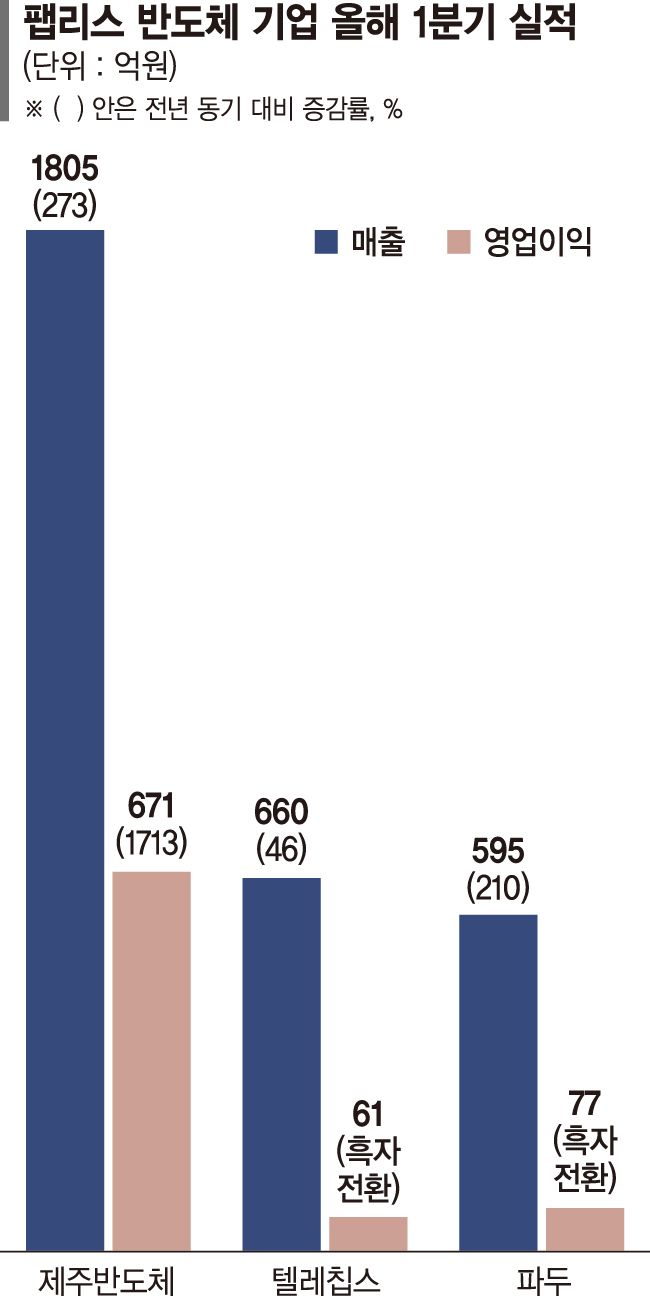
According to industry sources on the 25th, many fabless semiconductor companies listed on the KOSDAQ, including Jeju Semiconductor, Fadu, Telechips, Dongwoon Anatech, ABOV Semiconductor, and Pixelplus, posted revenue growth in the first quarter of this year. Among them, Fadu, which focuses on semiconductors for data centers, stood out for its rapid growth.
Fadu reported first-quarter revenue of 59.5 billion won, up 210% from 19.2 billion won a year earlier. Operating profit also reached 7.7 billion won, swinging from a 11 billion won loss in the same period last year to a profit. With the AI era underway, data center construction is accelerating, led by global tech giants such as Google, Meta, Amazon.com, Inc., and SpaceX. Fadu focuses on enterprise SSD controllers, a type of semiconductor used in those data centers. A Fadu official said, "Starting from the first quarter this year, we expect even steeper quarterly growth." The official added, "New orders disclosed so far have already reached 166.3 billion won, surpassing last year's annual revenue of 92.4 billion won."
Fabless companies specialize in chip design and outsource production. NVIDIA, which dominates the global AI semiconductor market, and Qualcomm, the leader in wireless communication semiconductors, are prime examples. Products developed by fabless firms are manufactured by foundry companies such as Taiwan Semiconductor Manufacturing Company Limited (TSMC), Semiconductor Manufacturing International Corporation (SMIC), and GlobalFoundries.
As fabless semiconductor companies grow, Design House firms are also continuing to improve their earnings. Design Houses serve as a bridge between fabless companies and foundries. ASICLAND, an official partner of TSMC in Taiwan, posted first-quarter revenue of 54 billion won, up 242% from a year earlier. Losses narrowed from 7.9 billion won to 3 billion won over the same period, improving profitability.
■ Ecosystem growth across Design Houses and related firms
SEMIFIVE, which is registered as a Samsung Electronics Design House, also reported revenue of 47.9 billion won in the same period, up 137% from a year earlier. Its loss of 14.1 billion won in the same quarter last year turned into an operating profit of 100 million won this time. In addition, many Design Houses, including Gaonchips and ADTechnology, recorded both revenue growth and improved profitability.
Still, some observers lament the sluggishness of the System Semiconductor sector, whose market is more than twice as large as that of memory semiconductors. In particular, many fabless semiconductor companies leading the System Semiconductor industry in South Korea remain small compared with overseas rivals.
In fact, as of last year, no Korean company ranked among the world's top 10 fabless semiconductor firms. The United States had seven companies on the list, including NVIDIA, Qualcomm, Broadcom Inc., Advanced Micro Devices, Inc. (AMD), Marvell Technology, OmniVision Technologies Inc., and Monolithic Power Systems. Taiwan had three, including MediaTek, Novatek Microelectronics Corp., and Realtek Semiconductor Corp. In China, companies such as HiSilicon and GigaDevice are also growing rapidly.
Kim Kyung-ho, chairman of the Korea Fabless Industry Association, said, "South Korea's share of the global System Semiconductor market remains at around 2%." He added, "If innovation at the fabless companies leading the System Semiconductor industry in South Korea is delayed, fabless competitiveness could weaken even in the midst of the semiconductor supercycle."
"Like the United States, Taiwan, and China, South Korea also needs chipmakers' attention, along with government support, so that fabless companies can be organically connected to manufacturing, including the front-end process and back-end semiconductor process," he added.
[email protected] Kang Kyung-rae Reporter