As labor-management strife deepens, Chinese and Taiwanese firms are accelerating their pursuit of Samsung Electronics
- Input
- 2026-05-25 18:15:41
- Updated
- 2026-05-25 18:15:41
According to the semiconductor industry on the 25th, the Shanghai Stock Exchange will hold a review meeting of its listing committee on the 27th to examine CXMT's new listing application on the SSE STAR Market. In its recently submitted IPO documents, CXMT said it posted revenue of 50.8 billion yuan, or about 11.3 trillion won, and net profit of 33.012 billion yuan, or about 7.3 trillion won, in the first quarter of this year. Revenue jumped 719.13% from a year earlier, while net profit surged an astonishing 1,268.45%.
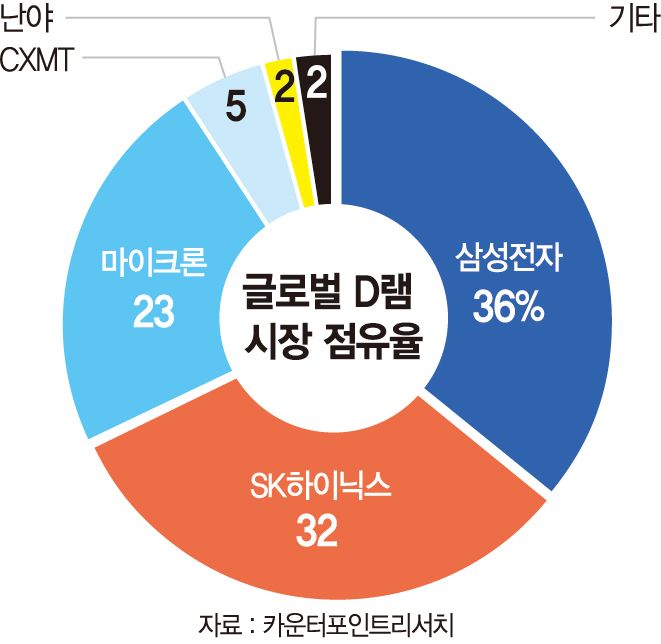
Backed by the Chinese government, CXMT has been growing rapidly and is also strengthening its foothold in the global DRAM market. According to Counterpoint Research, CXMT held about 5% of the global DRAM market in the fourth quarter of last year, ranking fourth in the world behind Samsung Electronics, SK hynix, and Micron. Although the gap with the top players remains wide, analysts say the company is dramatically accelerating its catch-up efforts by taking advantage of the supply shortage.
With this IPO, CXMT is set to receive a large capital injection and tighten its focus on next-generation process investments, further pressuring Korean memory chipmakers. The average utilization rate at its three factories in Hefei and Beijing reportedly exceeded 94% in the first half, effectively putting the plants at full capacity. CXMT plans to channel much of the funds raised into upgrading production lines and research and development for High Bandwidth Memory (HBM), while strengthening ties with China's AI ecosystem, including Huawei. Industry sources also say CXMT has already begun supplying samples of its HBM3 product late last year, raising the possibility that it could launch a full-scale push into the HBM market as early as this year.
"In a memory supply shortage, the ability to provide stable supply itself can become a core competitive edge," said an industry source. "If Chinese companies like CXMT continue to invest aggressively and Samsung Electronics' internal confusion deepens, or concerns over supply disruptions emerge, the market share gap could narrow much faster than expected."
Taiwanese semiconductor companies are also enjoying a revival as they benefit from the spillover effects of the AI memory boom. Industry observers say Nanya Technology Corp. and UMC, which were once left behind in the memory and foundry chicken game, are now benefiting from the recovery in the market and the ongoing supply shortage. In particular, demand for general-purpose legacy DRAM and mature-node semiconductors is also rising, allowing companies that had lost visibility amid price competition to improve utilization and profitability again. An industry source warned that if Samsung Electronics' internal confusion continues for too long, it could become a factor that further accelerates the pursuit by Chinese and Taiwanese firms.
[email protected] Im Subin, Jeong Won-il Reporter