"Bonus Package That Surpasses Hynix's" Reflects Sense of Crisis as Competition for AI Memory Talent Intensifies
- Input
- 2026-05-25 18:15:30
- Updated
- 2026-05-25 18:15:30
■Aiming for a 'talent lock-in' effect
According to industry sources on the 25th, the key point of the tentative agreement reached by Samsung Electronics and its labor union is a wage increase package that includes a base raise of 4.1% and an average performance-based raise of 2.1%, along with a newly created 'special management performance bonus' limited to the DS Division. In addition to the existing Over-Performance Incentive (OPI), the DS Division will receive an extra special bonus. The fund for the special management performance bonus has been set at 10.5% of agreed 'business performance,' or operating profit.
The agreement does not spell out what counts as business performance, but industry observers interpret it to mean operating profit. Given that OPI is equivalent to about 1.5% of operating profit, DS Division union members would effectively share 12% of total operating profit. That is higher than SK hynix's bonus pool, which is based on 10% of operating profit.
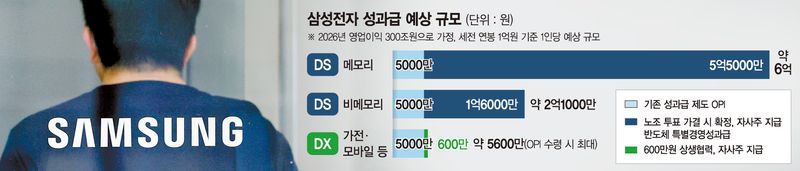
If Samsung Electronics' expected operating profit this year is assumed to reach 30 trillion won, the Memory Business is expected to receive performance pay in the 600 million won range, combining the existing OPI and the special management performance bonus. The compensation package is seen as reflecting a strong sense of crisis among management and the union over the recent acceleration of semiconductor talent outflows. Earlier, Choi Seung-ho, chairman of the Samsung Electronics Union, said that more than 200 union members had moved to SK hynix over the past three to four months, underscoring the urgency.
SK hynix, which has agreed to tie bonuses directly to operating profit without a cap, posted operating profit of 47.2063 trillion won last year. If 10% of that, or 4.7 trillion won, is divided among 33,000 employees, each worker would have received about 140 million won based on last year's performance. This year, operating profit is expected to exceed 20 trillion won, and by that calculation SK hynix employees could also receive bonuses in the 600 million won range, similar to Samsung Electronics workers.
The most notable part of this year's agreement is the hidden 'talent lock-in' clause in the payment method. The special management performance bonus for the DS Division will be paid entirely in after-tax company stock, but only one-third may be sold immediately. Another third can be sold after one year, and the remaining third only after two years. The strategy appears designed to provide immediate financial rewards while encouraging long-term service and blocking moves to rival companies.
■Strengthening a memory-centered compensation system
The agreement is also seen as reinforcing a memory-centered compensation structure within the DS Division. The bonus pool for the special management performance bonus is split 40% for the division and 60% for the business units. The 40% portion will be divided equally among the three business units within the DS Division: Memory Business, Samsung System LSI Division, and Samsung Foundry. The remaining 60% will be paid out on a differentiated basis depending on performance. The payout rate for common organizations such as staff teams has also been set at 70% of the Memory Business level. The move appears to reflect a shared understanding between management and labor that key talent driving the AI boom, including High Bandwidth Memory (HBM) and DRAM specialists, must be firmly protected.
An industry official said, "What matters is not the principle of allocating around 10% of operating profit, but the fact that the amount distributed will rise as the company's profits grow exponentially amid the AI boom. It could help prevent internal talent from leaving and also serve as an incentive for outside talent."
However, challenges remain. Unlike SK hynix, which focuses solely on semiconductors, Samsung Electronics has multiple business divisions, and the wide compensation gap between the DS Division and the Device eXperience Division (DX Division) could become a flashpoint. The DX Division and the CSS Business Team will receive only a fixed grant of company stock worth about 6 million won. As performance differences between the semiconductor and set business divisions are directly reflected in compensation, analysts warn that Samsung Electronics' long-standing 'one roof, two companies' conflict could intensify.
The agreement states that it will take effect only if approved in a vote by trade union members. Since there is considerable dissatisfaction not only in the relatively less rewarded Samsung System LSI Division and Samsung Foundry within the DS Division, but also in the DX Division, a significant number of no votes cannot be ruled out. In addition, the outcome of the injunction filed by DX Division members seeking to suspend the wage negotiation process could also affect the final result.
[email protected] Jeong Won-il Reporter