Government to Discuss Fiscal Reform as Early as Next Month, Likely to Tackle 10% Restructuring of Mandatory Spending
- Input
- 2026-05-25 18:13:07
- Updated
- 2026-05-25 18:13:07
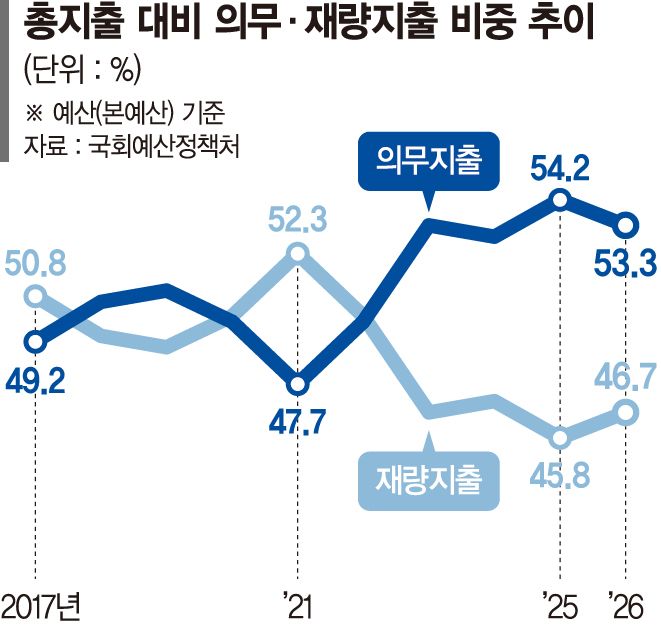
According to government ministries on the 25th, the National Fiscal Strategy Meeting is expected to be held as early as June. It is the highest-level fiscal meeting, where the president and all Cabinet ministers gather to discuss fiscal management strategy and direction. First held in June 2004 under the Roh Moo-hyun administration, it has been held every year since. Inside and outside the government, there is growing speculation that mandatory spending restructuring will be a central topic this year.
That is because the Ministry of Planning and Budget officially set a 10% restructuring target for mandatory spending in its budget guidelines for next year. This is the first time the government has specified a concrete target for adjusting mandatory spending.
The ministry has already begun the restructuring work. Since September last year, it has been operating the Fiscal Structure Innovation Task Force, led by Vice Minister Im Ki-geun, and it also launched the Government Spending Efficiency Task Force earlier this year. Previously, spending restructuring was concentrated only during the budget drafting period from June to August, which had been criticized as a limitation.
The ministry is reviewing possible restructuring measures for major mandatory spending programs such as the Basic Pension and the Local Education Fiscal Grant. Related discussions are being carried out through three channels: the budget office’s own analysis, the Government Spending Efficiency Task Force, and the working group for the National Fiscal Management Plan. The ministry plans to reflect the results in next year’s budget proposal, to be announced in August, as well as in the 2026-2030 National Fiscal Management Plan.
A ministry official said, "We are coordinating the schedule for a meeting between the Office of the President of the Republic of Korea and the National Fiscal Strategy Meeting," adding, "The agenda has not yet been finalized, but fiscal issues and next year’s budget proposal are typically the main topics of discussion."
Experts say this year should be treated as the starting point for discussions on mandatory spending restructuring.
Woocheol Kim, a professor at the University of Seoul and president of KAPF, said of the Local Grant Tax and the Local Education Fiscal Grant, "We need to move away from the current system, which automatically links them to growth in national tax revenue, and shift to a structure that reflects actual fiscal demand." He added, "We should consider a system that evaluates education and local fiscal needs every year and allocates only the necessary amount." He also said, "Realistically, at the very least, we need to discuss adjusting the ratio linked to national tax revenue."
Mandatory spending refers to budget items whose spending obligations and amounts are set by law, making them difficult for the government to cut at will. Public pensions and funds for local transfers are typical examples. By contrast, discretionary spending can be adjusted according to government policy decisions.
[email protected] Choi Yong-jun Reporter