Chief Presidential Secretary for Policy Kim Yong-beom Says High Interest Rates, High Inflation and a Weak Won Are the Cost of Success, Not a Crisis
- Input
- 2026-05-25 02:29:12
- Updated
- 2026-05-25 02:29:12
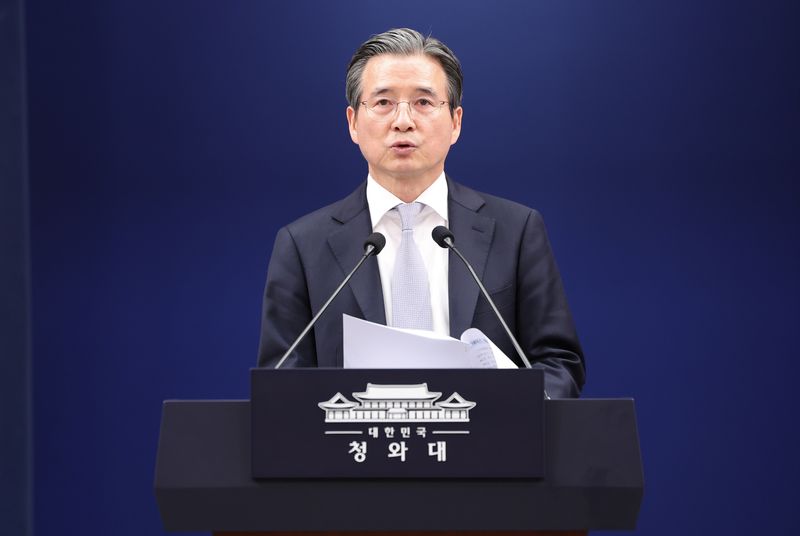
[Financial News] Kim Yong-beom, Chief Presidential Secretary for Policy at Cheong Wa Dae, said that high interest rates, high inflation and a weak won are “the cost of success that inevitably accompanies the South Korean economy as it makes a leap to a new level,” adding that they are “not a sign of crisis, but the friction of progress.” He explained that improving results in semiconductors and Artificial Intelligence (AI), along with strong exports and a rising stock market, are prompting a broad revaluation of prices across the economy. He also stressed that the government must respond in advance to concentration and volatility in key variables such as exchange rates and interest rates.
In a Facebook post on the 24th titled “The Cost of Success,” Kim said, “The way we view the South Korean economy these days is confusing,” and added, “Corporate earnings are hitting record highs and exports are overflowing, but interest rates are rising, exchange rates are unstable and home prices are climbing again.” He noted that “while seemingly contradictory developments are unfolding at the same time, markets and public opinion are busy looking for signs of crisis,” but argued that “the source of the confusion lies not in the economy itself, but in the framework through which we view it.”
Kim said the South Korean economy is this year entering a phase approaching 10% nominal growth. He said surging corporate earnings in semiconductors and AI are improving the terms of trade and lifting export prices, creating a cycle in which corporate profits, wages and asset prices are all rising together. “Household income is increasing, tax revenue is expanding and the government debt-to-GDP ratio is naturally falling, creating a virtuous cycle,” he said. “A step-up in the overall price structure of the economy is not, in itself, a negative development.”
On the won, he drew a line between the current situation and the currency weakness seen during the IMF Crisis, saying it is not being driven by a shortage of foreign currency. Kim explained that the KOSPI has risen more than 70% this year, doubling the value of foreign investors’ holdings of domestic stocks from 1,300 trillion won at the end of last year to 2,600 trillion won recently. He said, “As investors partially cash in on those enormous valuation gains, foreign selling has reached an unprecedented cumulative 110 trillion won this year, and the resulting demand for foreign exchange has pushed up the exchange rate.” He described it as “a paradox created by success, not a weakness in the South Korean economy.” Still, he emphasized, “This does not mean we will stand by and do nothing about a rising exchange rate,” adding that “excessive concentration and volatility will be actively managed.”
He also expressed caution about rising interest rates. Kim said the recent increase in rates reflects a combination of concerns over global inflation driven by oil prices, the possibility that major economies may shift toward tighter monetary policy, and expectations of higher benchmark rates due to upward revisions in growth and inflation forecasts. In South Korea, he said, the pace of rate increases is accelerating as inflation concerns are compounded by solid growth momentum. “What matters is not the level of interest rates itself, but the speed of the increase and the volatility,” he said. “In an economy with a heavy household debt burden, a sharp rise in rates inevitably increases interest payments for vulnerable groups and quickly heightens financial instability.”
On inflation, he said the rise in oil prices caused by the Arab-Israeli conflict is adding cost pressure across energy, food and logistics. Kim said, “Inflation stemming from supply shocks is difficult to control through monetary policy alone, and it is also hard to resolve in the short term.” He added, “An extraordinary response is required, mobilizing all available policy tools, including Energy Price Stabilization Measures, reform of unfair market structures, voucher support for vulnerable groups and flexible adjustments to reserve stock levels.”
He identified real estate as the area that requires the most decisive response. Kim said rising nominal growth, the synchronization of asset markets and a sharp drop in housing supply are once again building pressure for home prices to rise. In particular, he warned that “if capital flows into high-priced real estate, the new phase of takeoff that the South Korean economy has entered could itself be shaken.” He stressed that “structural demand-management measures to curb speculative demand and block the flow of capital into real estate must be carried out alongside supply policies.” He added, “The government must move faster and more forcefully than the market.”
He also said perceptions of external soundness must be redefined. As the value of assets held in South Korea by foreigners is growing faster than the overseas assets held by South Koreans, net external financial assets are shrinking.
Kim warned that as foreign-held domestic assets have grown to unprecedented levels, a sudden shift of funds during changes in the global environment or portfolio rebalancing could shock the foreign exchange and financial markets. He said the government should treat the sustainability of the current account surplus and the stability of the foreign currency money market as key management indicators, while pursuing expansion of foreign exchange reserves and the building of liquidity backstops as new policy tasks.
He also said that “the structural buffer against volatility in foreign capital is to increase the share of domestic stocks held by Koreans,” adding that “expanding policy incentives for stock ownership, such as activating Retirement Pension plans and Youth ISA accounts, is a key tool for managing external soundness.”
Kim said, “If the South Korean economy has entered a new dimension, the framework through which we view it must also evolve.” He added, “If we try to interpret a new era using the grammar of the old one, we will miss what is in front of us and respond in the wrong way.” He concluded, “What is needed now is not an explanation that calms anxiety, but the ability to face a changed reality with changed eyes.”
[email protected] Choi Jong-geun Reporter