"Samsung Electronics and SK hynix, I Want to Make Some Money Too"...Office Workers Investing on Margin [The Joys and Sorrows of Salary Workers]
- Input
- 2026-05-25 06:20:00
- Updated
- 2026-05-25 06:20:00

[Financial News] As the KOSPI rally continues, more office workers are opening margin accounts and jumping into stock investing, determined not to fall behind. Credit loan balances for Samsung Electronics and SK hynix have climbed above 7 trillion won, while balances at the five major banks' margin accounts have risen by nearly 1.5 trillion won in just one month. With lending rates also turning higher again, stock investing for salaried workers is becoming a game of chasing returns while also carrying a growing interest burden.
"You can't keep up by saving only your salary"
A male office worker in his 30s, identified as A, has recently been checking stock apps every lunch break. On days when Samsung Electronics and SK hynix move sharply, the office buzzes with talk about the two stocks. A said, "When I hear that a colleague next to me made several months' worth of salary from semiconductor stocks, I start to waver." He added, "If I'm short on cash, maybe I can just use a little of my margin account."
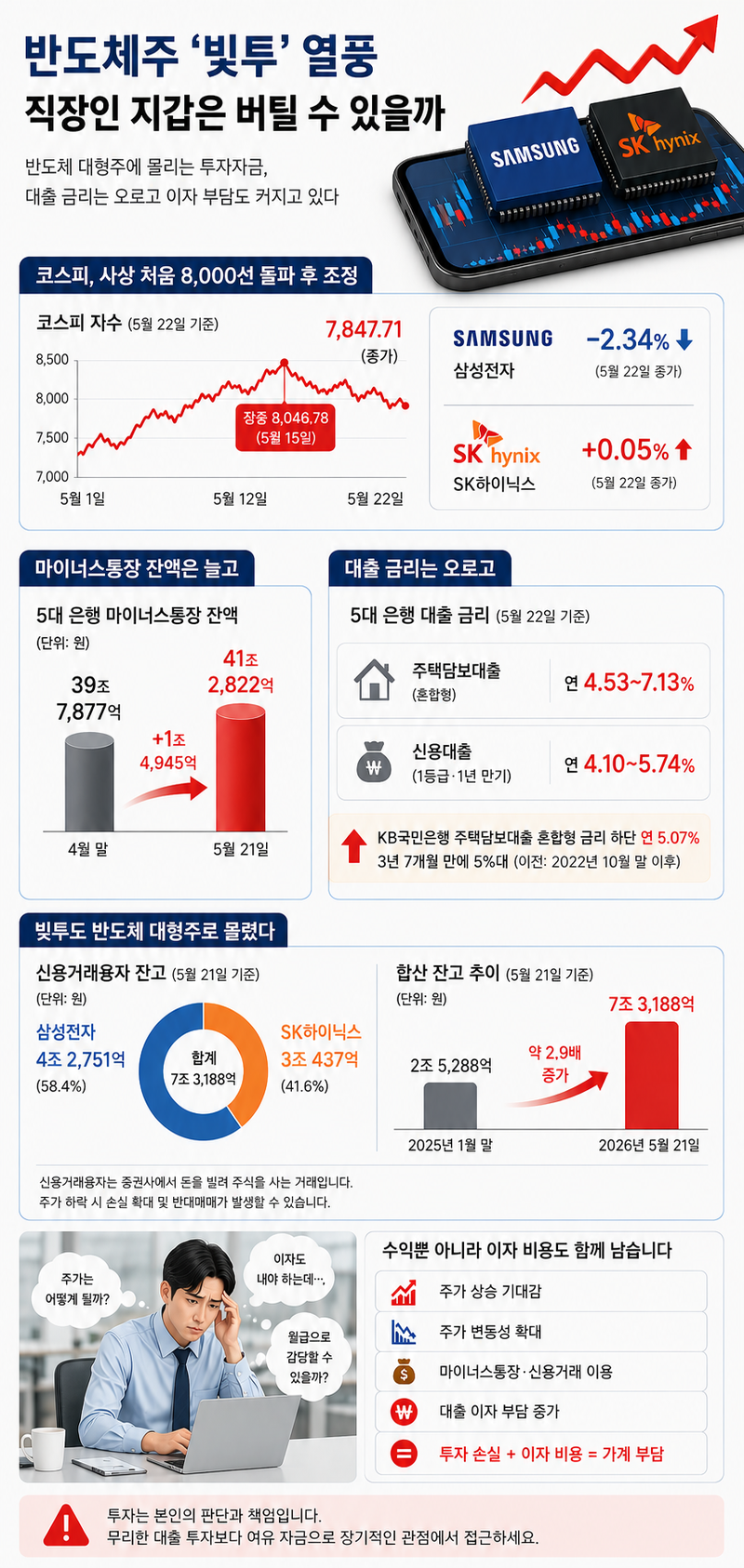
The sense of urgency among office workers is closely tied to recent market trends. On the 15th, the KOSPI briefly broke above the 8,000 mark for the first time in history during intraday trading. According to the Korea Exchange, the index rose as high as 8,046.78 during the session, but later closed at 7,493.20 as profit-taking orders came in. Even after pulling back from 8,000, interest in large-cap semiconductor stocks has not cooled.
The KOSPI also ended trading at 7,847.71 on the 22nd. Samsung Electronics fell 2.34% that day, while SK hynix edged up 0.05% and held in positive territory. Even when the market wobbles, large semiconductor stocks remain at the center of conversation among office worker investors.
Margin account balances in the 41 trillion won range... and interest burdens are rising too
The problem lies in the nature of the money being used for investing. It is not just spare cash flowing into stocks; loans and credit-based trading are also increasing. According to the financial sector, the balance of individual margin accounts at the five major banks stood at 41.2822 trillion won as of the 21st. That was up 1.4945 trillion won from 39.7877 trillion won at the end of last month.
Loan rates are also moving higher. KB Kookmin Bank will raise its mortgage loan mixed-rate and hybrid-rate products by 0.10 percentage point starting this week. As a result, the lower end of its hybrid mortgage rate will rise to 5.07% per year. It is the first time since late October 2022, or about three years and seven months, that KB Kookmin Bank's fixed-rate floor has exceeded 5%.
As of the 22nd, the five major banks' hybrid mortgage rates were in the 4.53% to 7.13% range. Credit loan rates were also quoted at 4.10% to 5.74% per year for top-grade borrowers on one-year terms. For office workers who must cover living expenses and loan interest with their salaries, the structure means that investment losses are not the only burden; interest costs keep piling up as well.
Borrowed money is also flowing into semiconductors
Within the stock market, borrowed funds are concentrating on Samsung Electronics and SK hynix. According to data from the Korea Exchange and the Korea Financial Investment Association, as of the 21st, Samsung Electronics had 4.2751 trillion won in credit loan balances, while SK hynix had 3.0437 trillion won. Combined, the two stocks accounted for 7.3188 trillion won.
Credit loans are transactions in which investors borrow money from securities firms to buy stocks. They can boost returns when share prices rise, but they also magnify losses when prices fall. If collateral ratios drop below a certain level, securities firms may carry out forced selling.
Credit loan balances in the two stocks have risen rapidly this year. At the end of last year, the combined credit loan balance for Samsung Electronics and SK hynix stood at 2.5288 trillion won, but by the 21st it had climbed above 7 trillion won. As the KOSPI moved through the 7,000 and 8,000 levels in succession, leveraged buying by individual investors also increased.
Salary calculations left behind after the rally
For office worker investors, a rising market is both an opportunity and a source of pressure. Salaries are fixed each month, but stock accounts can swing sharply even within a single day. When housing costs, living expenses, credit card bills and loan interest all pile up, using margin accounts and credit trading can quickly turn paper losses into a real household burden.
A male office worker in his 40s, identified as B, said, "When I only hear about people who made money from stocks, I feel like I'm the only one falling behind." He added, "But when I see the interest on my margin account, I also think I may have overdone it." B said, "At first I thought it was just a short-term loan, but if stock prices fall, the time to repay gets pushed back too."
In the end, investing with borrowed money leaves plenty to calculate even when profits are made. Interest comes out first, and if losses occur, both the recovery of principal and the repayment schedule are delayed. The more the money used to chase a rally is borrowed money, the more an office worker's account is left with not only returns, but also monthly interest payments.
[email protected] Han Seung-gon Reporter