"A child’s savings account for SK hynix?" Parents who bought stocks through their children’s accounts [Still Family]
- Input
- 2026-05-25 05:30:00
- Updated
- 2026-05-25 05:30:00

Because they are the closest to one another, family members tend to argue more easily, and sometimes find it harder to speak openly. Daily matters such as living expenses, childcare, housework and supporting parents can also become sources of conflict within a family. We follow the small but long-running stories unfolding inside our neighbors’ homes.
[Financial News] "That was the money we were going to use when our child goes to college." "The KOSPI keeps rising, and Samsung and SK hynix look fine!"
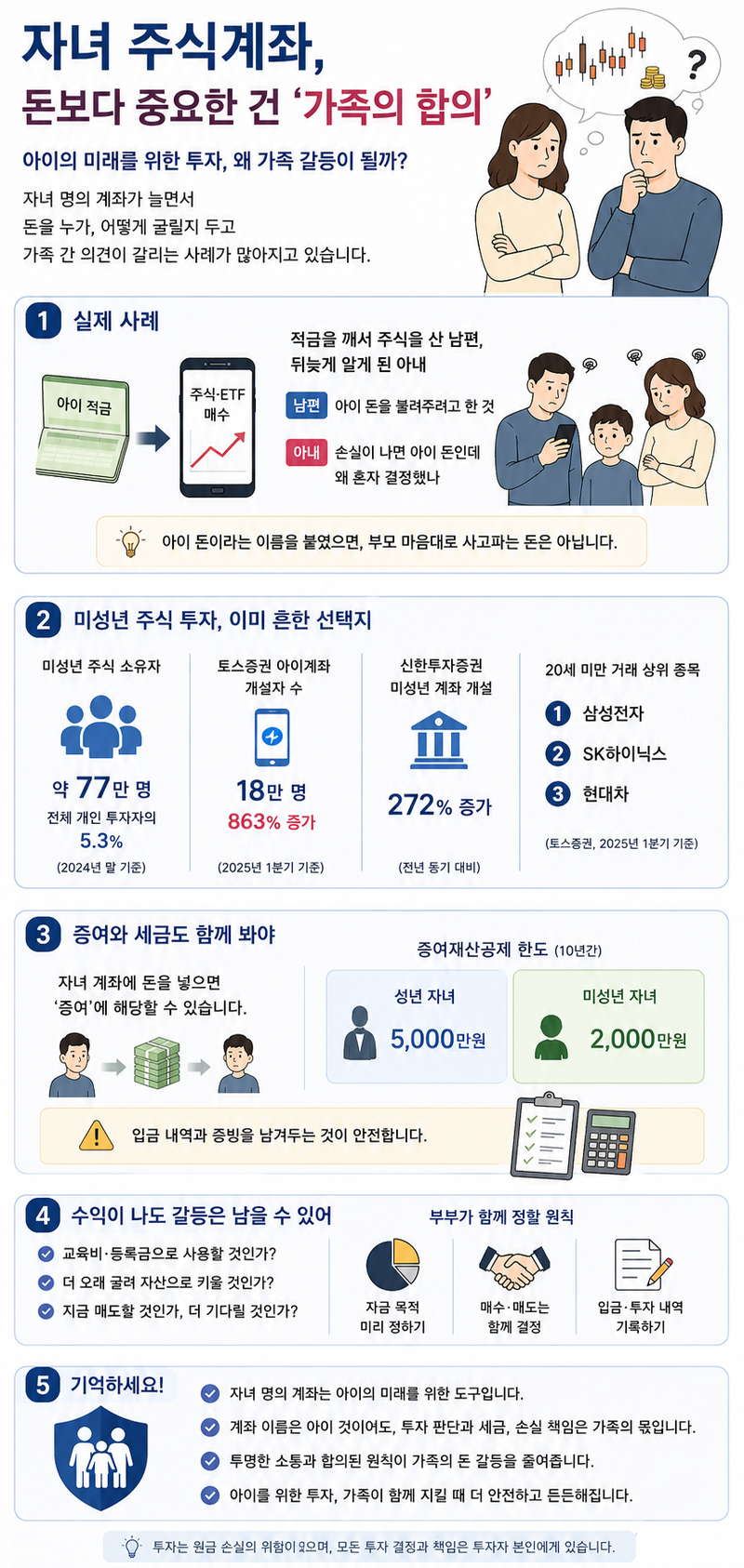
A couple in their 40s, both office workers and parents of an elementary school student, recently had a major fight over a stock account in their child’s name. The wife learned only later that her husband had cashed out part of the child’s savings account to buy semiconductor stocks and overseas exchange-traded funds (ETFs). The husband said he was trying to grow the child’s money, but the wife pushed back, saying, "If there are losses, that means the child’s money is gone. Why did you decide on your own?"
As stock accounts in minors’ names become more common, money-related conflicts inside families are also changing. In the past, many parents opened savings accounts or insurance policies in their children’s names. More recently, however, more parents have been buying stocks and ETFs for them. The idea is long-term investing and financial education, but couples are increasingly divided over who gets to decide how a child’s money is managed and how far it can be invested.
Is it the child’s money, or the parents’ investment decision?
The couple had initially agreed to open an account in their child’s name. The purpose was to set aside money from New Year’s gifts, first-birthday gifts and monthly savings deposits.
But as the stock market rose this year, the husband decided stocks were better than savings. He said, "If the money is going to stay there for more than 10 years for our child, I thought blue-chip stocks would be better." His wife, however, saw it differently. He said, "I wasn’t against investing itself. The problem was breaking the savings account without discussing it with me." He added, "If you put a child’s name on the money, doesn’t that mean it’s not something parents can just buy and sell however they want?"
Accounts in a child’s name are often managed by parents, since minors cannot easily open accounts or make investment decisions on their own. That makes it even easier for parental judgment to come into play. It is one reason why investments for children and parents’ own investment ambitions often become mixed in the same account.
Minor stock investing is no longer unusual
Investing in a child’s name is not limited to a few households. According to reports citing data from the Korea Securities Depository (KSD), the number of minor stock owners reached 769,264 as of the end of 2025, accounting for 5.3% of all individual investors.
Based on 88 listed companies among the top 200 by market capitalization that disclosed shareholder data by age, the number of shareholders under 20 was tallied at 728,344. The value of the stocks they held was estimated at about 2.9761 trillion won.
The trend is especially clear among familiar large-cap stocks such as Samsung Electronics. As of the end of 2025, Samsung Electronics had 343,694 shareholders under the age of 20. That means a significant share of all minor stock owners held Samsung Electronics shares.
The increase is also visible in brokerage data. In the first quarter of this year, Toss Securities recorded 180,480 users who opened minor-specific child accounts, up sharply from 18,738 in the same period last year. Shinhan Securities also said the number of minor account openings rose 272% year on year during the same period.
Gifts and taxes are also family matters
The moment money is deposited into a child’s account, tax issues come into play as well. If parents put cash or stocks into a child’s account, it may be considered a gift. The National Tax Service (NTS) says the gift tax deduction limit for gifts from direct ascendants to a minor child is 20 million won over 10 years. For an adult child, the limit is 50 million won over 10 years.
Being within the deduction limit does not mean there is no need to keep records. Questions later may arise over the source of funds or the timing of the gift, so filing requirements and supporting documents must be checked. In particular, if parents actively trade repeatedly in a child’s account, it can become difficult to distinguish the activity from simple investing for financial education.
The wife also brought up taxes. She said, "If you call it the child’s money and then a tax issue comes up later, who is going to be responsible?" The husband said he thought it was fine because the money was deposited within the limit, but the couple later agreed to review the deposit records and investment history again.
Even profits can leave conflict behind
Investing in a child’s name is not only a problem when losses occur. Conflict can also arise when there are gains. One parent may see the money as education expenses or college tuition, while the other may view it as an asset to hold for longer. The timing of a sale can differ as well.
In the end, the couple decided to divide the money in the child’s account into three categories. They will separately record the New Year’s gifts and allowance the child received, the money gifted by the parents, and the investment gains. Any additional buying or selling will be decided only after both of them review it together.
The wife said, "It’s not that stocks are bad. It’s that money in a child’s name should not be moved secretly by the parents." The husband also said, "I thought making a profit meant I had done a good job, but I realized the standards have to be different when it’s a child’s account."
An account in a child’s name can be a choice for the child’s future. But the people actually moving that money are the parents. Even if the account bears the child’s name, investment decisions, taxes and responsibility for losses are ultimately divided again within the family.
[email protected] Han Seung-gon Reporter