The United States Slows Its Middle East Pressure Campaign as Japan Expands Its Indo-Pacific Influence [Military World]
- Input
- 2026-05-24 18:26:22
- Updated
- 2026-05-24 18:26:22
The United States is taking a breath as it weighs the decisive timing for pressure on Iran. While peace handshakes are exchanged at the U.S.-China summit table in Beijing, Japan is reemerging in Northeast Asia as a new power by strengthening its air and naval forces under the banner of the U.S.-Japan alliance. The United States' delayed strikes on key Iranian facilities in the Middle East, along with strategic moves by neighboring countries that are shaking the military balance in Northeast Asia, go beyond local developments.
This is expected to become a major turning point in international politics and military affairs, revealing how the United States' "pace control of war" and its emphasis on multilateral security burden-sharing are reshaping the global Kill Web, a highly connected integrated battlespace. Behind the surface rhetoric lies a strict calculation of gains and losses, as well as the current state of multilateral collective defense posture surrounding electronic warfare dominance.
■The hidden side of the U.S.-China Beijing summit
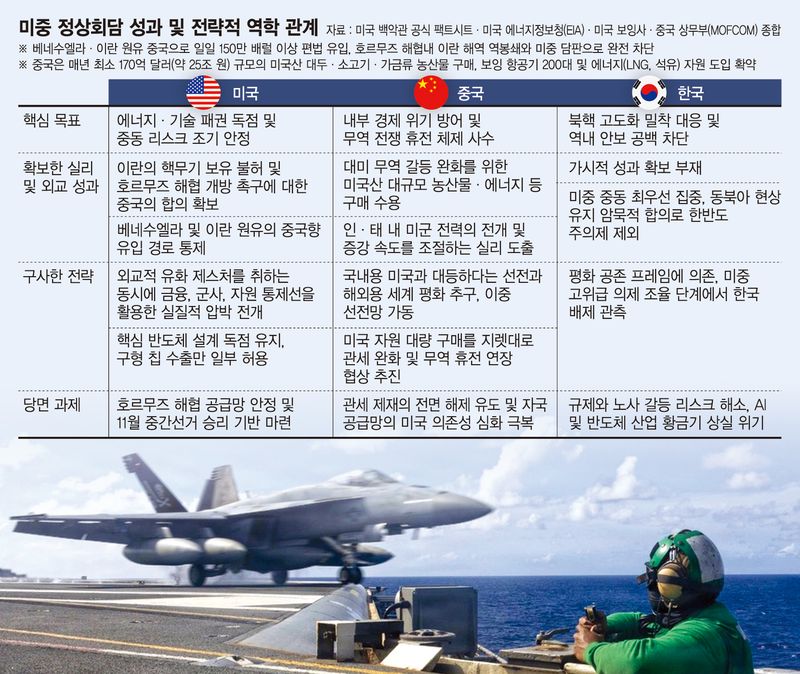
The recent U.S.-China summit in Beijing ended without any major public discord, leaving behind a "next appointment" for a U.S.-China meeting in Washington, D.C. on Sept. 24. Because differences on specific issues prevented a joint statement, some diplomats have described it as a "fruitless summit." However, the Center for Strategic and International Studies (CSIS) argued in its Indo-Pacific Security Landscape Report published last December that this "meeting between the two leaders would likely be premised on a thorough behind-the-scenes bilateral 'big deal.'" It is reasonable to conclude that the real calculations shaping the global security landscape were largely settled before the two leaders even sat down at the table.
In fact, the Trump administration shook Beijing by pressuring China to immediately curb imports of Iranian crude and to commit to investment in the United States. In effect, it used the promise of delaying tariff shocks as an economic carrot to win security concessions from Xi Jinping's leadership. In return, China secured an agreement on a practical basis: a slowdown in the pace of advanced U.S. force buildup in the Indo-Pacific. The International Institute for Strategic Studies (IISS) also analyzed earlier this year that the two countries' "peaceful atmosphere" is not the end of confrontation, but merely a silent period in which both sides are running the numbers for the next security bargain while holding each other's pressure points. It has now been proven as fact that Trump's diplomacy is driven not by principle, but by a strict balance sheet.
■The delay in U.S. strikes on Iran and "Kill Web tactics"
In the military campaign against Iran led by the United States and Israel, the modern battlefield reality of seizing Iran's radar air defenses and all frequencies has been clearly demonstrated. According to a February analysis by CNA of electronic warfare assets, U.S. Central Command is keeping roughly three squadrons' worth of powerful electromagnetic warfare capabilities on constant standby within its area of responsibility covering the Strait of Hormuz and the Gulf of Oman. These include escort-style electronic warfare aircraft such as the Boeing EA-18G Growler, which accompany friendly formations while carrying out high-power jamming, as well as high-altitude long-range standoff assets such as the EA-37B Compass Call and EC-130H Compass Call, which can disable broad frequency bands from beyond enemy range. This layered electronic warfare capability, which can jam communications both inside and outside enemy air defense range, has been a key asymmetric asset that effectively paralyzed Iran's latest air defense systems.
The reason the Trump administration has deliberately delayed a full-scale bombing campaign and the deployment of ground forces lies in a hard-nosed security realism. The United States is closely monitoring the worsening economic hardship inside Iran and the trajectory of anti-government sentiment. In other words, it is weighing a complex calculation: military intervention will be restrained until clear signs of a decisive regime change driven by internal self-correction emerge. By controlling the pace of war, both offensively and defensively, the United States is tightening the pressure on the hardline forces in Iran led by the Islamic Revolutionary Guard Corps (IRGC).
■U.S.-Japan security alignment and Japan's rapid rise
Under the security paradigm of Trump's second term, the most notable development in Northeast Asia is Japan's strategic expansion in scale. According to a special contribution published by RAND Corporation in April, the "East Asia Unified Theater Reorganization Proposal" that Japan has urgently proposed to the United States and is now coordinating is taking shape. This is a transnational integration strategy that seeks to link allies across the Indo-Pacific, including the United States, Japan, Australia, the Philippines, and South Korea, into a single network and unify the security front. In an era when the United States seeks to share global military risks and costs through a multilateral security system, Japan is actively cooperating with Washington while effectively leading this unified theater.
Japan's rapid rise is being viewed as a sophisticated defense and diplomatic achievement that turns U.S. first policy to its advantage. Japan is also actively involved in restructuring the ship MRO supply chain under the MAASGA framework, which aims to ease the United States' chronic shipbuilding bottlenecks. In return, Japan is moving to build platforms equipped with Rapid Dragon modules that can conduct long-range electronic warfare and offensive missile strikes at the same time. In the global mobility and arms trend indicators released in March by SIPRI, the successful first test flight of the next-generation remote electronic warfare aircraft EC-2, developed on the basis of Kawasaki C-2 heavy transport aircraft, was analyzed as a declaration that Japan intends to seize leadership of the One Theater strategy.
■The challenges facing the Republic of Korea
Global security think tanks say that under the Trump administration, the value of alliances is proven by quantitative indicators such as cost and the sharing of practical roles. According to announcements from the White House and reports from the Council on Foreign Relations (CFR), Trump's second-term administration has been accumulating six major global security and diplomatic achievements: blocking illegal refugees by pressuring authoritarian regimes in Latin America; maintaining key global maritime logistics routes such as Panama; preventing hostile states from establishing footholds in Cuba and the Caribbean Sea and containing them; securing supply chains for critical minerals in Africa to support advanced industry growth; gaining control over Arctic Circle routes to counter Russia and China; and carrying out precision strikes on Iranian military facilities to eliminate threats to the United States and the world.
Neighboring countries are calculating the costs and benefits of survival and the future within the framework of American pragmatism, which continues to lead the world. In the security discourse on the Korean Peninsula, the consensus among geopolitical pragmatists in international political science is that the alliance should be further strengthened on the basis of the Mutual Defense Treaty between the Republic of Korea and the United States, with a focus on reinforcing the security-economy nexus.
In the modern Kill Web battlefield environment, building an independent A2/AD strategy and force posture, a kind of hedgehog strategy, has emerged as an essential task for safeguarding sovereignty. In particular, military and technological responses for survival in Northeast Asia, where asymmetric and nuclear projection capabilities are concentrated, are an urgent priority. The key is to secure independent control over electronic warfare frequencies.
South Korea must face the harsh reality that Japan is rapidly emerging as the de facto command center for Northeast Asian security through closer military cooperation with the United States. In a recent joint security commentary, IISS and SIPRI also suggested that unless countries build a strong multilateral collective defense network and quantitatively demonstrate their own layered deterrence capabilities for defending their airspace and territory, they could lose the initiative in security and fall into strategic dependence amid a multipolar period of upheaval.
[email protected] Lee Jong-yoon Reporter