Pull it out, and the screen grows: Samsung smartphones evolve their form factor once again
- Input
- 2026-05-24 18:13:33
- Updated
- 2026-05-24 18:13:33
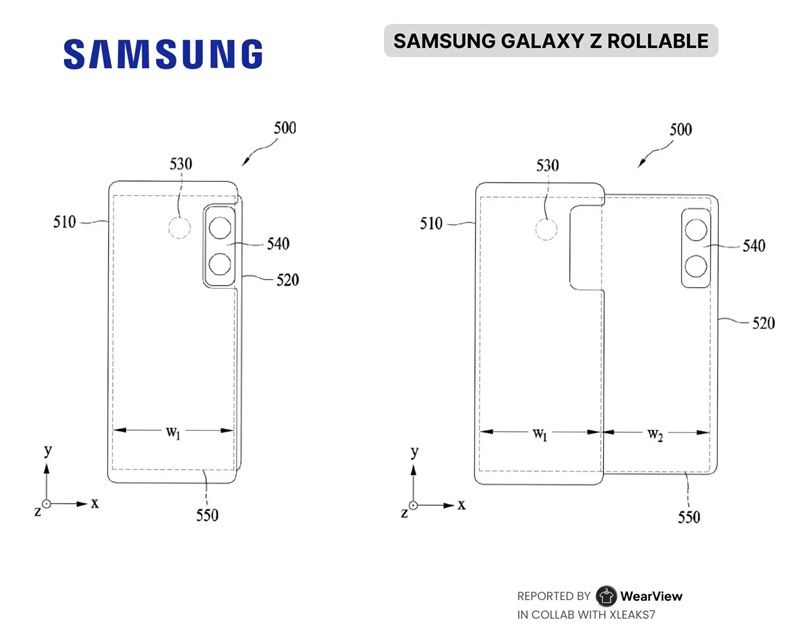
According to the industry on the 24th, new patent drawings for Samsung Electronics' so-called Galaxy Z Rollable, which expands the screen by pulling the display sideways, were recently made public. The most notable feature is its hardware recognition capability.
In its normal smartphone state, the rear camera module moves together with the panel as the screen unfolds. At that point, a dedicated internal sensor detects the position of the physically moving camera module in real time and automatically adjusts it to match the user interface.
When folded, the Galaxy Z Rollable offers portability. When unfolded, it can deliver a tablet-like large-screen experience while greatly reducing the risk of panel damage. The patent is being interpreted as a sign that commercialization of rollable phones is now accelerating in earnest.
Samsung Electronics is focusing on developing innovative form factor products because the need to find new growth drivers to break through the stagnant smartphone market has become more urgent.
At Galaxy Unpacked, the company’s new product event scheduled for July in London, the next-generation foldables, the Samsung Galaxy Z Fold 8 and Galaxy Z Flip 8, will be unveiled alongside the Galaxy Z Fold 8 Wide, a horizontally wider model shaped somewhat like a passport. The Samsung Galaxy Z TriFold, a double-folding foldable phone launched late last year, was sold in limited quantities in select countries including the Republic of Korea, the United States, China, and the United Arab Emirates (UAE). Despite a launch price well above 3 million won, it sold out both at home and abroad.
Samsung is also pursuing a strategy of focus and selection, choosing to scale back businesses if it judges that even an innovative form factor will not have strong market potential. The Samsung Galaxy S25 Edge, released in May last year, was developed to target demand for ultra-slim phones thinner than conventional smartphones, but weak sales have made a follow-up model uncertain. Major manufacturers such as Apple and Xiaomi, which launched or planned ultra-slim phones, are also pulling back from the segment because of low battery life and performance issues.
Samsung Electronics aims to strengthen its influence in the global smartphone market by putting innovative form factor products at the forefront.
According to market research firm Counterpoint Research, Samsung Electronics held a 21% share of the global smartphone market in the fourth quarter of last year, matching Apple. Compared with the previous quarter, Samsung's share rose by 3 percentage points, while Apple's fell by 4 percentage points. Although total smartphone shipments fell 3% from a year earlier due to rising component costs led by memory semiconductors, Samsung's Galaxy S26 series, introduced in March, drove shipment growth as it enjoyed strong early sales.
[email protected] Jang Min-kwon Reporter