Can the Weak KOSDAQ Be Revived by the National Growth Fund's Success?
- Input
- 2026-05-24 18:10:22
- Updated
- 2026-05-24 18:10:22
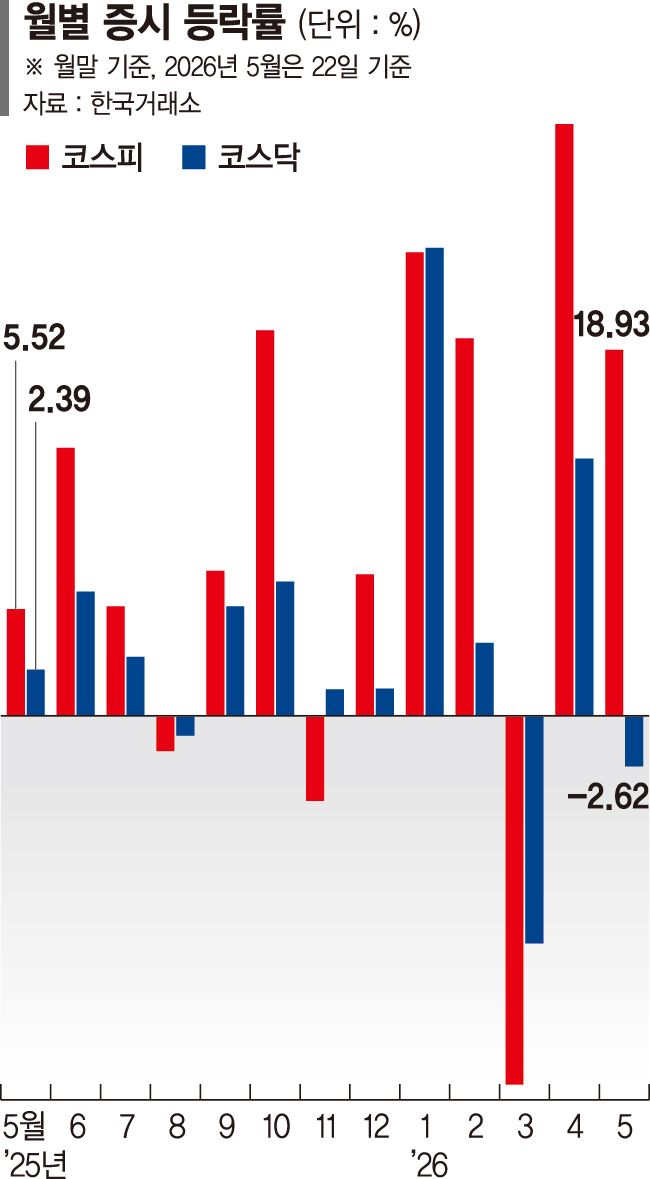
According to the Korea Exchange (KRX) on the 24th, KOSPI had risen 18.93% from the start of the month through the 22nd, while KOSDAQ fell 2.62%.
The gap in gains between KOSPI and KOSDAQ widened further than last year. So far this year through the 24th, KOSPI has surged 86.22%, while KOSDAQ has risen only 25.46%. Last year, KOSPI and KOSDAQ gained 75.63% and 36.46%, respectively, so the disparity has deepened.
Liquidity has also been concentrated in KOSPI. From the start of the month through the 22nd, average daily trading value in KOSDAQ stood at 1.59782 trillion won, only 33.26% of KOSPI's 4.80469 trillion won. In the previous month, KOSDAQ's average daily trading value was 1.40794 trillion won, about half of KOSPI's 2.95507 trillion won.
This is seen as the result of KOSPI's rapid climb, led by semiconductors such as Samsung Electronics and SK hynix, while biotechnology stocks that drive KOSDAQ have remained sluggish, leaving investor sentiment unimproved.
In the securities market, attention is focused on whether measures to revitalize KOSDAQ, such as the National Growth Fund and the promotion and demotion system, can trigger a rebound. In fact, KOSDAQ jumped 4.99% on the 22nd, the day the People Participation National Growth Fund was launched, far outpacing KOSPI's 0.41% gain.
The National Growth Fund is a policy fund that will invest 150 trillion won over five years in advanced strategic industries such as Artificial Intelligence (AI), semiconductors, biotechnology, robots, hydrogen and rechargeable batteries. Since many of the target sectors are concentrated among KOSDAQ-listed companies, the market is expected to benefit.
Lee Kyung-min, a researcher at Daishin Securities, said, "The National Growth Fund, which is scheduled to invest 7 trillion won this year, drew strong market attention as the 600 billion won allocation for the public was quickly exhausted on the launch day." He added, "Because KOSDAQ has a high share of advanced industries and growth stocks, policy momentum was reflected more strongly than in KOSPI."
The KOSDAQ promotion and demotion system, which could be introduced as early as October, is another factor raising hopes for market revitalization. The system will divide the KOSDAQ market into three leagues: premium, standard and management, and allow companies to move between upper and lower tiers depending on performance, size and governance. If the market is restructured around stronger companies, investor sentiment is expected to improve.
Jo Ain, a researcher at Samsung Securities, said, "If zombie companies are removed through the introduction of the promotion and demotion system, overall KOSDAQ earnings will improve and valuation pressure will ease." She added, "Greater transparency in disclosures can strengthen companies' efforts to enhance corporate value, improve trust in the KOSDAQ market and make it easier for foreign and institutional funds to enter."
jisseo@fnnews.com Seo Min-ji Reporter