A Bet on Gains Turned Volatile, Pushing Ultra-Short-Term Margin Investors Into Forced Liquidation
- Input
- 2026-05-24 18:10:14
- Updated
- 2026-05-24 18:10:14
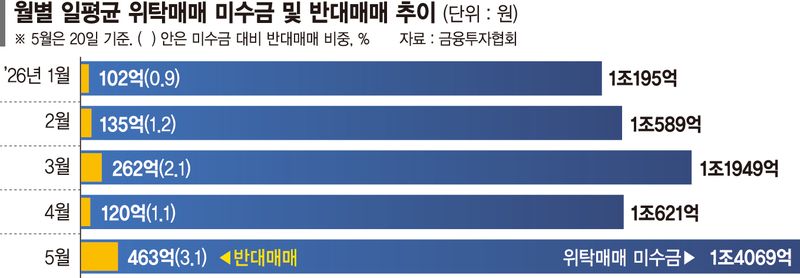
According to the Korea Financial Investment Association (KOFIA) on the 24th, margin trading receivables and the actual amount of forced selling against those receivables reached 1.6421 trillion won and 145.8 billion won, respectively, on the 20th. The ratio of forced selling to receivables was 7.6%. The amount of forced selling topped 100 billion won for the first time in two years and seven months, since 548.7 billion won on Oct. 24, 2023.
Margin trading receivables refer to a form of ultra-short-term credit in which individual investors borrow money from securities firms to buy stocks and repay the funds within two business days. If an investor fails to pay the settlement amount for stocks bought with such receivables on time, the securities firm forcibly sells the shares through forced liquidation to recover the loan. It may also dispose of the shares if their collateral value falls below a certain level.
As the domestic stock market has swung sharply up and down this month, the size of margin trading receivables has expanded. The daily average for margin trading receivables from the 4th to the 20th stood at 1.4069 trillion won, while forced selling averaged 46.3 billion won, both the highest levels this year. By month, the daily averages for margin trading receivables and forced selling this year were 1.0195 trillion won and 10.2 billion won in January, 1.0589 trillion won and 13.5 billion won in February, 1.1949 trillion won and 26.2 billion won in March, and 1.0621 trillion won and 12 billion won in April.
The KOSPI Volatility Index (V-KOSPI) averaged 49.84 from January to April, but rose to 68.09 through the 22nd of this month. On the 20th, when forced selling topped 100 billion won, it reached 71.37. On that day, the KOSPI opened 0.73% higher than the previous session, but at one point fell as much as 3% intraday to 7,053.84, putting the 7,000-point level at risk.
Lee Sang-heon, a researcher at iM Securities, explained, "A sharp rise over a short period means a sharp decline is also possible over a short period." He added, "When a specific stock surges and investors buy it on margin, a sudden reversal can trigger a wave of forced selling. It is not simply because the market is weak; forced selling has increased because volatility has become severe."
Brokerage firms say volatility could remain elevated for some time and advise investors to prepare response strategies such as securing cash. At the same time, they note that the sectors best able to withstand recent domestic and external uncertainties are those with strong earnings, and say investors should maintain exposure to leading stocks with solid fundamentals.
Han Ji-young, a researcher at KIWOOM Securities Co., Ltd., said, "Variables such as ceasefire negotiations between the United States and Iran, and the Federal Reserve's interest rate policy, have been changing frequently lately. We should accept higher volatility as a given for now." She added, "In a period of rising uncertainty, the force that offsets negative shocks is earnings. From a volatility-management perspective, it may be appropriate to secure some cash, but cutting exposure to leading stocks such as semiconductors should be a lower priority."
[email protected] Im Sang-hyeok Reporter