Ants Pull All-Nighters as KOSPI 200 Futures Night Trading Hits a Record 1.6 Trillion Won
- Input
- 2026-05-24 17:58:36
- Updated
- 2026-05-24 17:58:36
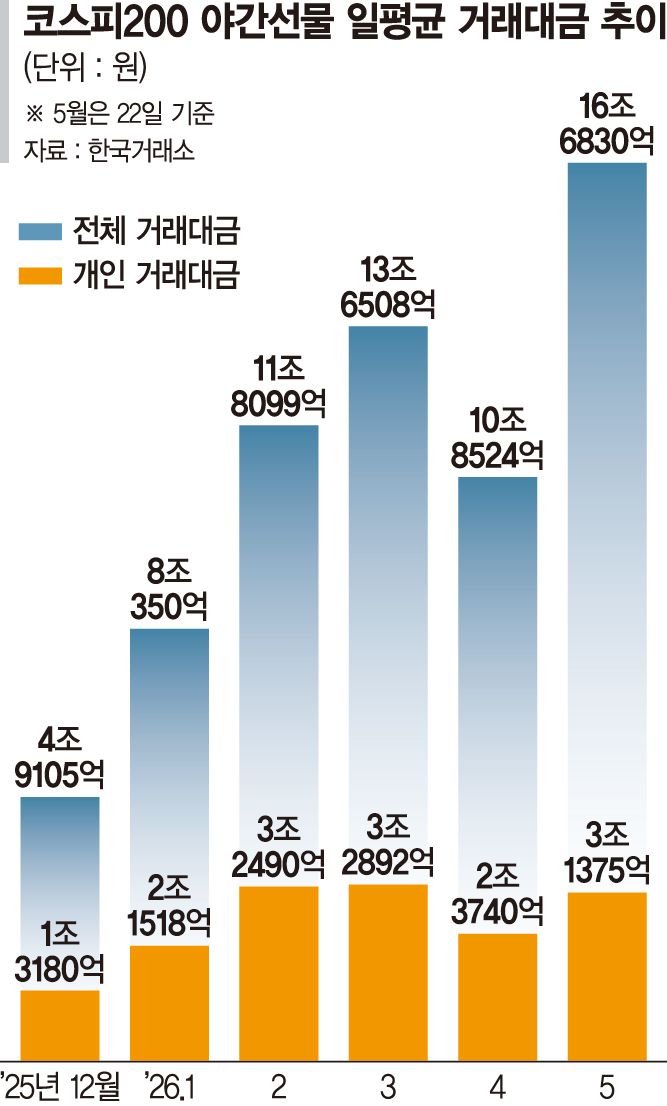
According to the Korea Exchange (KRX) on the 24th, the average daily trading value of KOSPI 200 Futures night sessions from the start of this month through the 22nd stood at 1.6683 trillion won.
The average daily trading value, which came to just 491.06 billion won in December last year, rose sharply to 803.5 billion won in January, 1.18099 trillion won in February, and 1.36508 trillion won in March. It appeared to ease somewhat to 1.08524 trillion won in April, but it climbed back above 1.6 trillion won this month, setting a year-to-date high.
KOSPI 200 Futures night sessions refer to KOSPI 200 futures products traded for 12 hours from 6 p.m. to 6 a.m. the following day.
Retail investor trading has grown especially quickly this year. The average daily trading value by individual investors in KOSPI 200 Futures night sessions reached 313.75 billion won this month, up 32.2% from 237.4 billion won in the previous month. Compared with December last year, when it stood at 131.8 billion won, the figure has increased 2.5 times.
Although night futures are generally seen as derivatives aimed at global investors, individual investors account for nearly a quarter of total trading value. The scale is also significant compared with the average daily trading value of individual investors in the KOSPI market this month, which stood at 38.4728 trillion won.
Interest in KOSPI 200 Futures night sessions has risen because the product's price serves as an indicator for predicting the next day's regular trading session. Since these futures continue trading even after the Alternative Trading System Aftermarket ends at 8 p.m., overnight moves in the U.S. stock market and geopolitical risks are reflected in prices.
In particular, after war broke out between the United States and Iran in March, KOSPI 200 Futures night sessions have become a gauge for anticipating the direction of the market before it opens. This month, as the KOSPI has surged to unprecedented levels above 7,000, more investors appear to be trading in advance, which has pushed up turnover.
For example, on the evening of the 20th, after Samsung Electronics Co., Ltd. (SEC) reached a tentative wage agreement and U.S. stocks closed higher across the board on expectations for NVIDIA earnings, KOSPI 200 Futures night sessions ended 4.51% higher than the previous trading day. Trading value for that single day reached 2.13118 trillion won, the highest daily figure so far this year. The KOSPI then jumped 8.42% from the previous close on the 21st.
Trading in KOSPI 200 Futures night sessions is expected to continue growing. Geopolitical risks in the Middle East that have affected the domestic market since March remain unresolved, while overseas developments such as possible rate hikes or holds by central banks in major economies, including the United States, are still ahead.
Concerns are also rising over uncertainty in U.S. interest rate policy after Kevin Warsh took office as chair of the Federal Reserve System (Fed) on the 22nd local time. Warsh has long been viewed as a hawkish figure who prioritizes price stability, but after the launch of the Trump second-term administration, he publicly mentioned the need for rate cuts.
However, as U.S. inflation indicators have been trending higher amid stronger international oil and commodity prices following the Middle East war, expectations for Fed rate cuts are being revised lower. The U.S. Consumer Price Index (CPI) for April rose 3.8% from a year earlier, the largest increase in three years since December 2022.
Jeon Gyu-yeon, a researcher at Hana Securities, said, "At present, consumption and investment in the U.S. economy are growing faster than productivity, so inflation concerns remain elevated." She added, "It will not be easy for the Fed under the Warsh era to continue its rate-cutting cycle."
[email protected] Park Ji-yeon Reporter